Mental Compulsions Checklist
An OCD checklist of 12 common mental compulsions with a table for triggers, time spent and response-prevention ideas.
1-page fillable PDF · US Letter (prints on A4) · ERP · Assessment
- Approach / concern
- OCD
- Technique
- ERP · Assessment
- Format
- Fillable PDF, 1 page (US Letter / A4)
- Access
- Pro and Advanced plans (3-day free trial)
- For
- Licensed clinicians to use with clients
- Updated
- October 2026
Key facts
What is the Mental Compulsions Checklist?
Mental compulsions are covert rituals, such as reviewing, neutralizing, counting, praying or self-reassurance, performed to reduce anxiety or prevent feared outcomes. They are common in OCD, particularly presentations sometimes called ‘Pure O’.
Why it works
Identifying all compulsions, including mental ones, is essential for effective ERP (Foa et al., 2012; Abramowitz, 2018). Unaddressed mental rituals can undermine exposure.
When to use it
- OCD assessment
- Clients who say they have ‘no compulsions’
- Relationship, harm and moral scrupulosity OCD
- ERP planning
How to use it in session
- Explain mental compulsions with examples.
- Tick those the client uses.
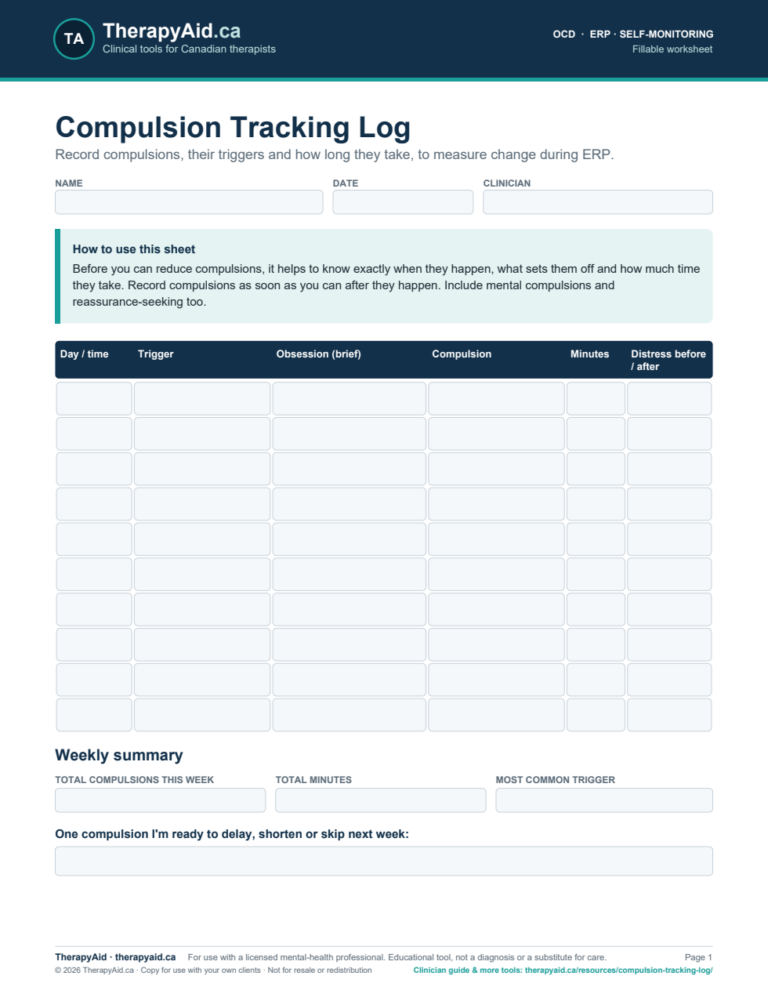
- Map triggers and time spent.
- Plan response prevention strategies.
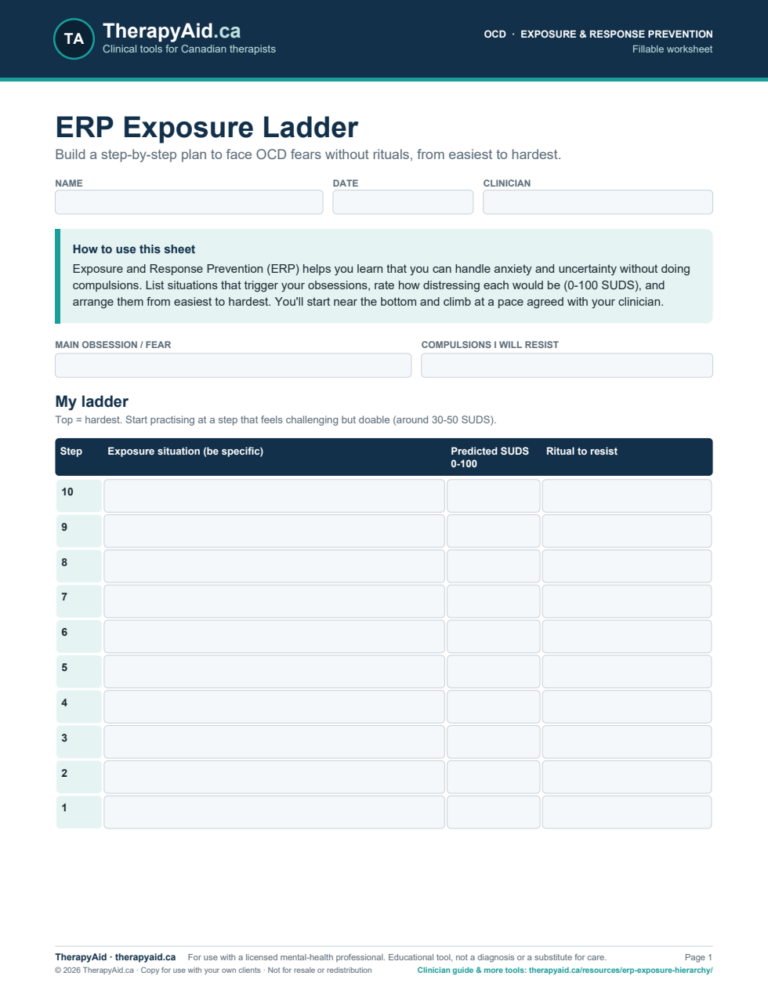
- Integrate into the ERP hierarchy.
Clinician tips
- Mental compulsions can be subtle; ask specific questions.
- Response prevention may involve allowing uncertainty or postponing analysis.
- Distinguish intrusive thoughts (not chosen) from mental rituals (done to reduce anxiety).
Worked example
Sharing with clients
Members can download the PDF to print or email, or copy a private client link from the download box. Your client opens the link and downloads the worksheet on any device. No client account is needed, and nothing your client writes is stored on TherapyAid.
Frequently asked questions
What is ‘Pure O’?
An informal term for OCD where compulsions are mostly mental rather than visible. Mental rituals are still compulsions.
How do you do response prevention for mental compulsions?
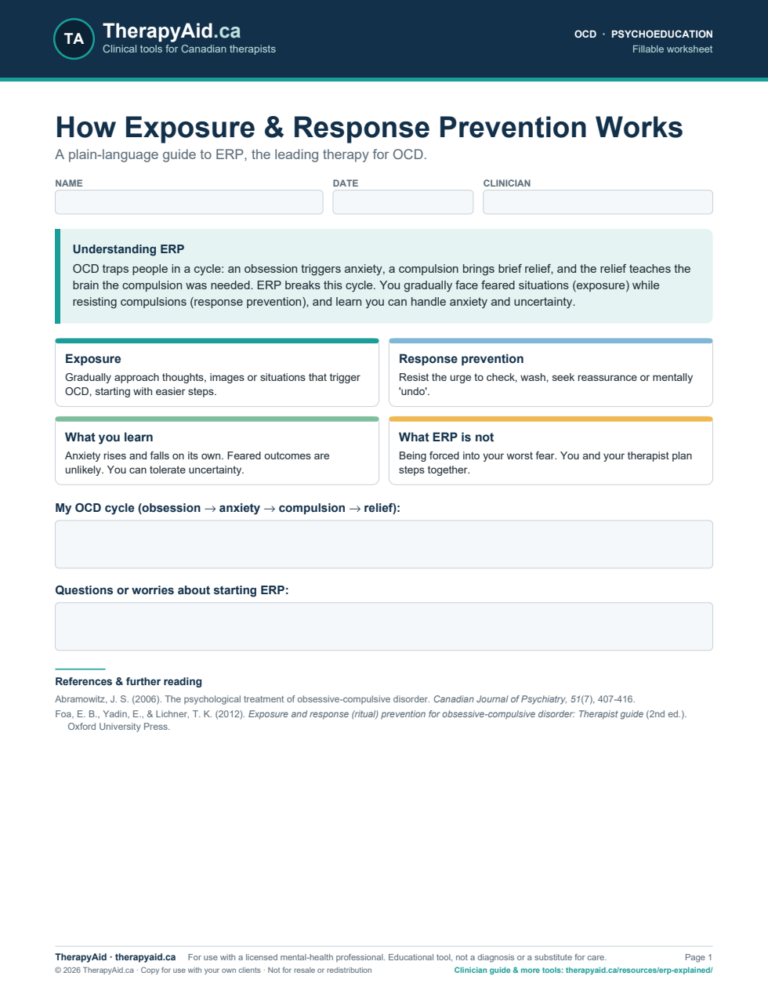
By noticing the urge to ritualize and choosing not to engage, often while allowing uncertainty, with clinician guidance.
References
Abramowitz, J. S. (2018). Getting over OCD: A 10-step workbook for taking back your life (2nd ed.). Guilford Press.
Foa, E. B., Yadin, E., & Lichner, T. K. (2012). Exposure and response (ritual) prevention for obsessive-compulsive disorder: Therapist guide (2nd ed.). Oxford University Press.
This worksheet is an educational tool for use by, or under the guidance of, a licensed or registered mental-health professional. It is not a diagnostic instrument or a substitute for clinical judgement. If a client is in crisis in Canada, call or text 9-8-8 or call 9-1-1.