ERP Exposure Ladder
A fillable exposure ladder and practice record for Exposure and Response Prevention (ERP) in OCD treatment. Clients rank triggers by SUDS, name rituals to resist, and record what they learn from each exposure.
2-page fillable PDF · US Letter (prints on A4) · Exposure & response prevention
- Approach / concern
- OCD
- Technique
- Exposure & response prevention
- Format
- Fillable PDF, 2 pages (US Letter / A4)
- Access
- Pro and Advanced plans (3-day free trial)
- For
- Licensed clinicians to use with clients
- Updated
- October 2026
Key facts
What is the ERP Exposure Ladder?
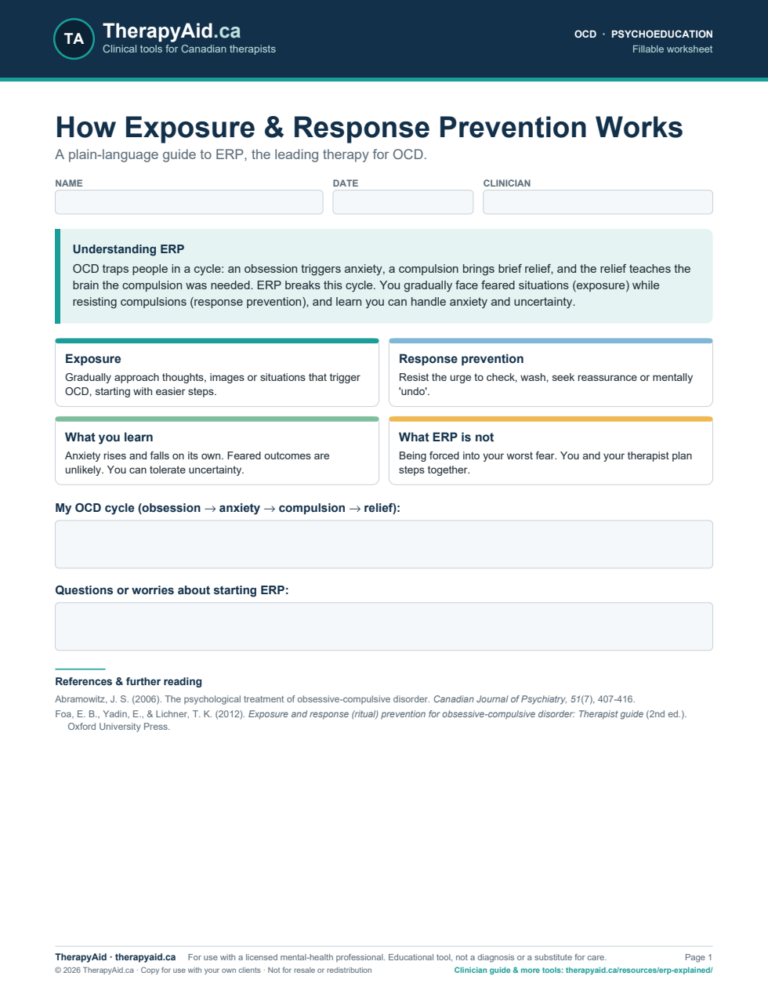
Exposure and Response Prevention is the gold-standard behavioural treatment for obsessive-compulsive disorder. Clients gradually and deliberately approach feared thoughts, images, objects or situations (exposure) while refraining from compulsions, reassurance-seeking or avoidance (response prevention). The exposure hierarchy, or ‘fear ladder’, organizes this work from least to most distressing.
Why it works
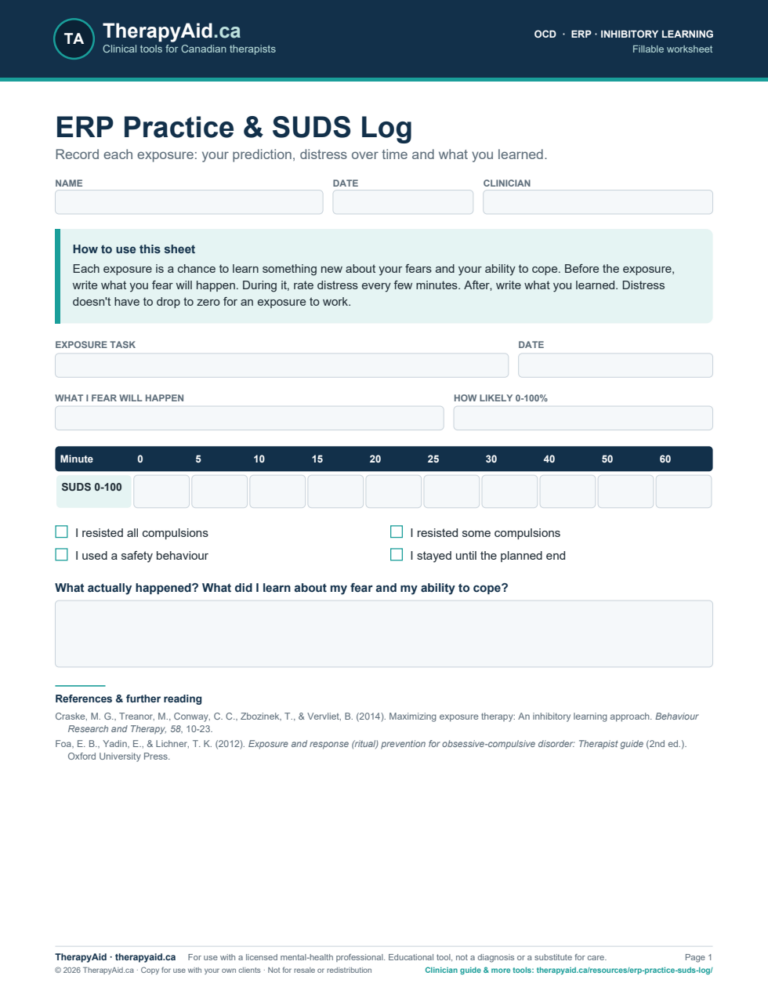
ERP-based CBT produces large effect sizes for OCD and is recommended as first-line treatment in clinical guidelines (Ost et al., 2015). Modern inhibitory-learning approaches emphasize testing feared predictions and building tolerance of uncertainty, rather than simply waiting for anxiety to drop.
When to use it
- Obsessive-compulsive disorder (all subtypes)
- Health anxiety with checking and reassurance-seeking
- Body-focused or ‘just right’ OCD
- Specific phobias, using an adapted hierarchy
How to use it in session
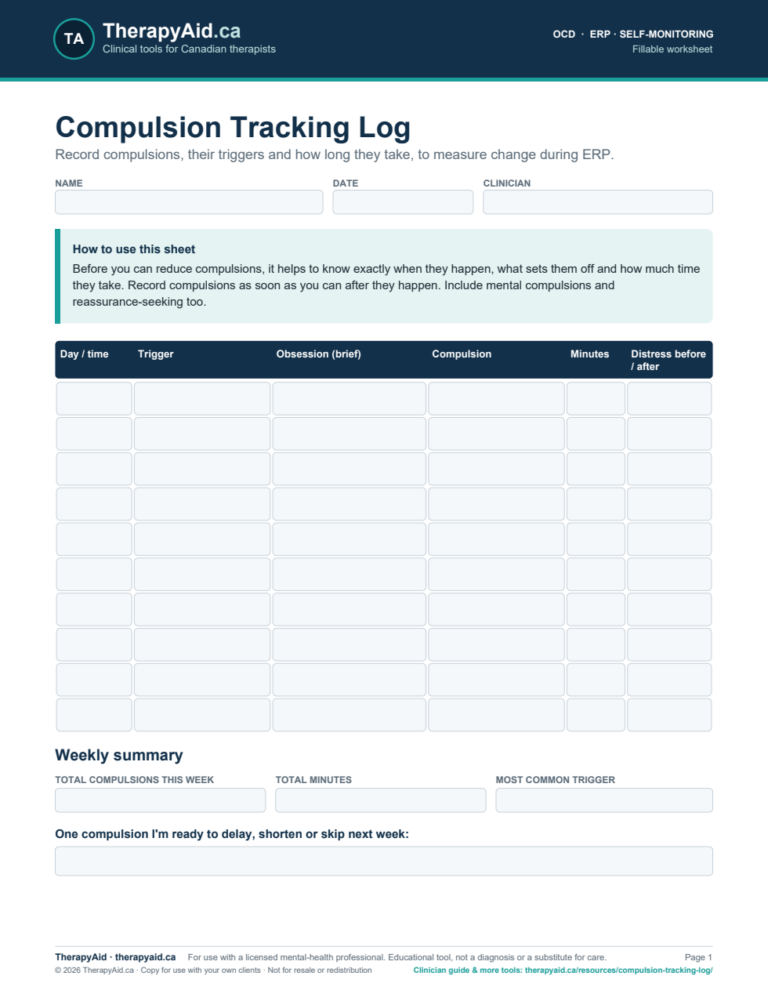
- Complete a thorough assessment of obsessions, compulsions and avoidance.
- Brainstorm 10-15 triggers and rate predicted SUDS for each.
- Arrange them into the ladder and agree on a starting step.
- Plan the first exposure in session, including which rituals to resist.
- Practise daily between sessions and log results.
- Move up the ladder as confidence grows, including varied and unexpected exposures.
Clinician tips
- Watch for subtle rituals and mental compulsions, and name them explicitly.
- Avoid reassurance during exposures. Validate the difficulty instead.
- Variation (different places, times, intensities) improves generalization.
- Celebrate willingness, not just low SUDS.
Worked example
Sharing with clients
Members can download the PDF to print or email, or copy a private client link from the download box. Your client opens the link and downloads the worksheet on any device. No client account is needed, and nothing your client writes is stored on TherapyAid.
Frequently asked questions
Should anxiety go down during every exposure?
Not necessarily. Current research suggests that learning to tolerate distress and testing predictions matter more than anxiety dropping within a session.
What is SUDS?
Subjective Units of Distress Scale: a 0-100 rating of how distressing something feels right now.
References
Foa, E. B., Yadin, E., & Lichner, T. K. (2012). Exposure and response (ritual) prevention for obsessive-compulsive disorder: Therapist guide (2nd ed.). Oxford University Press.
Abramowitz, J. S. (2018). Getting over OCD: A 10-step workbook for taking back your life (2nd ed.). Guilford Press.
Ost, L.-G., Havnen, A., Hansen, B., & Kvale, G. (2015). Cognitive behavioral treatments of obsessive-compulsive disorder: A systematic review and meta-analysis of studies published 1993-2014. Clinical Psychology Review, 40, 156-169.
This worksheet is an educational tool for use by, or under the guidance of, a licensed or registered mental-health professional. It is not a diagnostic instrument or a substitute for clinical judgement. If a client is in crisis in Canada, call or text 9-8-8 or call 9-1-1.