Compulsion Tracking Log
A self-monitoring log for OCD that records triggers, obsessions, compulsions, minutes spent and distress, with a weekly summary to guide ERP targets.
2-page fillable PDF · US Letter (prints on A4) · ERP · Self-monitoring
- Approach / concern
- OCD
- Technique
- ERP · Self-monitoring
- Format
- Fillable PDF, 2 pages (US Letter / A4)
- Access
- Pro and Advanced plans (3-day free trial)
- For
- Licensed clinicians to use with clients
- Updated
- October 2026
Key facts
What is the Compulsion Tracking Log?
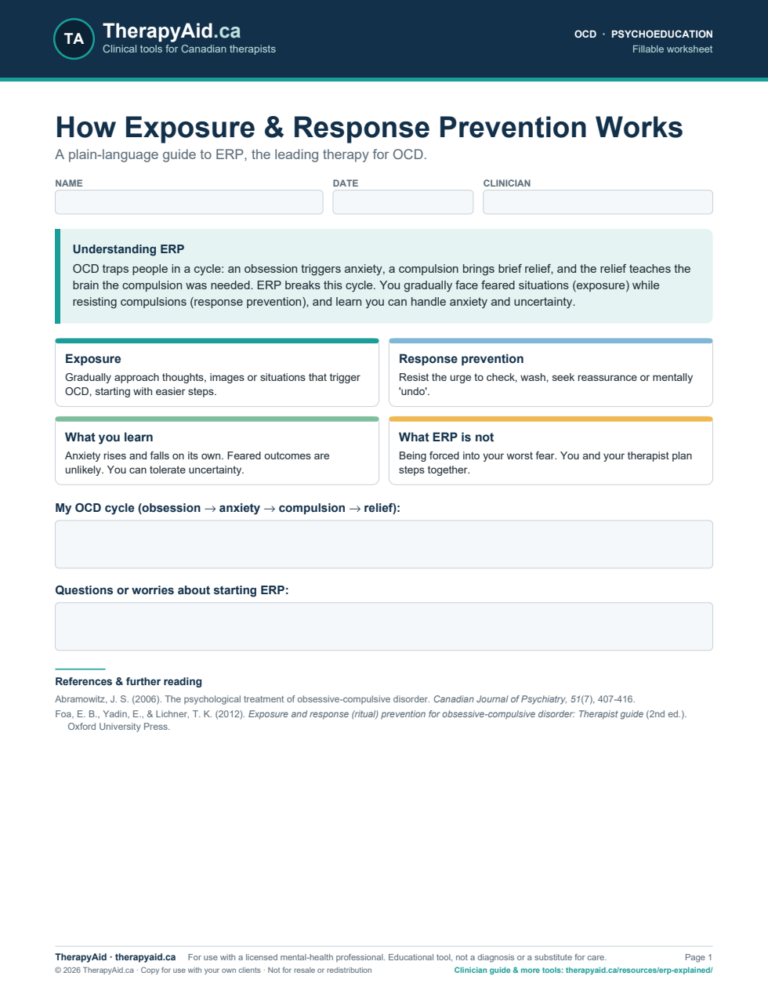
Self-monitoring of compulsions is a standard component of exposure and response prevention. Recording triggers, obsessions and rituals in real time provides a baseline, reveals patterns and helps measure progress as response prevention begins.
Why it works
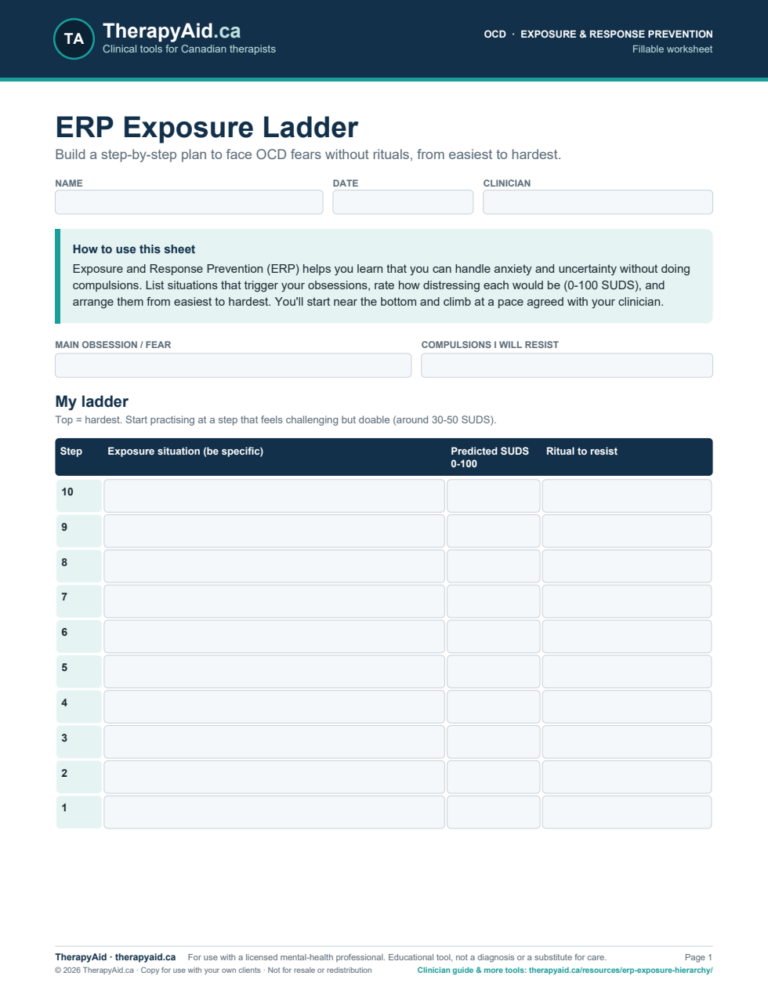
Systematic monitoring improves assessment accuracy and supports building an exposure hierarchy (Foa et al., 2012). Seeing time spent on rituals can also increase motivation to change (Abramowitz, 2018).
When to use it
- Assessment phase of OCD treatment
- Throughout ERP to track change
- Clients who underestimate rituals
- Mental compulsions and reassurance-seeking
How to use it in session
- Explain what counts as a compulsion, including mental acts.
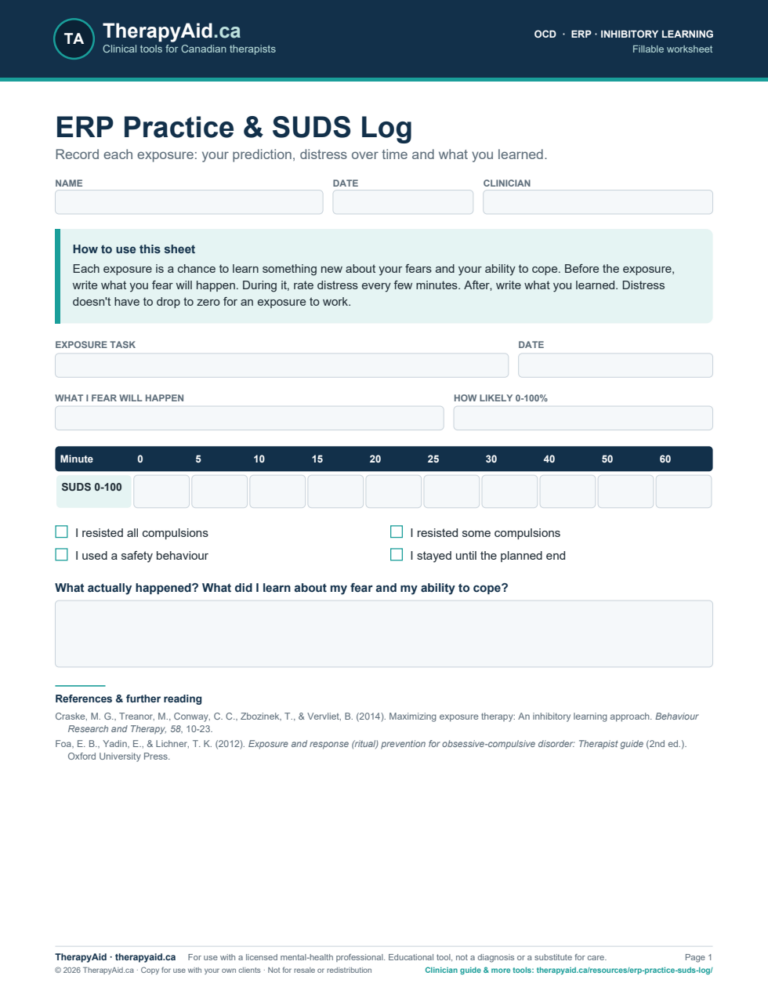
- Ask the client to log as close to real time as possible.
- Review totals and patterns weekly.
- Use data to choose exposure targets.
- Continue logging during ERP to measure change.
Clinician tips
- Make sure logging doesn’t itself become a ritual.
- Estimates are fine if exact times are hard.
- Celebrate reductions in time, not only frequency.
Worked example
Sharing with clients
Members can download the PDF to print or email, or copy a private client link from the download box. Your client opens the link and downloads the worksheet on any device. No client account is needed, and nothing your client writes is stored on TherapyAid.
Frequently asked questions
Should mental compulsions be recorded?
Yes. Mental reviewing, counting, praying or neutralizing are compulsions too and should be tracked.
How long should I keep the log?
Usually one to two weeks for a baseline, then periodically during ERP to measure progress.
References
Foa, E. B., Yadin, E., & Lichner, T. K. (2012). Exposure and response (ritual) prevention for obsessive-compulsive disorder: Therapist guide (2nd ed.). Oxford University Press.
Abramowitz, J. S. (2018). Getting over OCD: A 10-step workbook for taking back your life (2nd ed.). Guilford Press.
This worksheet is an educational tool for use by, or under the guidance of, a licensed or registered mental-health professional. It is not a diagnostic instrument or a substitute for clinical judgement. If a client is in crisis in Canada, call or text 9-8-8 or call 9-1-1.