Unblending From a Part
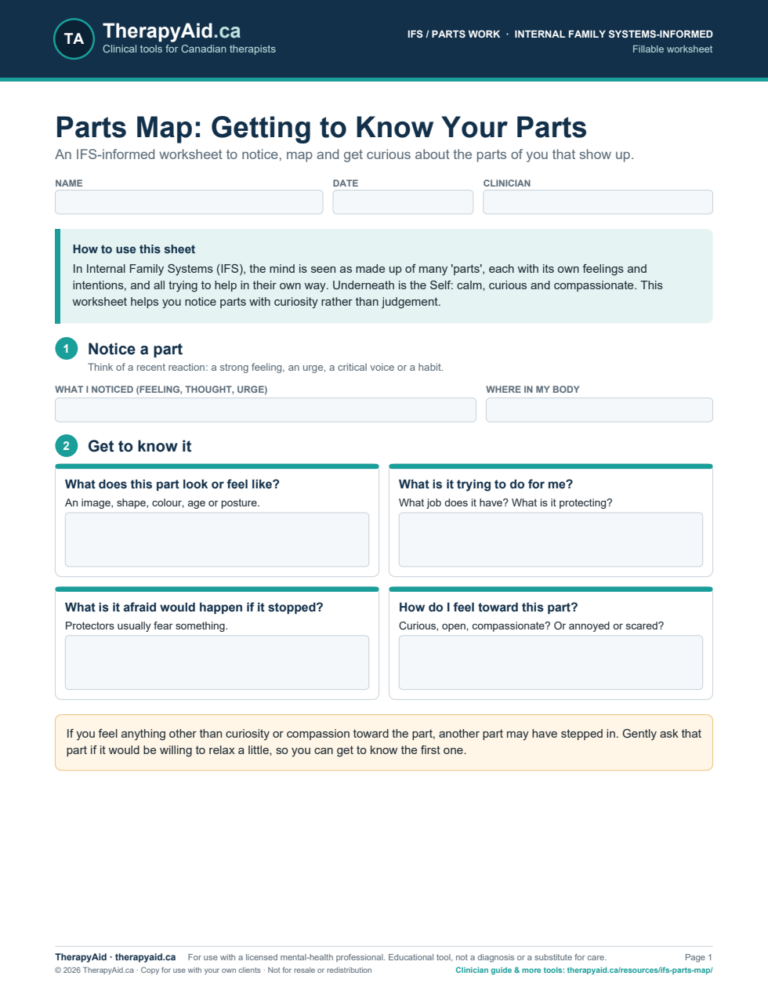
A step-by-step IFS-informed worksheet for unblending: noticing a part, naming it, creating space through imagery and checking how the client feels toward it.
1-page fillable PDF · US Letter (prints on A4) · IFS-informed · Unblending
- Approach / concern
- IFS / Parts Work
- Technique
- IFS-informed · Unblending
- Format
- Fillable PDF, 1 page (US Letter / A4)
- Access
- Pro and Advanced plans (3-day free trial)
- For
- Licensed clinicians to use with clients
- Updated
- October 2026
Key facts
What is the Unblending From a Part?
Blending is the IFS term for when a part’s feelings, beliefs and impulses take over, so that a person experiences them as their whole self. Unblending is the process of differentiating from the part, often through language (‘a part of me’), imagery and requests for the part to step back, so that Self can lead.
Why it works
Unblending is a core move in IFS that allows clients to approach parts with curiosity rather than reactivity (Schwartz & Sweezy, 2020). The ‘part of me’ language alone often reduces overwhelm and shame.
When to use it
- Overwhelming emotions in or between sessions
- Inner critics and harsh self-talk
- Before working with protectors
- Clients who are new to parts language
How to use it in session
- Help the client notice what’s present and locate it in the body.
- Reframe it as a part.
- Use imagery or requests to create space.
- Check the client’s feeling toward the part (is Self present?).
- Proceed to getting to know the part if there is enough space.
Clinician tips
- If a part refuses to step back, respect it and get curious about its fears.
- Some clients prefer external objects (cushions, figures) to represent parts.
- Go slowly with trauma-related parts.
Worked example
Sharing with clients
Members can download the PDF to print or email, or copy a private client link from the download box. Your client opens the link and downloads the worksheet on any device. No client account is needed, and nothing your client writes is stored on TherapyAid.
Frequently asked questions
What does unblending feel like?
Often like a small sense of space or relief, as if you’re watching the feeling rather than being inside it.
Is unblending the same as dissociation?
No. Unblending keeps you present and connected to the part; dissociation disconnects you from experience.
References
Schwartz, R. C., & Sweezy, M. (2020). Internal family systems therapy (2nd ed.). Guilford Press.
Schwartz, R. C. (2021). No bad parts: Healing trauma and restoring wholeness with the internal family systems model. Sounds True.
This worksheet is an educational tool for use by, or under the guidance of, a licensed or registered mental-health professional. It is not a diagnostic instrument or a substitute for clinical judgement. If a client is in crisis in Canada, call or text 9-8-8 or call 9-1-1.