What Is EMDR Therapy? (Client Handout)
A client handout explaining EMDR therapy, the preparation and processing phases, the stop signal and between-session effects, with space for questions.
1-page fillable PDF · US Letter (prints on A4) · Psychoeducation
- Approach / concern
- EMDR
- Technique
- Psychoeducation
- Format
- Fillable PDF, 1 page (US Letter / A4)
- Access
- Advanced plan
- For
- Licensed clinicians to use with clients
- Updated
- October 2026
Key facts
What is the What Is EMDR Therapy? (Client Handout)?
EMDR therapy is a structured, eight-phase psychotherapy for trauma and other distressing experiences. Clients briefly focus on a memory while engaging in bilateral stimulation, supporting adaptive processing of the memory.
Why it works
The World Health Organization (2013) recommends EMDR for post-traumatic stress disorder in adults and children. A meta-analysis found EMDR effective for PTSD and possibly other conditions (Cuijpers et al., 2020).
When to use it
- Before starting EMDR
- Clients curious or anxious about EMDR
- Informed consent discussions
- Family psychoeducation
How to use it in session
- Review the handout in the preparation phase.
- Explain bilateral stimulation options.
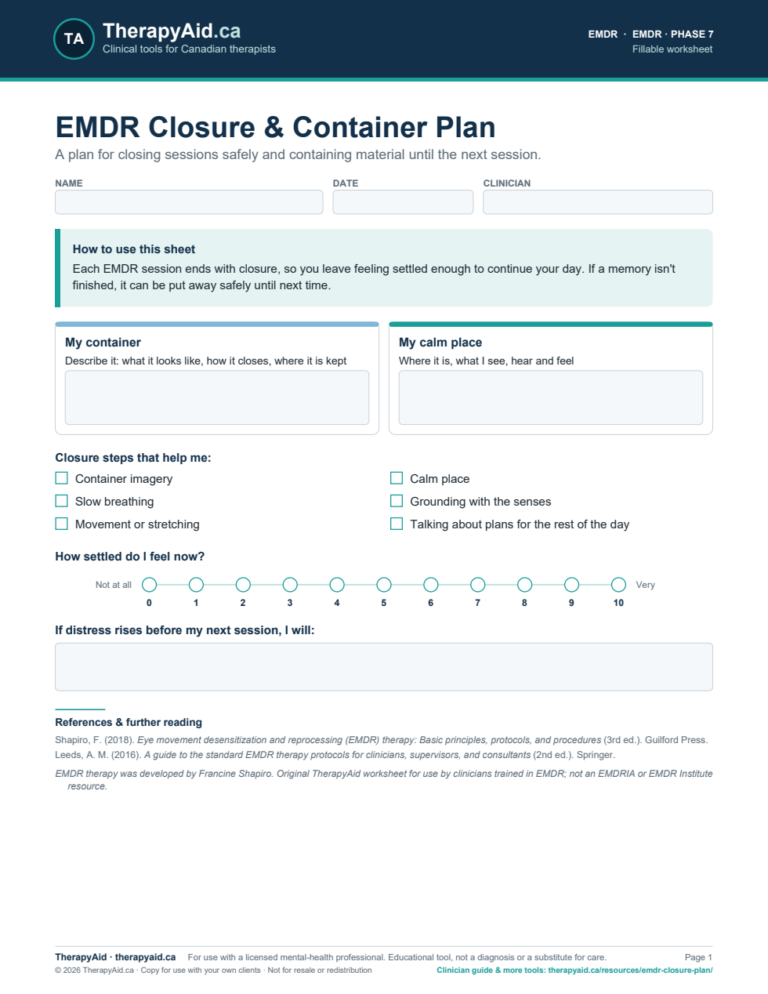
- Agree a stop signal.
- Identify a calm place word.
- Invite questions and concerns.
Clinician tips
- Use the train or movie metaphor.
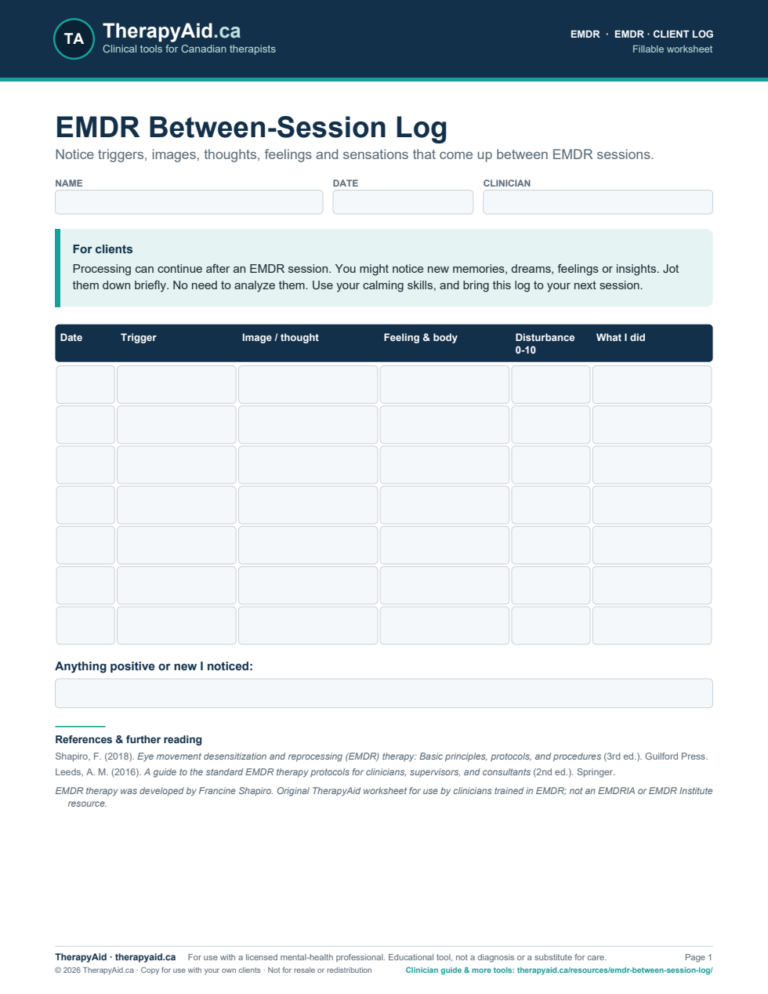
- Normalize between-session processing.
- Emphasize control and choice.
Worked example
Sharing with clients
Members can download the PDF to print or email, or copy a private client link from the download box. Your client opens the link and downloads the worksheet on any device. No client account is needed, and nothing your client writes is stored on TherapyAid.
Frequently asked questions
Do I have to talk about the trauma in detail?
No. EMDR doesn’t require detailed descriptions of the memory.
Is EMDR evidence-based?
Yes. It’s recommended by the WHO and other guidelines for PTSD.
References
Shapiro, F. (2018). Eye movement desensitization and reprocessing (EMDR) therapy: Basic principles, protocols, and procedures (3rd ed.). Guilford Press.
World Health Organization. (2013). Guidelines for the management of conditions specifically related to stress. World Health Organization.
This worksheet is an educational tool for use by, or under the guidance of, a licensed or registered mental-health professional. It is not a diagnostic instrument or a substitute for clinical judgement. If a client is in crisis in Canada, call or text 9-8-8 or call 9-1-1.