EMDR Closure & Container Plan
An EMDR closure worksheet describing a container and calm place, selecting closure steps, rating settledness and planning for between-session distress.
1-page fillable PDF · US Letter (prints on A4) · EMDR · Phase 7
- Approach / concern
- EMDR
- Technique
- EMDR · Phase 7
- Format
- Fillable PDF, 1 page (US Letter / A4)
- Access
- Advanced plan
- For
- Licensed clinicians to use with clients
- Updated
- October 2026
Key facts
What is the EMDR Closure & Container Plan?
Closure is the seventh phase of EMDR, ensuring clients leave sessions stable, particularly after incomplete processing. Container imagery and calm place are common closure procedures.
Why it works
The standard protocol requires closure to return clients to equilibrium and prepare them for between-session effects (Shapiro, 2018; Leeds, 2016).
When to use it
- End of every EMDR session
- Incomplete sessions
- Clients with high between-session distress
- Preparation phase rehearsal
How to use it in session
- Develop the container and calm place in preparation.
- Choose closure steps.
- Rate settledness.
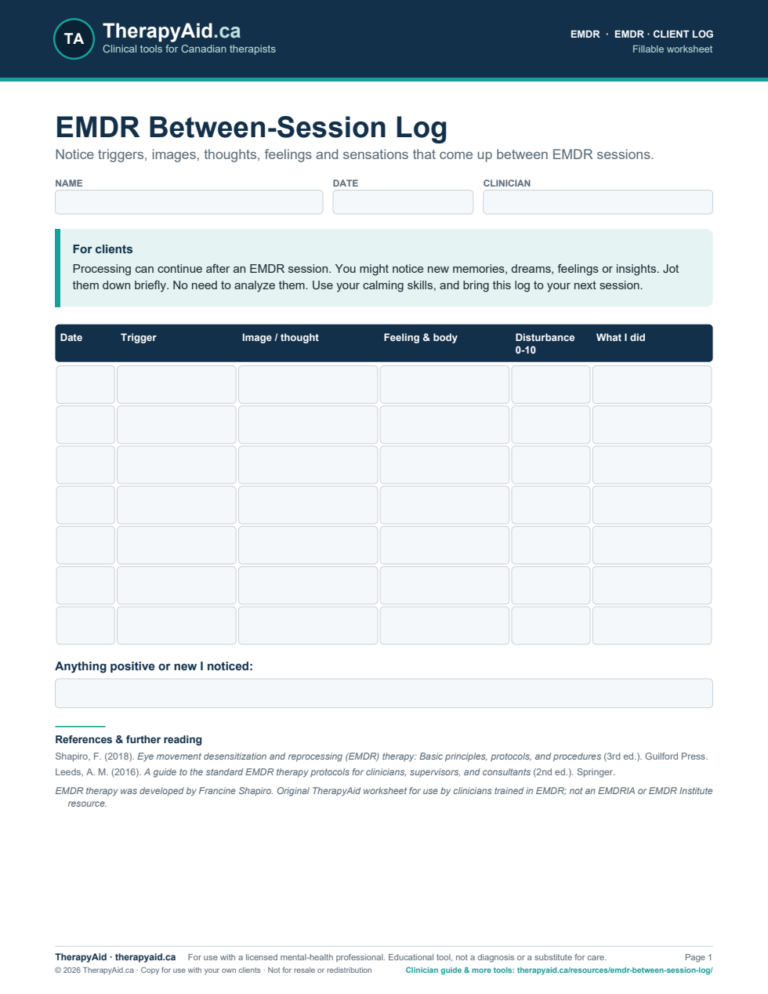
- Plan between-session coping.
- Review next session.
Clinician tips
- Leave enough time for closure.
- Practise the container before reprocessing.
- Give a contact plan for crises.
Worked example
Sharing with clients
Members can download the PDF to print or email, or copy a private client link from the download box. Your client opens the link and downloads the worksheet on any device. No client account is needed, and nothing your client writes is stored on TherapyAid.
Frequently asked questions
What if I can’t close the container?
Tell your therapist. You can adapt the image or use grounding and calm place instead.
Is it okay to leave a memory unfinished?
Yes. Containment allows processing to continue safely next time.
References
Shapiro, F. (2018). Eye movement desensitization and reprocessing (EMDR) therapy: Basic principles, protocols, and procedures (3rd ed.). Guilford Press.
Leeds, A. M. (2016). A guide to the standard EMDR therapy protocols for clinicians, supervisors, and consultants (2nd ed.). Springer.
This worksheet is an educational tool for use by, or under the guidance of, a licensed or registered mental-health professional. It is not a diagnostic instrument or a substitute for clinical judgement. If a client is in crisis in Canada, call or text 9-8-8 or call 9-1-1.