Living With Uncertainty: OCD Responses
An OCD worksheet replacing reassurance-seeking and checking with uncertainty-accepting responses, plus statements to practise.
1-page fillable PDF · US Letter (prints on A4) · ERP · Uncertainty tolerance
- Approach / concern
- OCD
- Technique
- ERP · Uncertainty tolerance
- Format
- Fillable PDF, 1 page (US Letter / A4)
- Access
- Pro and Advanced plans (3-day free trial)
- For
- Licensed clinicians to use with clients
- Updated
- October 2026
Key facts
What is the Living With Uncertainty: OCD Responses?
Intolerance of uncertainty maintains OCD. Accepting uncertainty and resisting reassurance-seeking are central to ERP.
Why it works
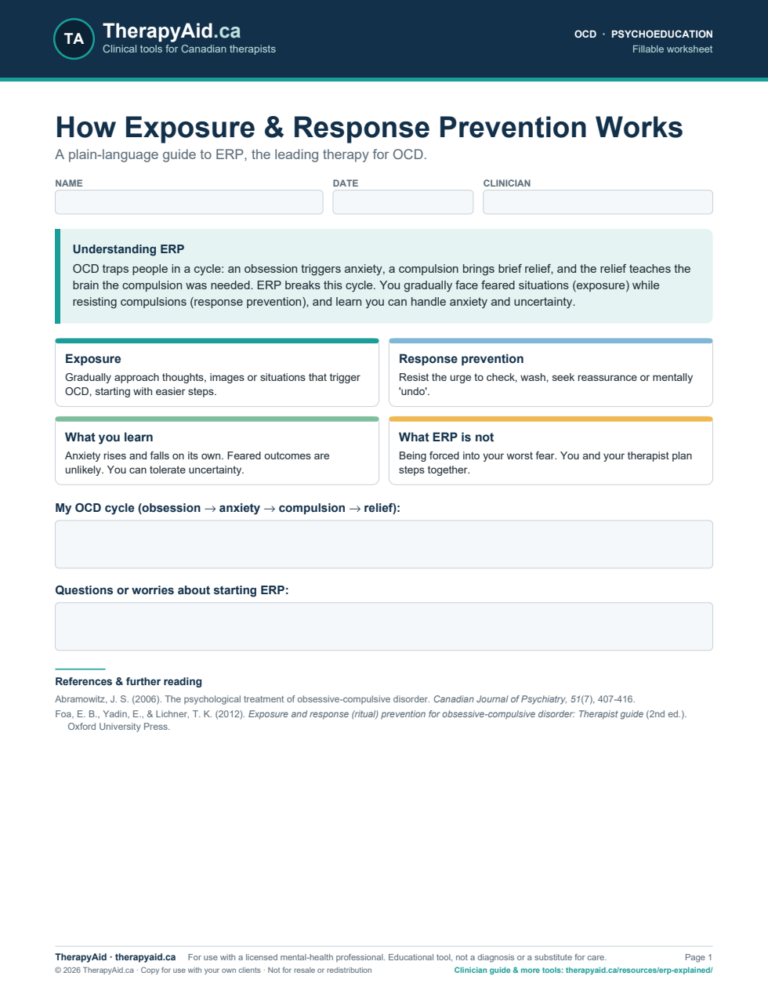
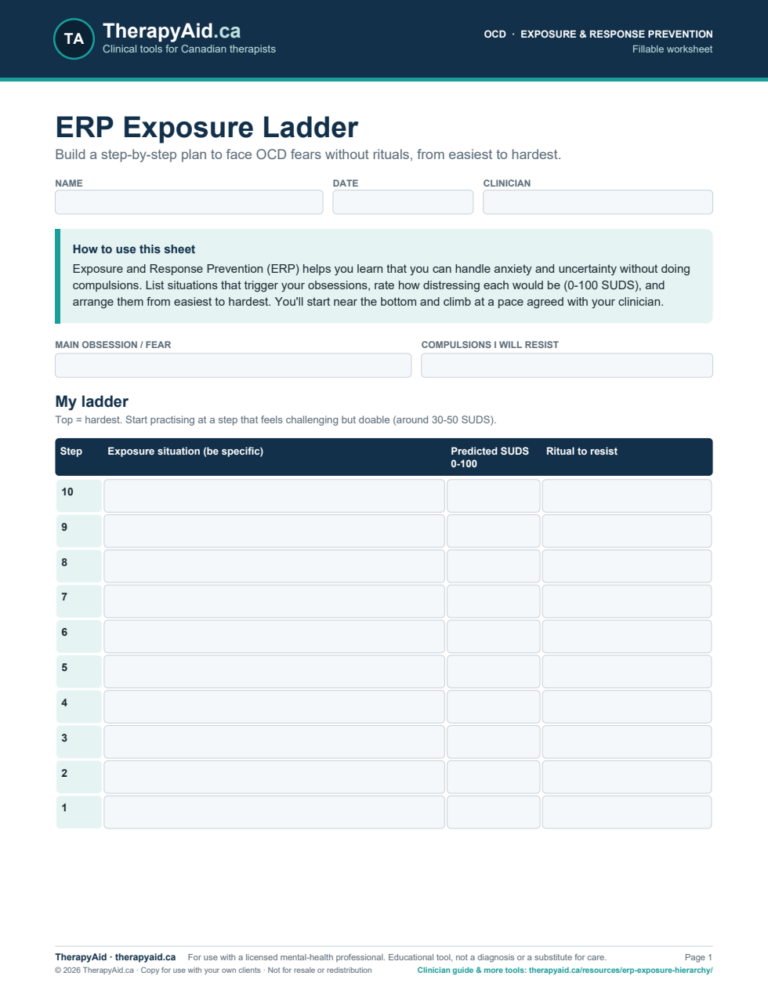
ERP aims to reduce compulsions, including reassurance-seeking (Abramowitz, 2006). Response prevention involves tolerating uncertainty without neutralizing (Foa et al., 2012).
When to use it
- OCD with doubt and checking
- Reassurance-seeking
- Relationship OCD
- Health anxiety
How to use it in session
- List OCD demands.
- Note old responses.
- Write uncertainty responses.
- Practise.
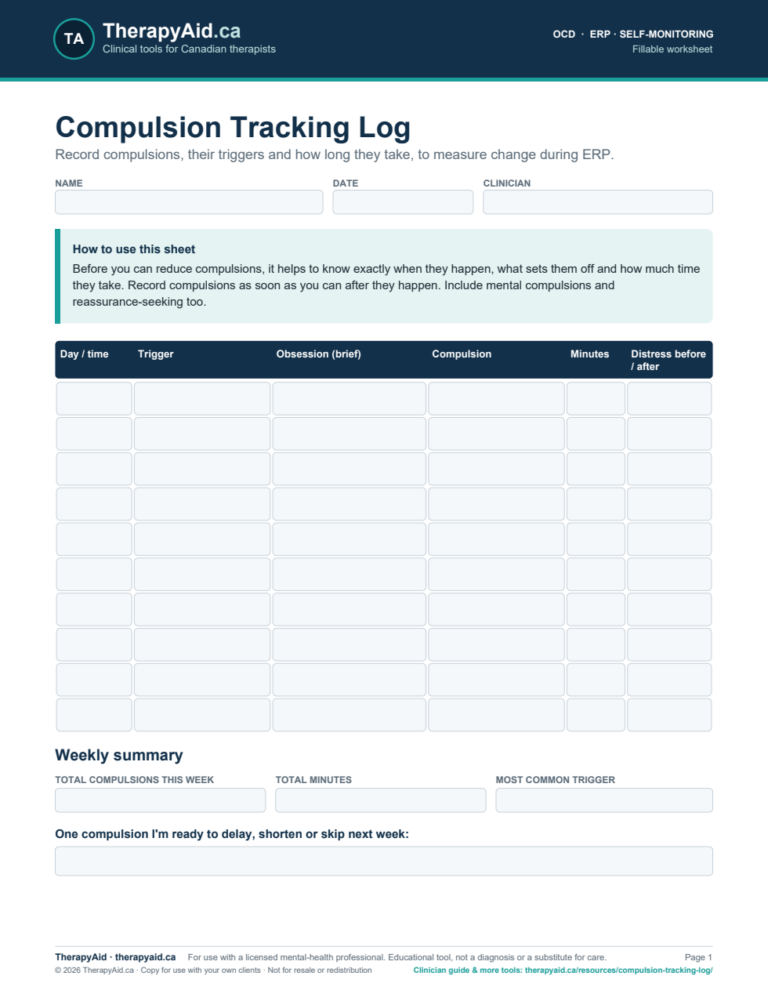
- Track urges.
Clinician tips
- Avoid turning statements into rituals.
- Family should also reduce reassurance.
- Use alongside exposure.
Worked example
Sharing with clients
Members can download the PDF to print or email, or copy a private client link from the download box. Your client opens the link and downloads the worksheet on any device. No client account is needed, and nothing your client writes is stored on TherapyAid.
Frequently asked questions
Isn’t reassurance helpful?
It brings brief relief but strengthens OCD’s need for certainty.
What if uncertainty feels unbearable?
It’s uncomfortable at first, but tolerance grows with practice.
References
Abramowitz, J. S. (2006). The psychological treatment of obsessive-compulsive disorder. Canadian Journal of Psychiatry, 51(7), 407-416.
Foa, E. B., Yadin, E., & Lichner, T. K. (2012). Exposure and response (ritual) prevention for obsessive-compulsive disorder: Therapist guide (2nd ed.). Oxford University Press.
This worksheet is an educational tool for use by, or under the guidance of, a licensed or registered mental-health professional. It is not a diagnostic instrument or a substitute for clinical judgement. If a client is in crisis in Canada, call or text 9-8-8 or call 9-1-1.