Relationship OCD: Noticing the Doubts
An OCD worksheet identifying relationship-centred obsessive doubts and compulsions, with a planned non-compulsive response.
1-page fillable PDF · US Letter (prints on A4) · ERP · Relationship OCD
- Approach / concern
- OCD
- Technique
- ERP · Relationship OCD
- Format
- Fillable PDF, 1 page (US Letter / A4)
- Access
- Pro and Advanced plans (3-day free trial)
- For
- Licensed clinicians to use with clients
- Updated
- October 2026
Key facts
What is the Relationship OCD: Noticing the Doubts?
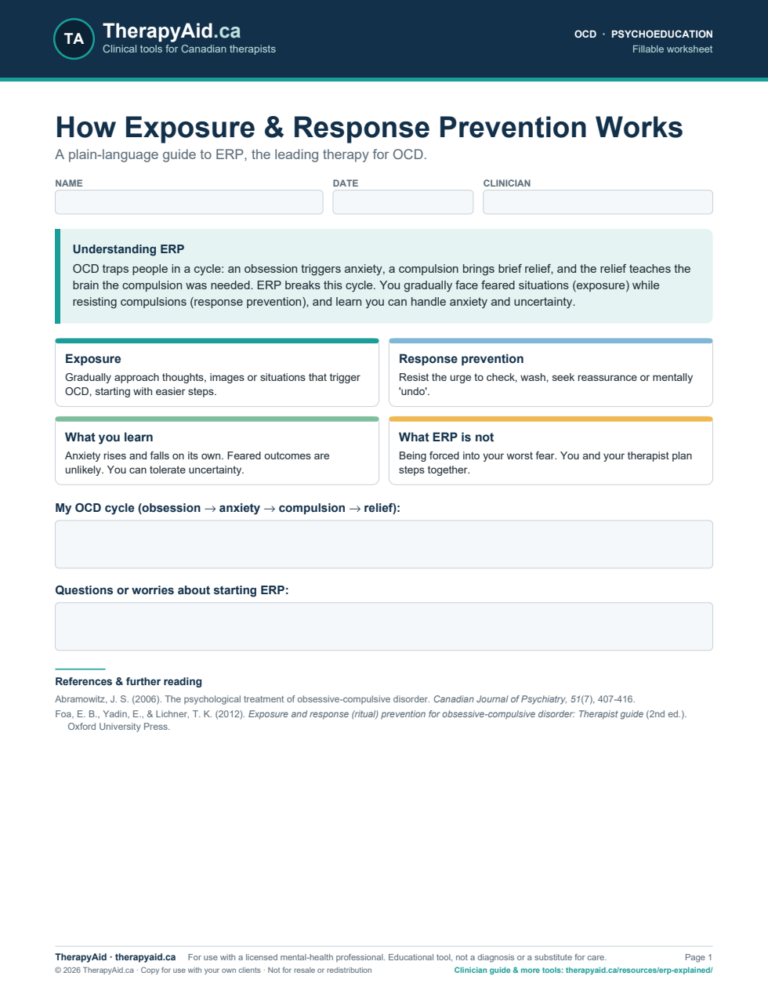
Relationship OCD (ROCD) involves obsessive doubts about one’s relationship or partner, with compulsions such as checking feelings and reassurance-seeking. It’s treated with ERP.
Why it works
Doron et al. (2012) described relationship-centred obsessive-compulsive symptoms. ERP is the first-line treatment for OCD across themes (Abramowitz, 2006).
When to use it
- Relationship doubts that feel intrusive
- Reassurance seeking about love
- ERP for OCD
- Couples therapy referrals
How to use it in session
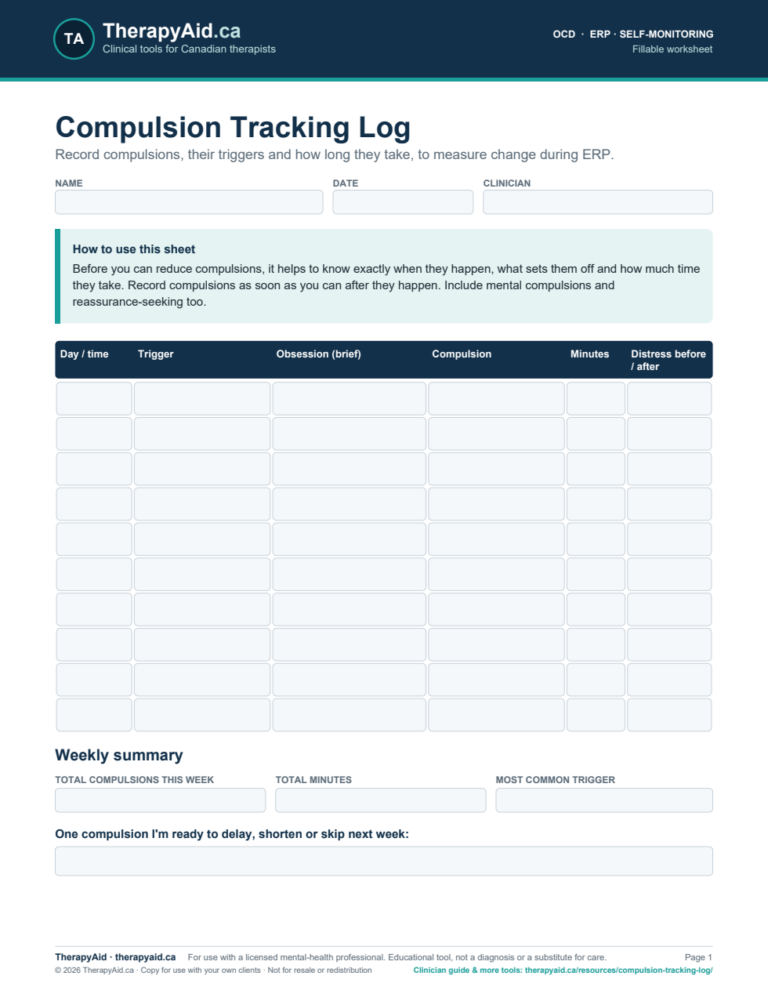
- Identify doubts.
- Identify compulsions.
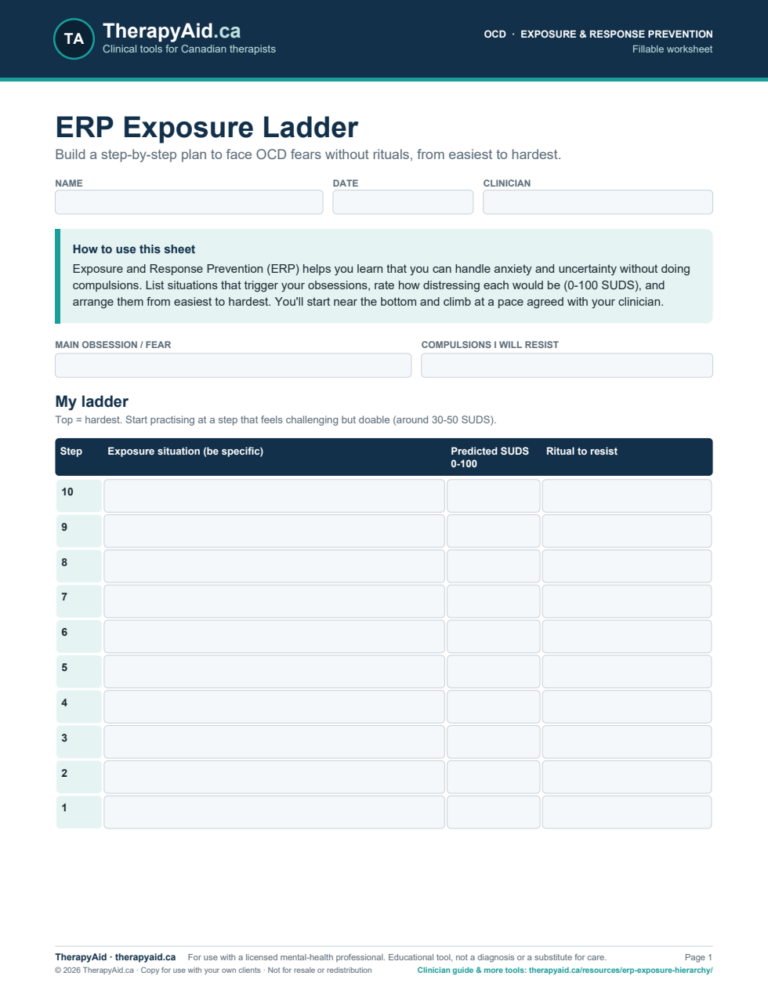
- Plan non-compulsive responses.
- Build an ERP hierarchy.
- Track progress.
Clinician tips
- Distinguish ROCD from genuine relationship problems carefully.
- Avoid giving reassurance.
- Involve partners in reducing accommodation.
Worked example
Sharing with clients
Members can download the PDF to print or email, or copy a private client link from the download box. Your client opens the link and downloads the worksheet on any device. No client account is needed, and nothing your client writes is stored on TherapyAid.
Frequently asked questions
How do I know if it’s OCD or a real relationship problem?
OCD doubts are intrusive, repetitive and driven by need for certainty; a clinician can help assess.
Should I end the relationship to stop the doubts?
Decisions made to escape OCD doubts rarely help; work on the OCD first.
References
Doron, G., Derby, D., Szepsenwol, O., & Talmor, D. (2012). Tainted love: Exploring relationship-centered obsessive compulsive symptoms in two non-clinical cohorts. Journal of Obsessive-Compulsive and Related Disorders, 1(1), 16-24.
Abramowitz, J. S. (2006). The psychological treatment of obsessive-compulsive disorder. Canadian Journal of Psychiatry, 51(7), 407-416.
This worksheet is an educational tool for use by, or under the guidance of, a licensed or registered mental-health professional. It is not a diagnostic instrument or a substitute for clinical judgement. If a client is in crisis in Canada, call or text 9-8-8 or call 9-1-1.