IFS at a Glance: Clinician Quick Guide
A one-page clinician quick guide to IFS summarizing parts, Self qualities, the 6 Fs for protectors and the healing steps for exiles.
1-page fillable PDF · US Letter (prints on A4) · Clinician quick guide
- Approach / concern
- IFS / Parts Work
- Technique
- Clinician quick guide
- Format
- Fillable PDF, 1 page (US Letter / A4)
- Access
- Pro and Advanced plans (3-day free trial)
- For
- Licensed clinicians to use with clients
- Updated
- October 2026
Key facts
What is the IFS at a Glance: Clinician Quick Guide?
Internal Family Systems is a parts-based psychotherapy model that helps clients access Self and relate to their protective and exiled parts with compassion.
Why it works
Schwartz and Sweezy (2020) describe the IFS model and therapeutic steps. Schwartz (2021) presents the model for clinicians and the public.
When to use it
- Clinicians new to IFS
- Parts-informed practice
- Session planning
- Supervision
How to use it in session
- Review concepts.
- Identify target parts.
- Use the 6 Fs.
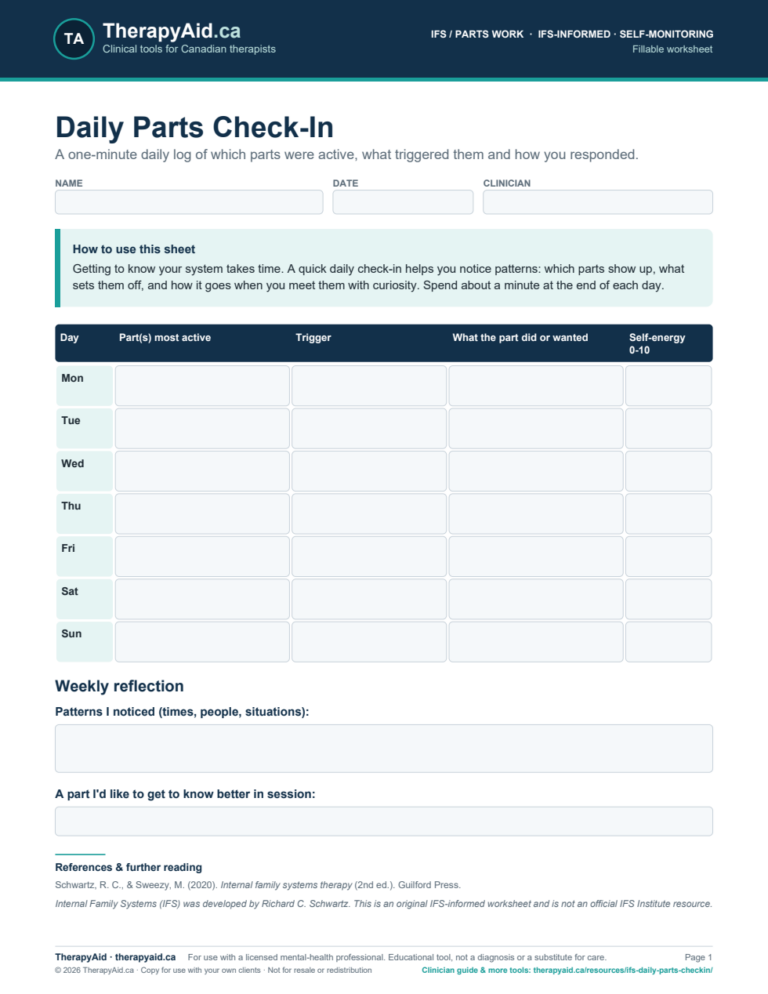
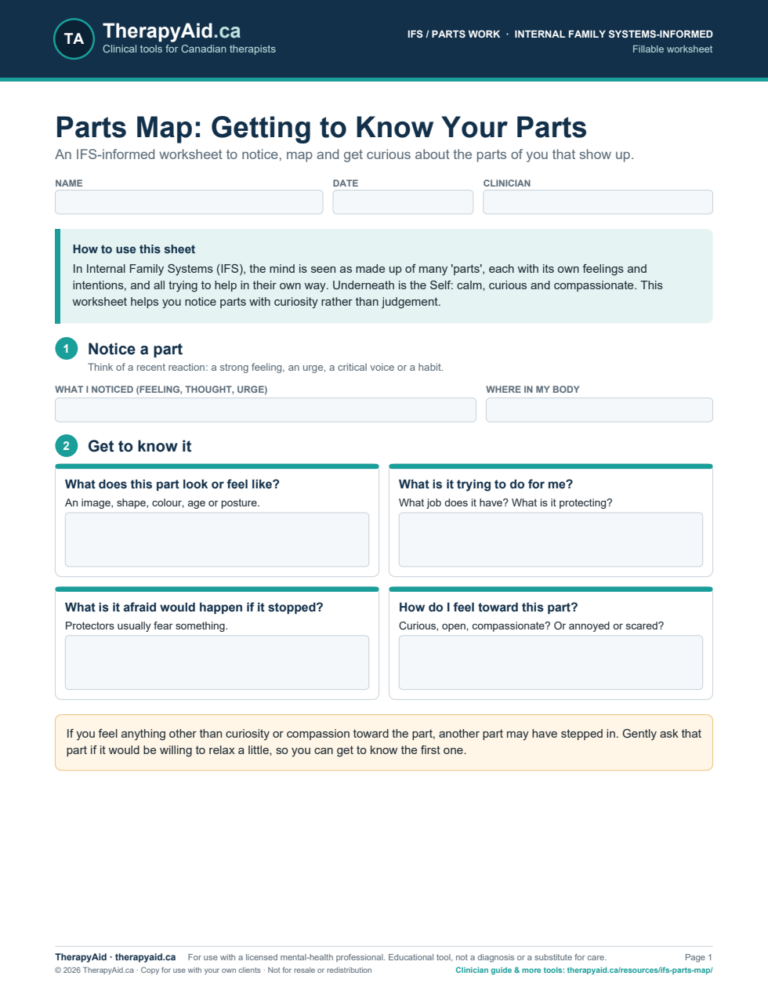
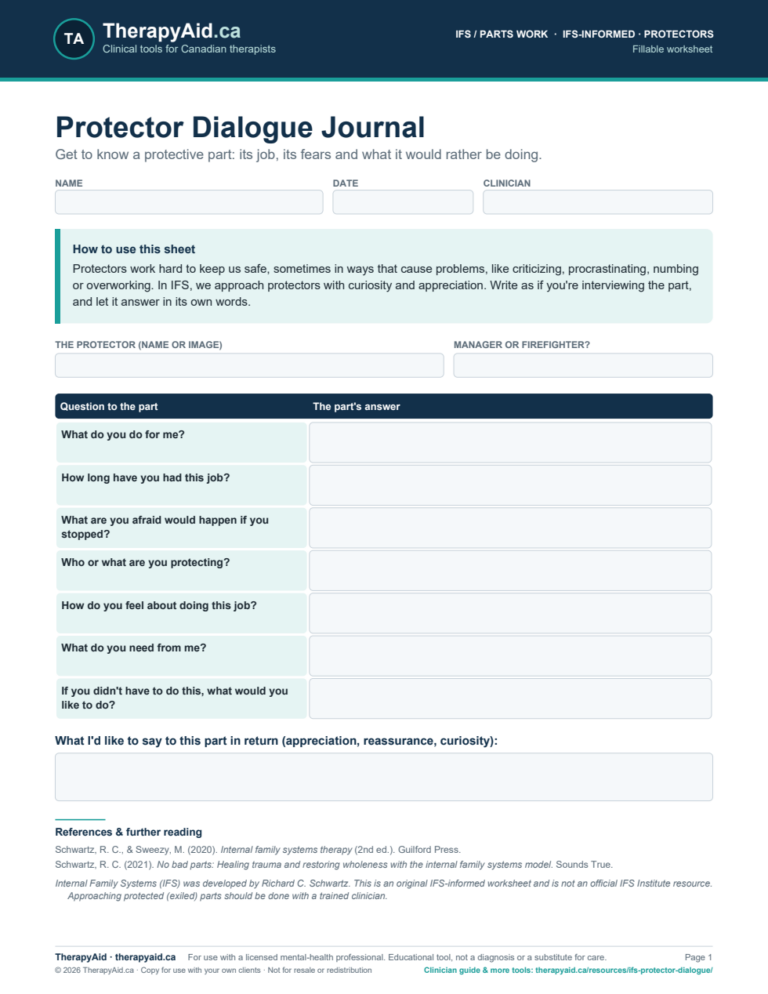
- Link to parts worksheets and parts mapper.
- Seek IFS training for exile work.
Clinician tips
- Always get protector permission before exile work.
- Check ‘How do you feel toward this part?’
- Respect the pace of the system.
Worked example
Sharing with clients
Members can download the PDF to print or email, or copy a private client link from the download box. Your client opens the link and downloads the worksheet on any device. No client account is needed, and nothing your client writes is stored on TherapyAid.
Frequently asked questions
What are the 6 Fs?
Steps for getting to know protectors: find, focus, flesh out, feel toward, befriend and fear.
Do I need IFS training?
IFS-informed techniques are widely used; deeper work with exiles benefits from formal training.
References
Schwartz, R. C., & Sweezy, M. (2020). Internal family systems therapy (2nd ed.). Guilford Press.
Schwartz, R. C. (2021). No bad parts: Healing trauma and restoring wholeness with the internal family systems model. Sounds True.
This worksheet is an educational tool for use by, or under the guidance of, a licensed or registered mental-health professional. It is not a diagnostic instrument or a substitute for clinical judgement. If a client is in crisis in Canada, call or text 9-8-8 or call 9-1-1.