EMDR’s Eight Phases: Clinician Quick Guide
A one-page clinician quick guide to the eight phases of EMDR therapy, the AIP model and the three-pronged protocol.
1-page fillable PDF · US Letter (prints on A4) · Clinician quick guide
- Approach / concern
- EMDR
- Technique
- Clinician quick guide
- Format
- Fillable PDF, 1 page (US Letter / A4)
- Access
- Advanced plan
- For
- Licensed clinicians to use with clients
- Updated
- October 2026
Key facts
What is the EMDR’s Eight Phases: Clinician Quick Guide?
EMDR therapy follows an eight-phase protocol grounded in the Adaptive Information Processing model, addressing past memories, present triggers and future templates.
Why it works
Shapiro (2018) defines the eight phases and three-pronged protocol. The WHO (2013) recommends EMDR for PTSD.
When to use it
- EMDR-trained clinicians
- Consultation and supervision
- Session planning
- Teaching
How to use it in session
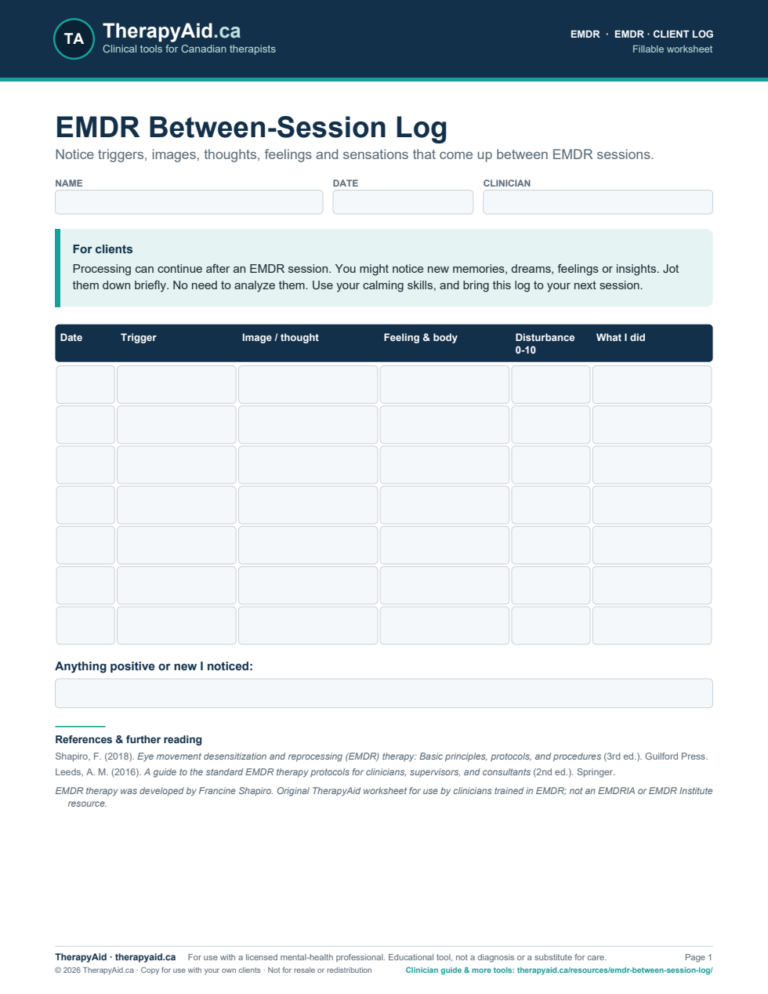
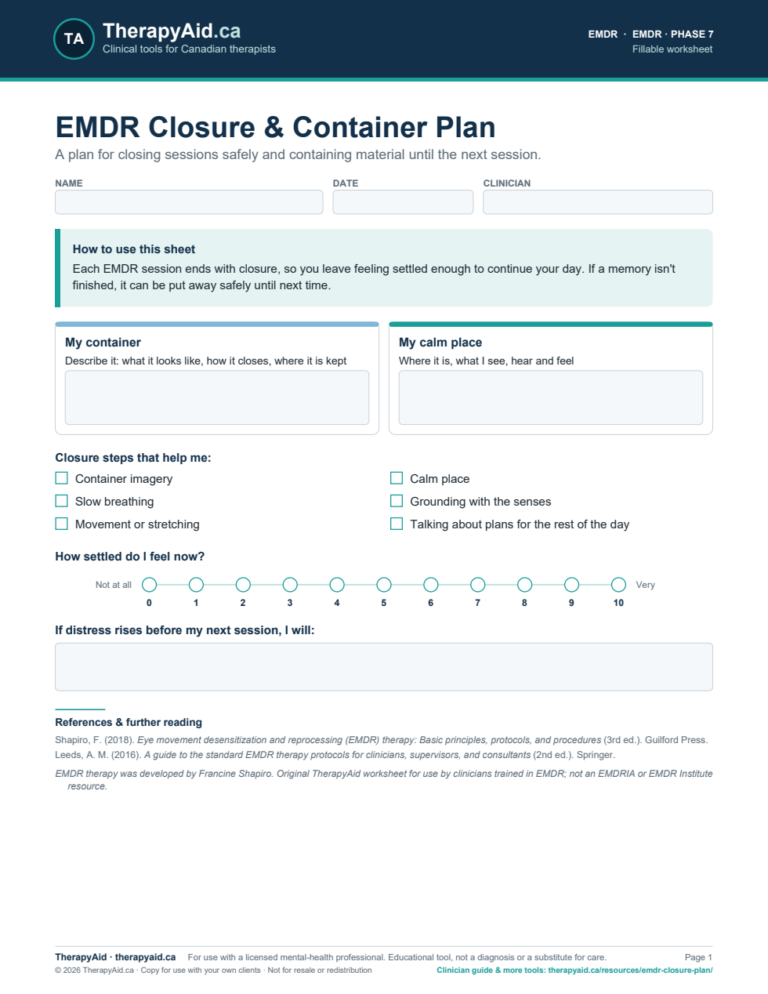
- Review phases.
- Check readiness.
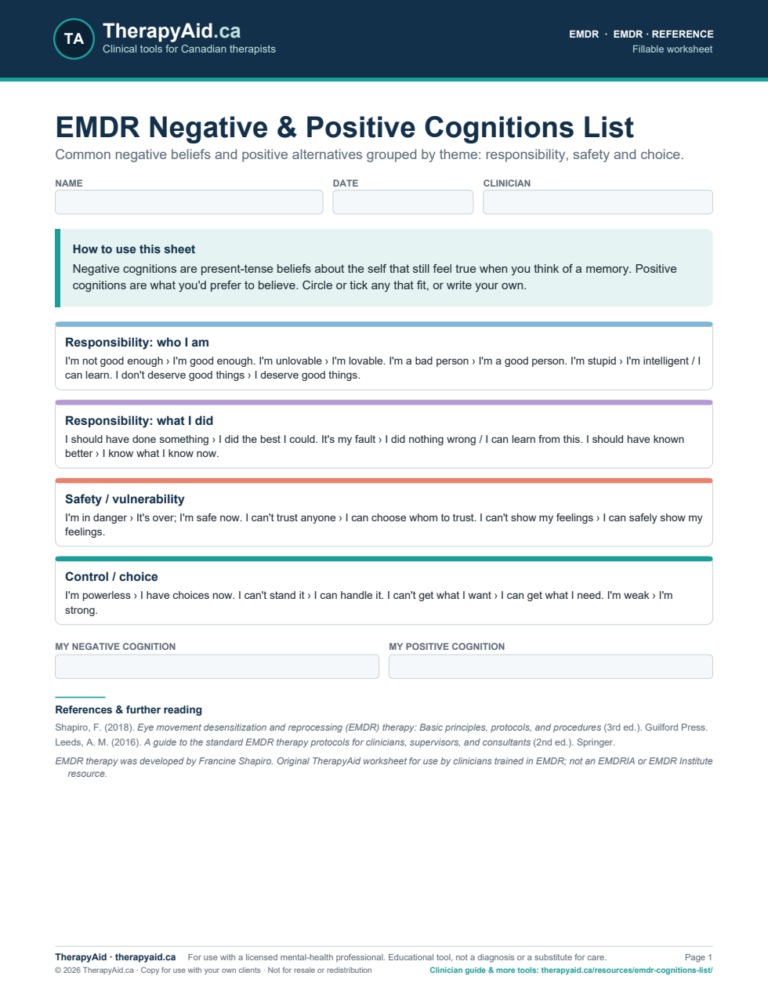
- Use phase-specific worksheets.
- Track SUD and VOC.
- Re-evaluate each session.
Clinician tips
- Formal EMDR training is required to practise EMDR.
- Extend preparation for complex trauma and dissociation.
- Leave time for closure.
Worked example
Sharing with clients
Members can download the PDF to print or email, or copy a private client link from the download box. Your client opens the link and downloads the worksheet on any device. No client account is needed, and nothing your client writes is stored on TherapyAid.
Frequently asked questions
Can I use EMDR without training?
No. EMDR requires formal training and consultation.
What is the AIP model?
The theory that unprocessed memories underlie many symptoms, and that processing them leads to adaptive resolution.
References
Shapiro, F. (2018). Eye movement desensitization and reprocessing (EMDR) therapy: Basic principles, protocols, and procedures (3rd ed.). Guilford Press.
World Health Organization. (2013). Guidelines for the management of conditions specifically related to stress. World Health Organization.
This worksheet is an educational tool for use by, or under the guidance of, a licensed or registered mental-health professional. It is not a diagnostic instrument or a substitute for clinical judgement. If a client is in crisis in Canada, call or text 9-8-8 or call 9-1-1.