EMDR Resource Development Worksheet
An EMDR resourcing worksheet identifying a needed quality and mastery, relational and symbolic resources, with images, body feelings and cue words.
1-page fillable PDF · US Letter (prints on A4) · EMDR · Resourcing
- Approach / concern
- EMDR
- Technique
- EMDR · Resourcing
- Format
- Fillable PDF, 1 page (US Letter / A4)
- Access
- Advanced plan
- For
- Licensed clinicians to use with clients
- Updated
- October 2026
Key facts
What is the EMDR Resource Development Worksheet?
Resource development and installation (RDI) strengthens positive memory networks and qualities through imagery and short sets of bilateral stimulation, often in the preparation phase for complex trauma.
Why it works
Preliminary evidence suggests RDI improves stabilization in complex PTSD (Korn & Leeds, 2002). Resourcing is part of EMDR’s preparation phase (Shapiro, 2018).
When to use it
- EMDR preparation
- Complex trauma
- Low affect tolerance
- Before difficult targets
How to use it in session
- Identify a needed quality.
- Find mastery, relational and symbolic resources.
- Develop image and body felt-sense.
- Add a cue word.
- Install with short, slow sets if trained.
Clinician tips
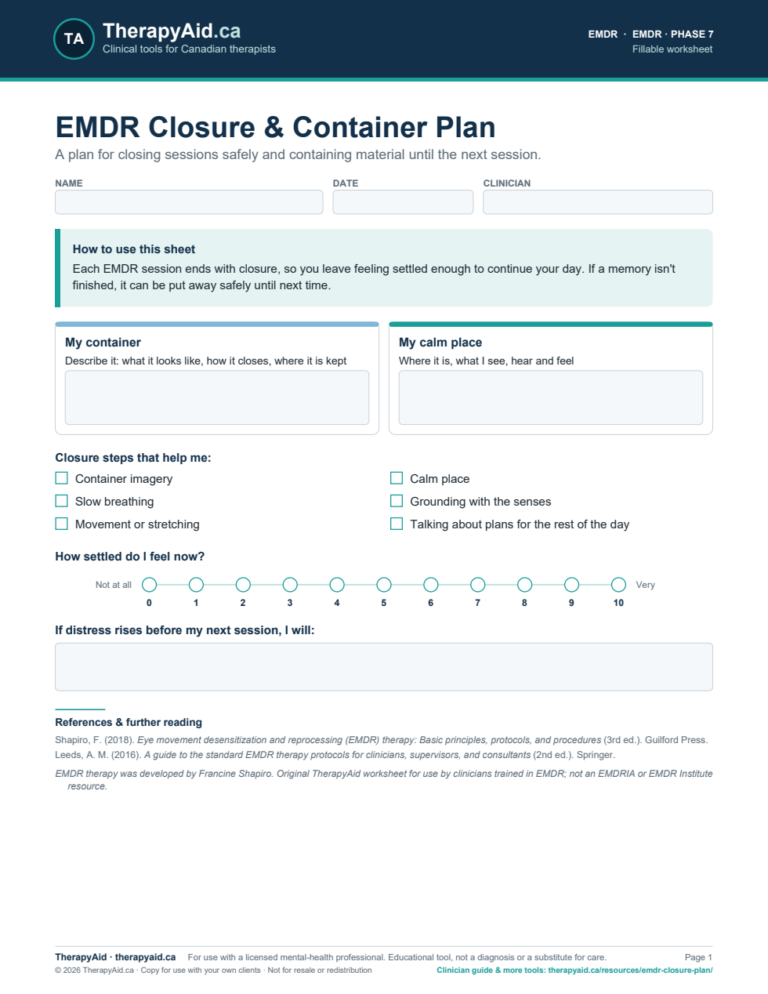
- Stop if resources become contaminated by distressing material.
- Keep sets short and slow.
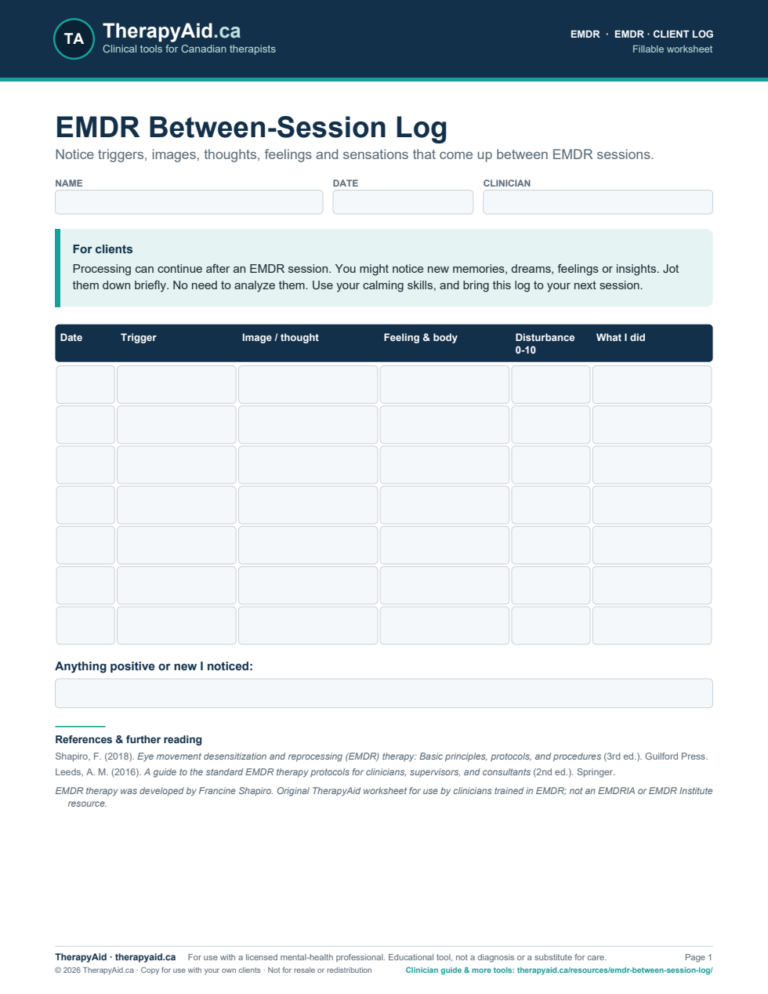
- Practise cue words between sessions.
Worked example
Sharing with clients
Members can download the PDF to print or email, or copy a private client link from the download box. Your client opens the link and downloads the worksheet on any device. No client account is needed, and nothing your client writes is stored on TherapyAid.
Frequently asked questions
What’s the difference between a calm place and resource development?
Calm place focuses on calm; RDI develops specific qualities using several resource types.
Can resources be imaginary?
Yes. Imagined figures, symbols and fictional characters can be powerful resources.
References
Korn, D. L., & Leeds, A. M. (2002). Preliminary evidence of efficacy for EMDR resource development and installation in the stabilization phase of treatment of complex posttraumatic stress disorder. Journal of Clinical Psychology, 58(12), 1465-1487.
Shapiro, F. (2018). Eye movement desensitization and reprocessing (EMDR) therapy: Basic principles, protocols, and procedures (3rd ed.). Guilford Press.
This worksheet is an educational tool for use by, or under the guidance of, a licensed or registered mental-health professional. It is not a diagnostic instrument or a substitute for clinical judgement. If a client is in crisis in Canada, call or text 9-8-8 or call 9-1-1.