EMDR Readiness & Stabilization Checklist
A clinician checklist covering safety and stability, coping skills and resources, dissociation screening and informed consent before EMDR reprocessing.
1-page fillable PDF · US Letter (prints on A4) · EMDR · Clinician tool
- Approach / concern
- EMDR
- Technique
- EMDR · Clinician tool
- Format
- Fillable PDF, 1 page (US Letter / A4)
- Access
- Advanced plan
- For
- Licensed clinicians to use with clients
- Updated
- October 2026
Key facts
What is the EMDR Readiness & Stabilization Checklist?
EMDR’s preparation phase ensures clients have sufficient stability, resources and informed consent before reprocessing. Readiness assessment includes safety, affect tolerance, dissociation screening and life circumstances.
Why it works
Shapiro (2018) emphasizes client selection and preparation, including screening for dissociative disorders. The Dissociative Experiences Scale is a widely used dissociation screening measure (Carlson & Putnam, 1993).
When to use it
- Before Phase 3 assessment
- Complex trauma presentations
- Consultation and supervision
- Documentation
How to use it in session
- Complete after history-taking.
- Note gaps.
- Plan further preparation if needed.
- Document consent.
- Review periodically.
Clinician tips
- Readiness is dynamic; recheck after life events.
- Seek consultation for dissociative presentations.
- Not a substitute for formal training.
Worked example
Sharing with clients
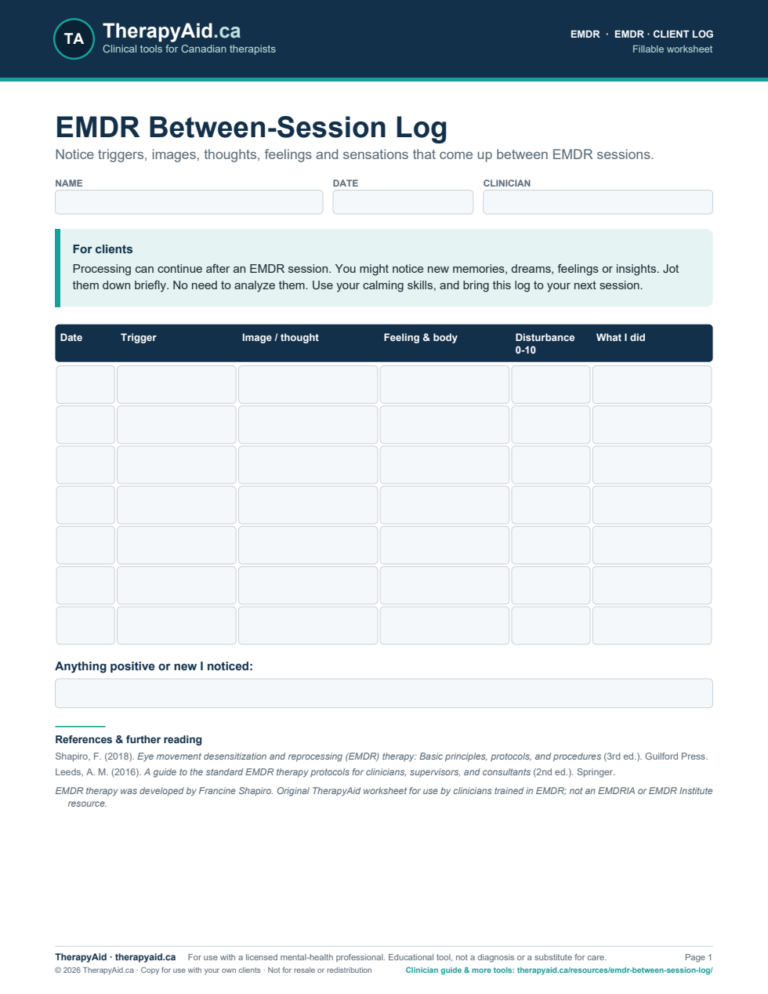
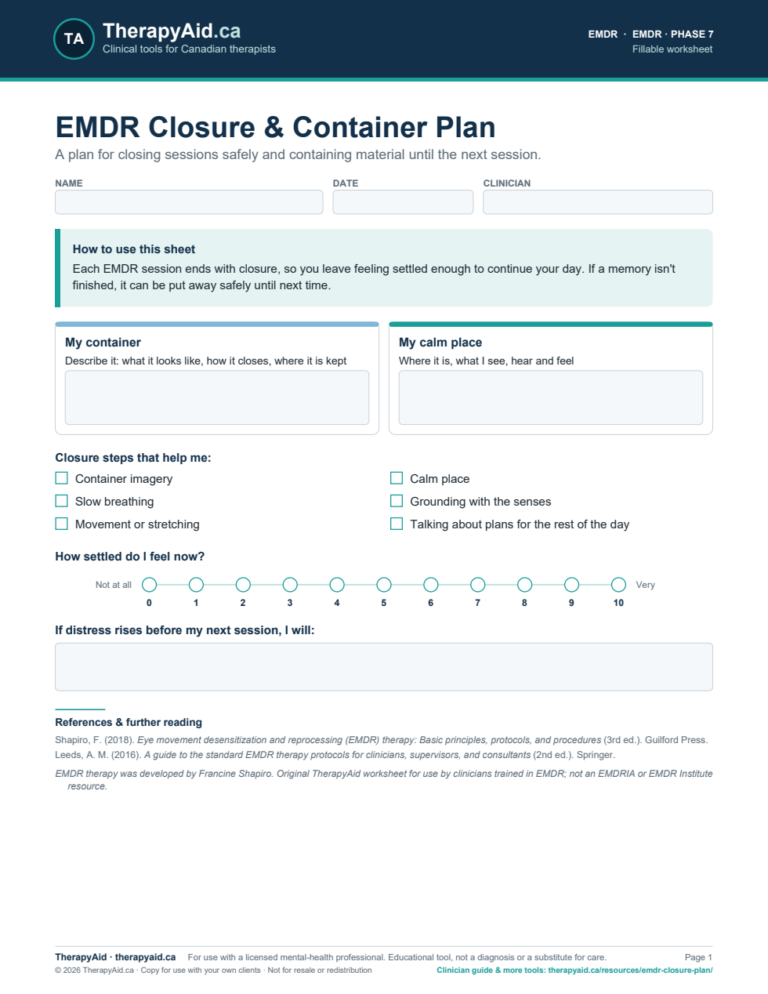
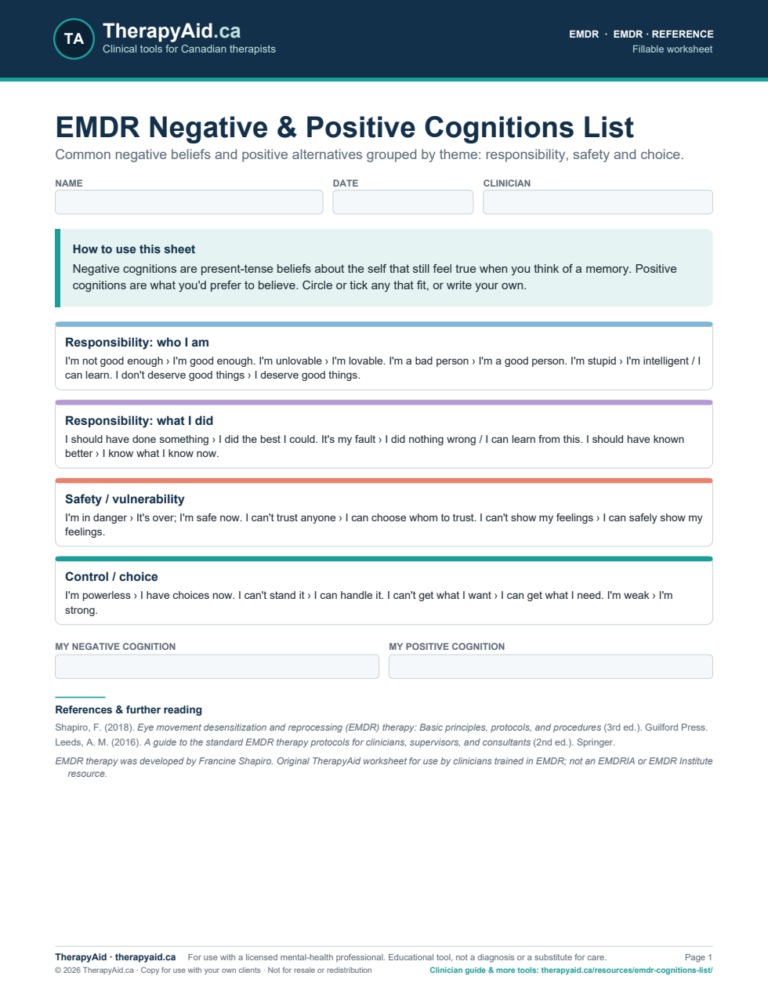
Members can download the PDF to print or email, or copy a private client link from the download box. Your client opens the link and downloads the worksheet on any device. No client account is needed, and nothing your client writes is stored on TherapyAid.
Frequently asked questions
Is this a validated measure?
No. It’s a structured clinical checklist to support judgement and documentation.
What if my client isn’t ready?
Continue preparation and resource development, and seek consultation where needed.
References
Shapiro, F. (2018). Eye movement desensitization and reprocessing (EMDR) therapy: Basic principles, protocols, and procedures (3rd ed.). Guilford Press.
Carlson, E. B., & Putnam, F. W. (1993). An update on the Dissociative Experiences Scale. Dissociation, 6(1), 16-27.
This worksheet is an educational tool for use by, or under the guidance of, a licensed or registered mental-health professional. It is not a diagnostic instrument or a substitute for clinical judgement. If a client is in crisis in Canada, call or text 9-8-8 or call 9-1-1.