How Exposure & Response Prevention Works
A psychoeducation handout explaining the OCD cycle, exposure, response prevention, what clients learn and common misconceptions, with space for the client's own cycle.
1-page fillable PDF · US Letter (prints on A4) · Psychoeducation
- Approach / concern
- OCD
- Technique
- Psychoeducation
- Format
- Fillable PDF, 1 page (US Letter / A4)
- Access
- Pro and Advanced plans (3-day free trial)
- For
- Licensed clinicians to use with clients
- Updated
- October 2026
Key facts
What is the How Exposure & Response Prevention Works?
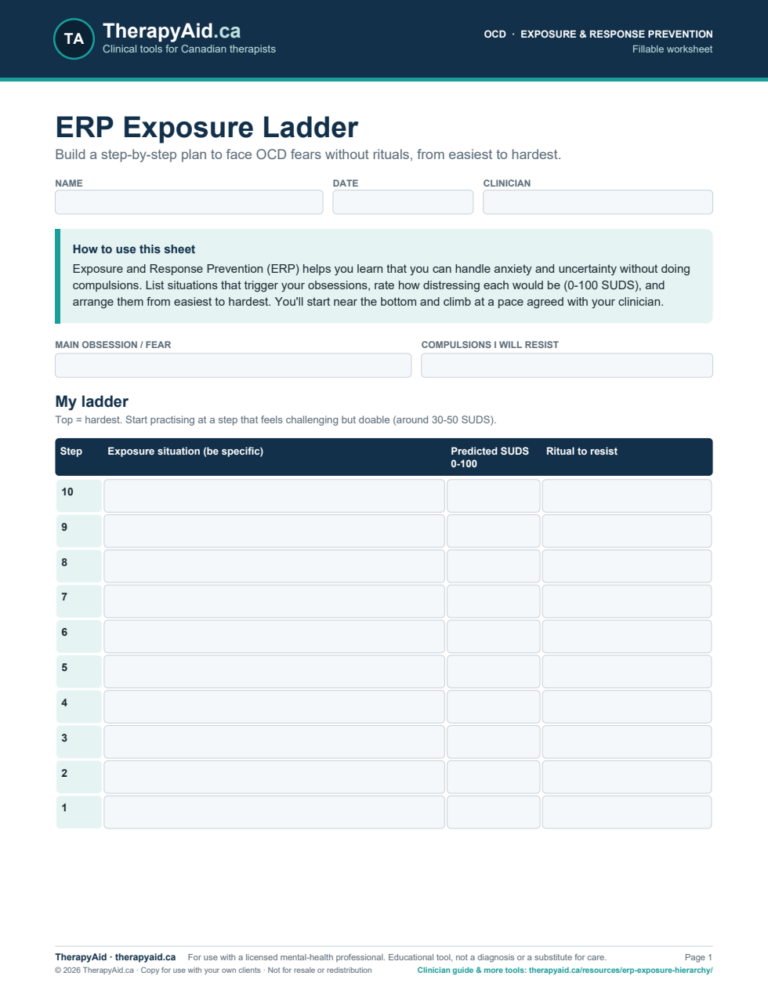
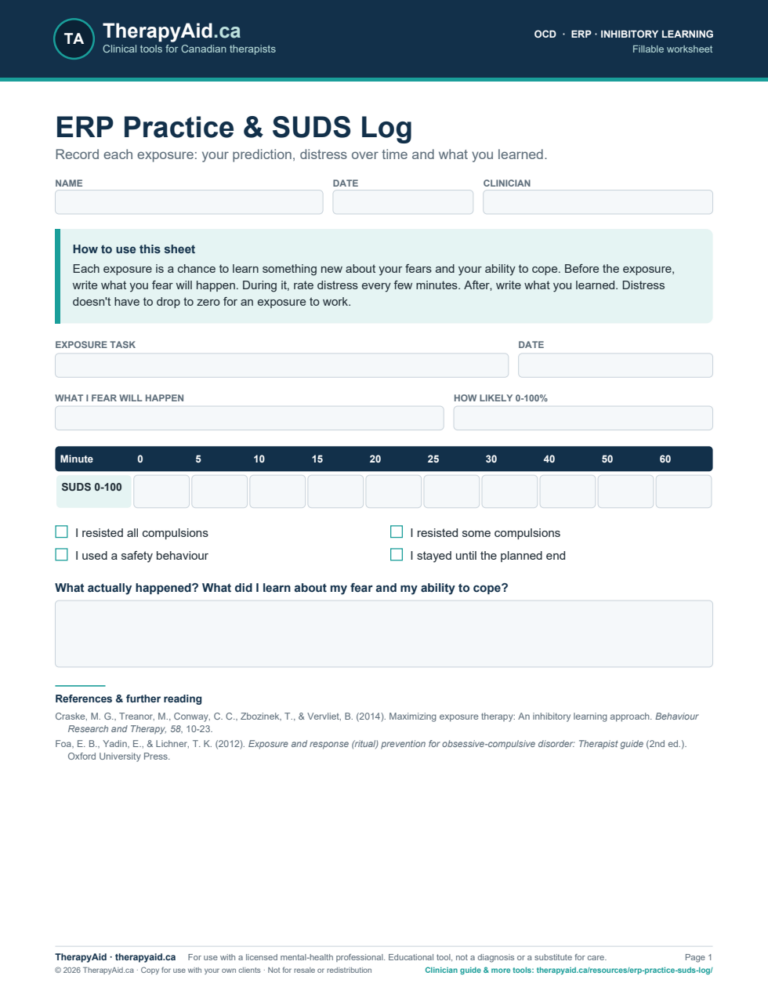
Exposure and response prevention (ERP) is a form of CBT and the first-line psychological treatment for OCD. Clients gradually confront obsessional triggers while refraining from compulsions, learning that anxiety and uncertainty are tolerable.
Why it works
ERP is the psychological treatment with the strongest evidence for OCD (Abramowitz, 2006). Manualized ERP protocols provide structured, collaborative exposure hierarchies (Foa et al., 2012).
When to use it
- Before starting ERP
- Clients ambivalent about exposure
- Family education
- OCD psychoeducation groups
How to use it in session
- Review the OCD cycle.
- Explain exposure and response prevention.
- Address myths and fears.
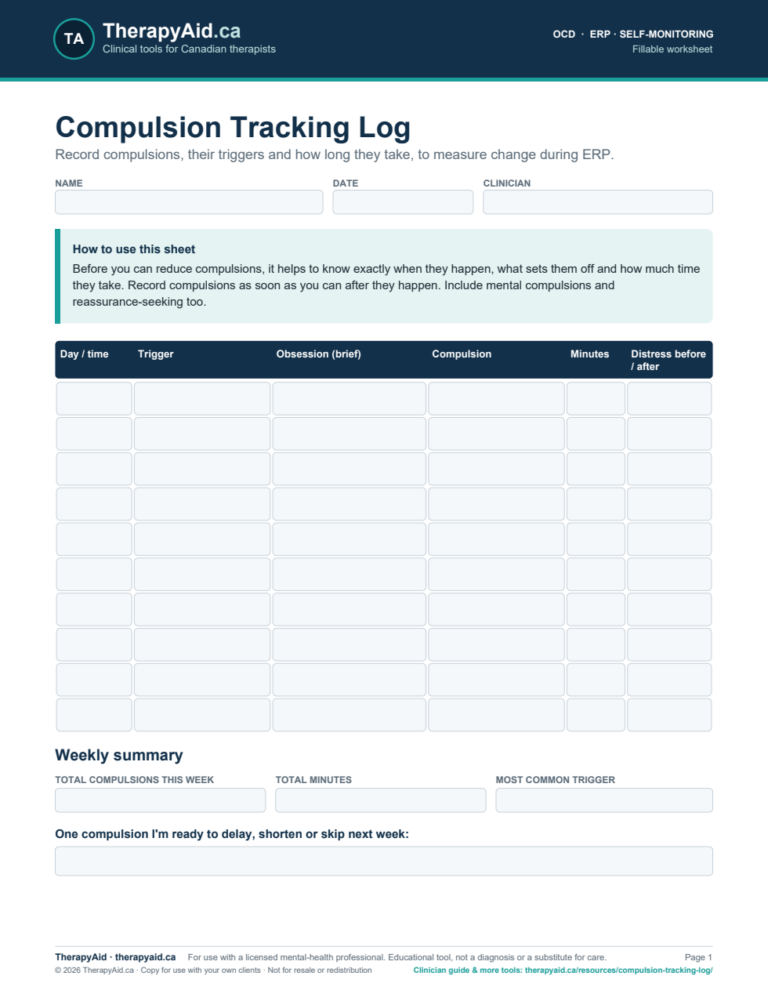
- Map the client’s cycle.
- Invite questions.
Clinician tips
- Emphasize collaboration and choice.
- Include mental compulsions and reassurance.
- Involve family in reducing accommodation.
Worked example
Sharing with clients
Members can download the PDF to print or email, or copy a private client link from the download box. Your client opens the link and downloads the worksheet on any device. No client account is needed, and nothing your client writes is stored on TherapyAid.
Frequently asked questions
Is ERP effective?
Yes. ERP is the most effective psychological treatment for OCD for many people.
Will ERP make my anxiety worse?
Anxiety may rise temporarily during exposures but typically decreases with practice.
References
Abramowitz, J. S. (2006). The psychological treatment of obsessive-compulsive disorder. Canadian Journal of Psychiatry, 51(7), 407-416.
Foa, E. B., Yadin, E., & Lichner, T. K. (2012). Exposure and response (ritual) prevention for obsessive-compulsive disorder: Therapist guide (2nd ed.). Oxford University Press.
This worksheet is an educational tool for use by, or under the guidance of, a licensed or registered mental-health professional. It is not a diagnostic instrument or a substitute for clinical judgement. If a client is in crisis in Canada, call or text 9-8-8 or call 9-1-1.