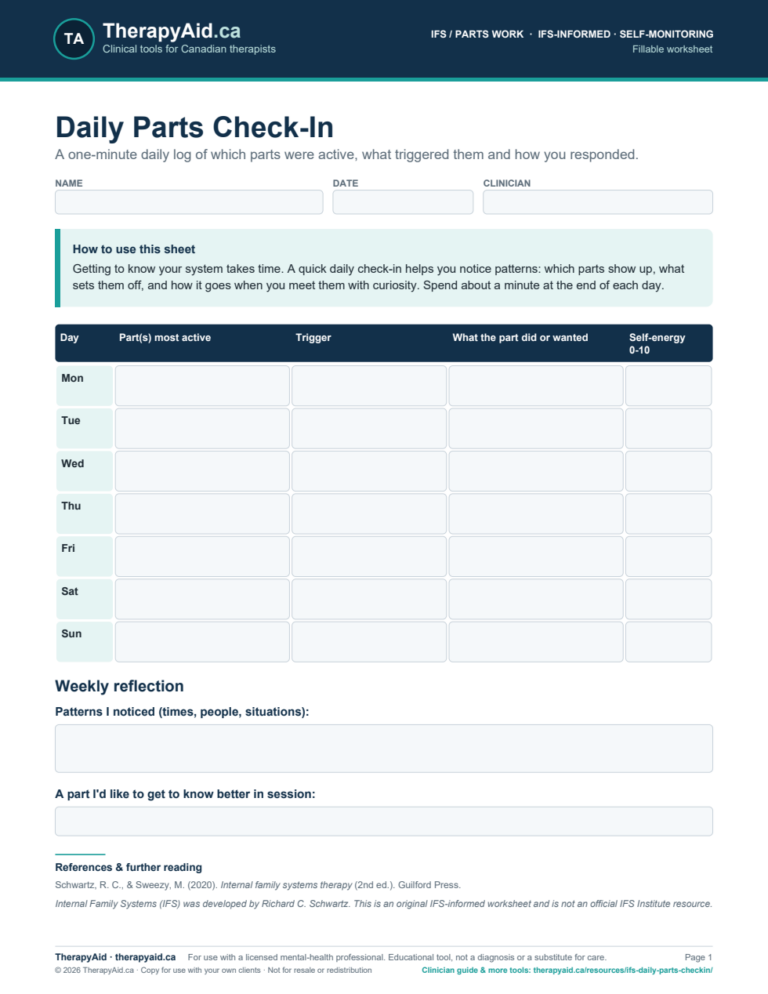
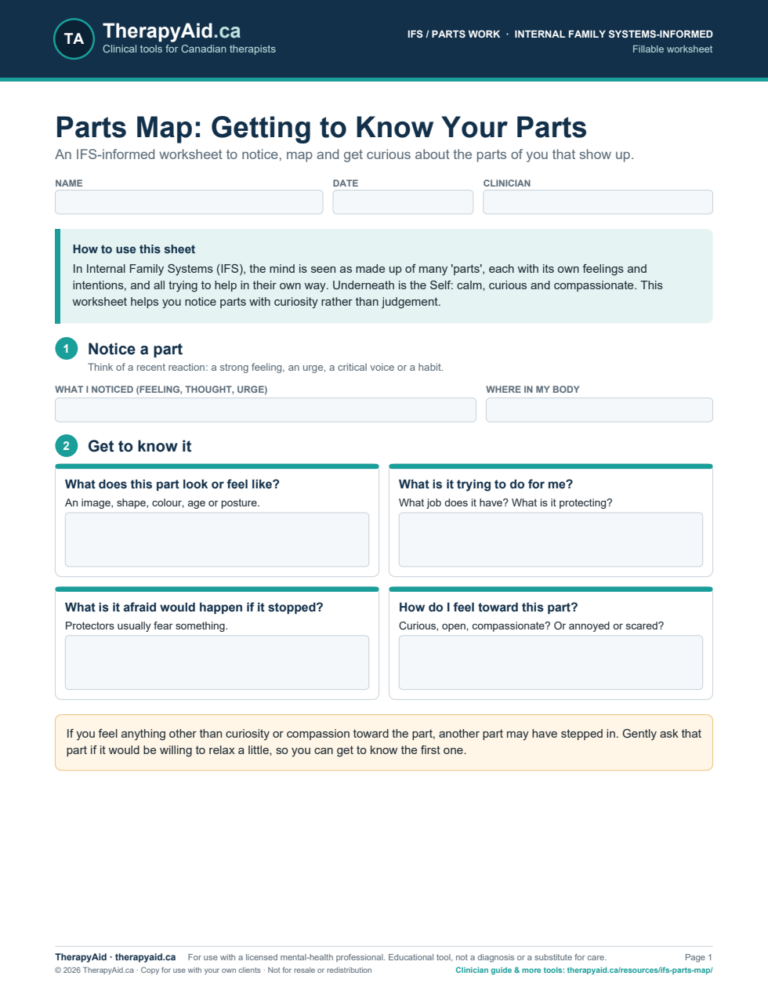
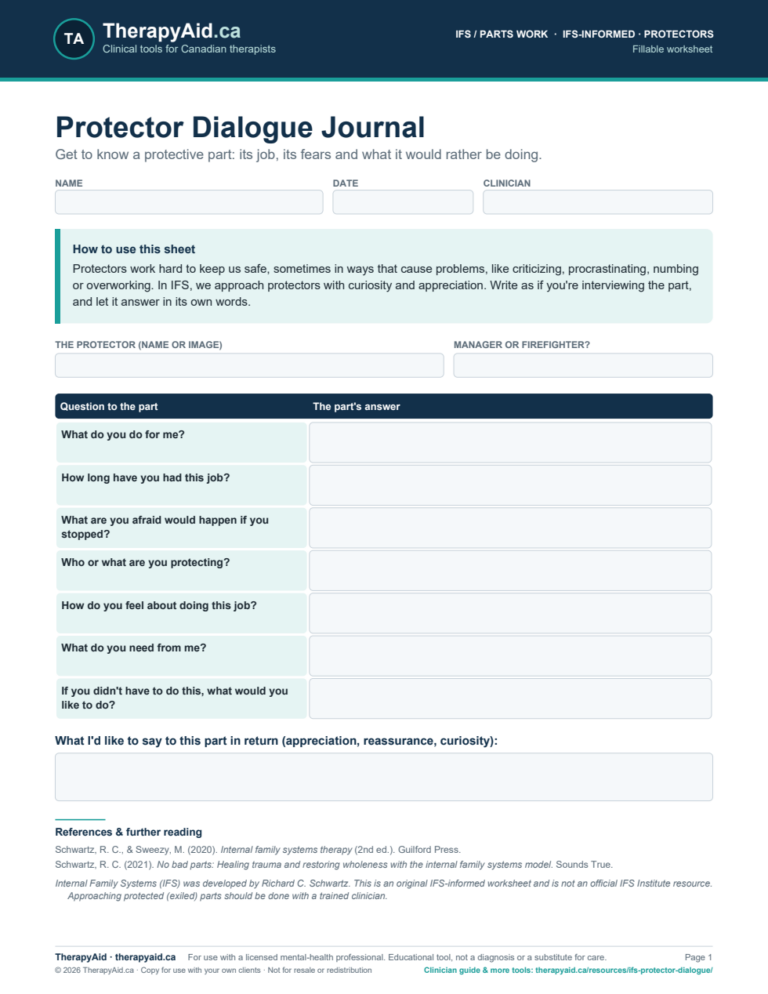
Letter of Appreciation to a Part
An IFS-informed journaling worksheet guiding clients to write a letter of appreciation from Self to a protective part, then notice the part's response.
2-page fillable PDF · US Letter (prints on A4) · IFS-informed
- Approach / concern
- IFS / Parts Work
- Technique
- IFS-informed
- Format
- Fillable PDF, 2 pages (US Letter / A4)
- Access
- Pro and Advanced plans (3-day free trial)
- For
- Licensed clinicians to use with clients
- Updated
- October 2026
Key facts
What is the Letter of Appreciation to a Part?
Appreciating protective parts for their intentions and hard work is a core IFS practice that builds trust between Self and parts, often allowing protectors to soften.
Why it works
In IFS, protectors relax when they feel understood and appreciated, and trust that Self can lead (Schwartz, 2021). Written letters extend this relationship-building between sessions.
When to use it
- IFS-informed therapy
- Inner critics and perfectionist parts
- Parts behind compulsive or numbing behaviours
- Between-session journaling
How to use it in session
- Check for Self-energy toward the part.
- Write each section of the letter.
- Notice the part’s response.
- Discuss in session.
- Repeat with other protectors over time.
Clinician tips
- If irritation arises, another part is present; get to know it first.
- Don’t make promises Self can’t keep.
- Deeper work with exiles should be done with a trained clinician.
Worked example
Sharing with clients
Members can download the PDF to print or email, or copy a private client link from the download box. Your client opens the link and downloads the worksheet on any device. No client account is needed, and nothing your client writes is stored on TherapyAid.
Frequently asked questions
What if I don’t feel appreciation toward the part?
That likely means another part is present. Get curious about that part first.
Is this an official IFS exercise?
It’s an original TherapyAid worksheet informed by IFS principles.
References
Schwartz, R. C. (2021). No bad parts: Healing trauma and restoring wholeness with the internal family systems model. Sounds True.
This worksheet is an educational tool for use by, or under the guidance of, a licensed or registered mental-health professional. It is not a diagnostic instrument or a substitute for clinical judgement. If a client is in crisis in Canada, call or text 9-8-8 or call 9-1-1.