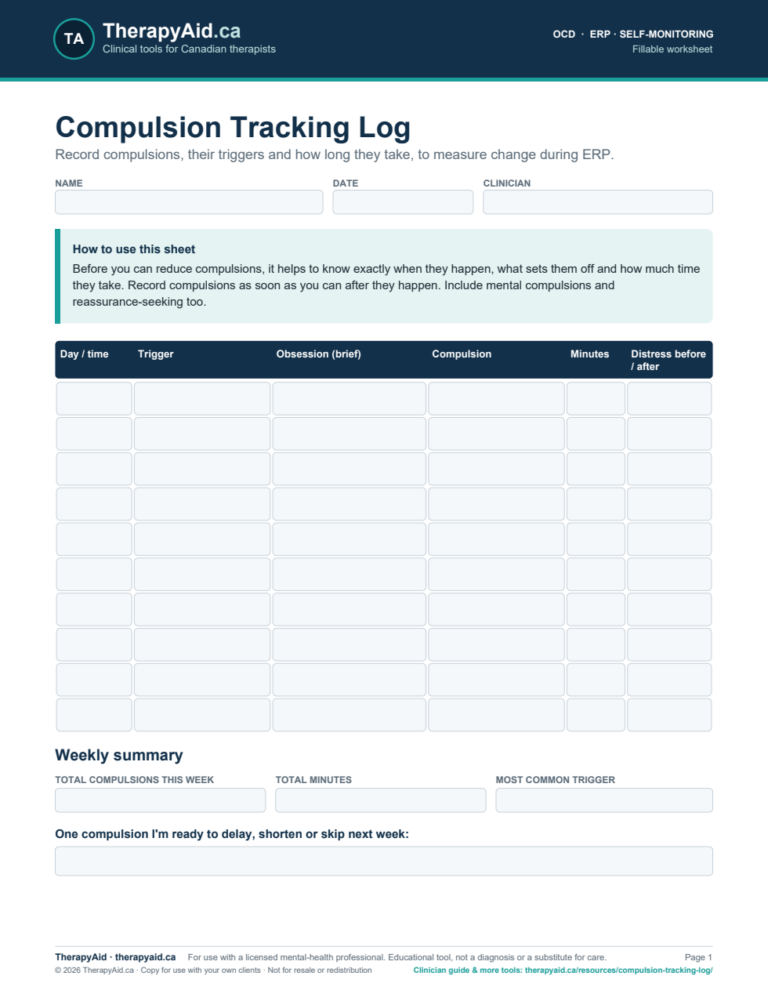
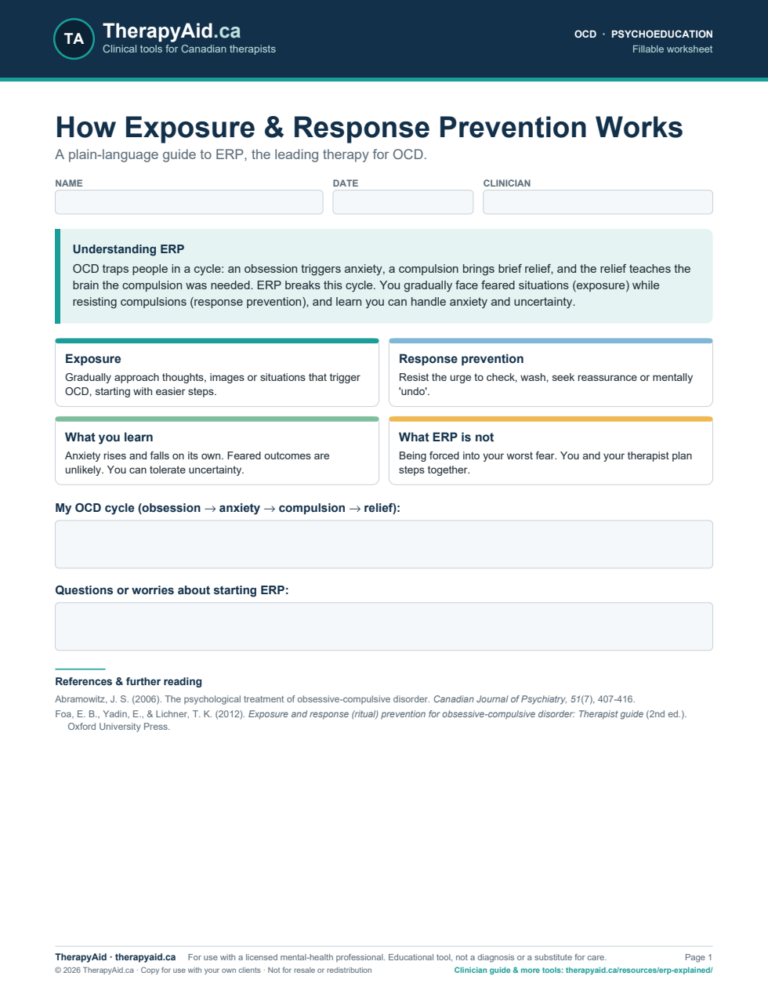
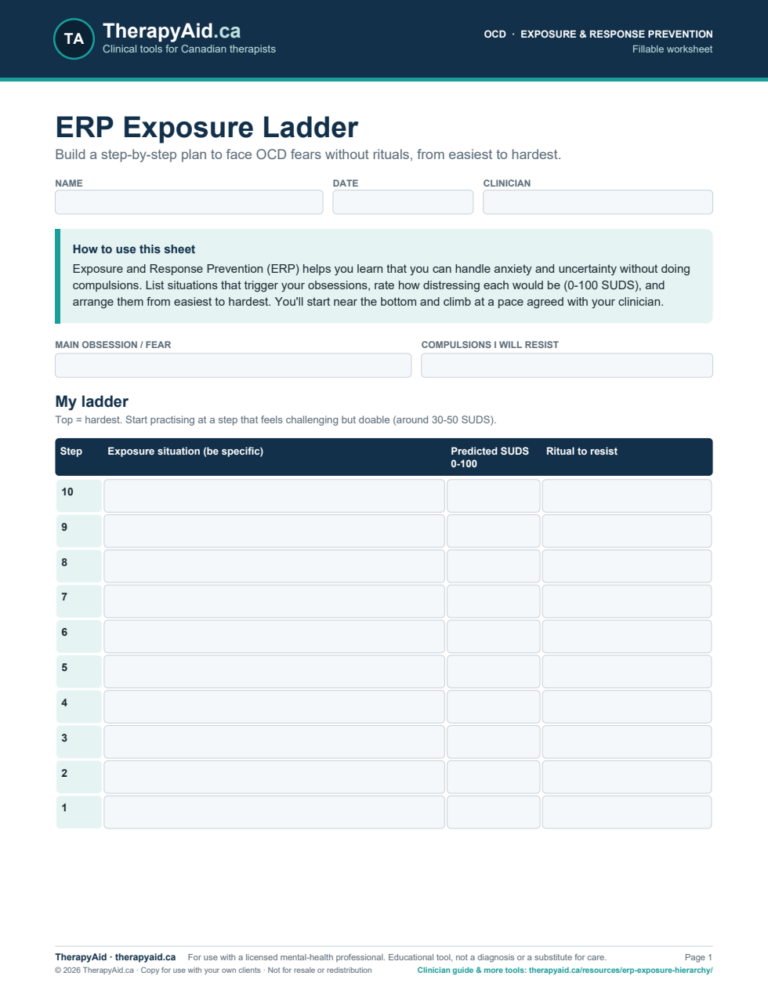
ERP Practice & SUDS Log
An ERP practice record capturing the exposure task, feared outcome and likelihood, SUDS ratings across an hour, ritual prevention and learning.
1-page fillable PDF · US Letter (prints on A4) · ERP · Inhibitory learning
- Approach / concern
- OCD
- Technique
- ERP · Inhibitory learning
- Format
- Fillable PDF, 1 page (US Letter / A4)
- Access
- Pro and Advanced plans (3-day free trial)
- For
- Licensed clinicians to use with clients
- Updated
- October 2026
Key facts
What is the ERP Practice & SUDS Log?
An exposure practice log documents each ERP session: the task, feared prediction, subjective units of distress (SUDS) over time, compulsions resisted and what was learned. Modern inhibitory learning approaches emphasize expectancy violation rather than habituation alone.
Why it works
Inhibitory learning principles, such as violating expectancies and tolerating distress, can enhance exposure outcomes (Craske et al., 2014). Systematic recording supports ERP for OCD (Foa et al., 2012).
When to use it
- ERP for OCD
- Exposure for phobias and anxiety
- Between-session homework
- Tracking progress across a hierarchy
How to use it in session
- Write the feared outcome and likelihood.
- Rate SUDS at intervals.
- Note compulsions resisted.
- Record what actually happened.
- Use learning to plan the next exposure.
Clinician tips
- Emphasize learning over distress reduction.
- Vary exposures to strengthen generalization.
- Celebrate resisting compulsions.
Worked example
Sharing with clients
Members can download the PDF to print or email, or copy a private client link from the download box. Your client opens the link and downloads the worksheet on any device. No client account is needed, and nothing your client writes is stored on TherapyAid.
Frequently asked questions
Does my distress need to go down for exposure to work?
Not necessarily. Learning that you can tolerate distress and that feared outcomes don’t happen is what matters most.
What are SUDS?
Subjective Units of Distress, a 0-100 rating of how distressed you feel.
References
Craske, M. G., Treanor, M., Conway, C. C., Zbozinek, T., & Vervliet, B. (2014). Maximizing exposure therapy: An inhibitory learning approach. Behaviour Research and Therapy, 58, 10-23.
Foa, E. B., Yadin, E., & Lichner, T. K. (2012). Exposure and response (ritual) prevention for obsessive-compulsive disorder: Therapist guide (2nd ed.). Oxford University Press.
This worksheet is an educational tool for use by, or under the guidance of, a licensed or registered mental-health professional. It is not a diagnostic instrument or a substitute for clinical judgement. If a client is in crisis in Canada, call or text 9-8-8 or call 9-1-1.