The OCD Cycle: Map Yours
A psychoeducation worksheet that helps clients map their personal OCD cycle (trigger, obsession, meaning, compulsion, relief) and identify where to break it.
1-page fillable PDF · US Letter (prints on A4) · CBT · Psychoeducation
- Approach / concern
- OCD
- Technique
- CBT · Psychoeducation
- Format
- Fillable PDF, 1 page (US Letter / A4)
- Access
- Pro and Advanced plans (3-day free trial)
- For
- Licensed clinicians to use with clients
- Updated
- October 2026
Key facts
What is the The OCD Cycle: Map Yours?
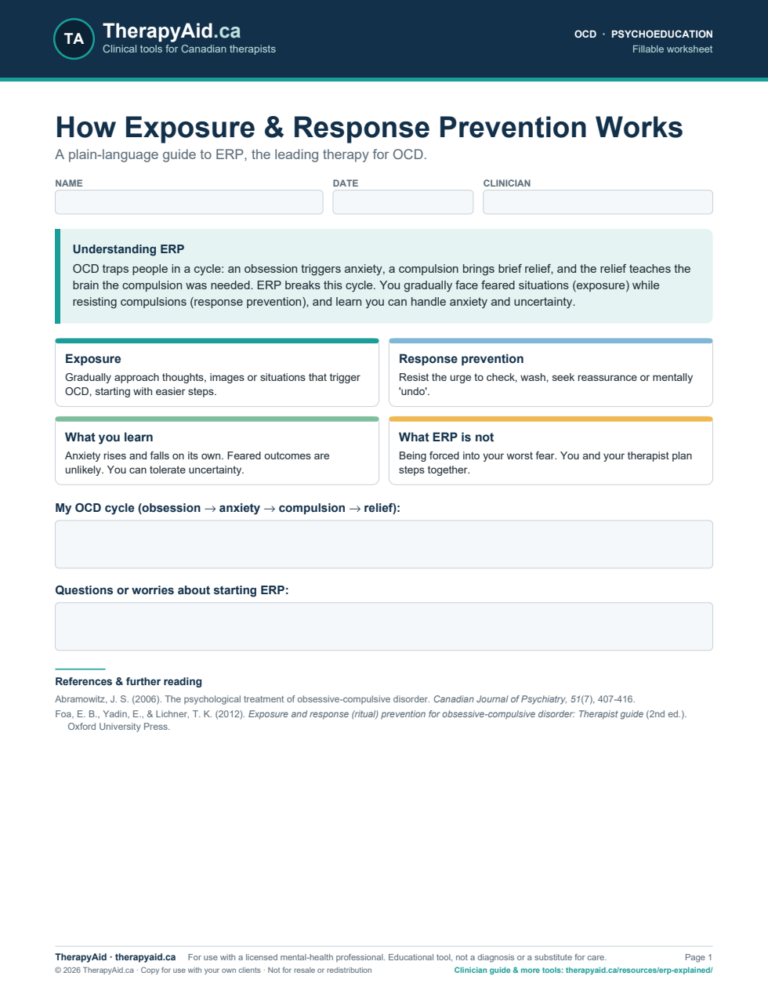
Cognitive-behavioural models describe OCD as a cycle in which normal intrusive thoughts are interpreted as significant or threatening, leading to anxiety and compulsions that bring short-term relief but maintain the problem (Salkovskis, 1985; Rachman, 1997). Mapping the cycle helps clients understand why compulsions keep OCD going.
Why it works
Understanding the maintaining cycle builds motivation for exposure and response prevention, the most effective psychological treatment for OCD (Abramowitz, 2018). Normalizing intrusive thoughts reduces shame and secrecy.
When to use it
- Early OCD treatment
- Clients ashamed of intrusive thoughts
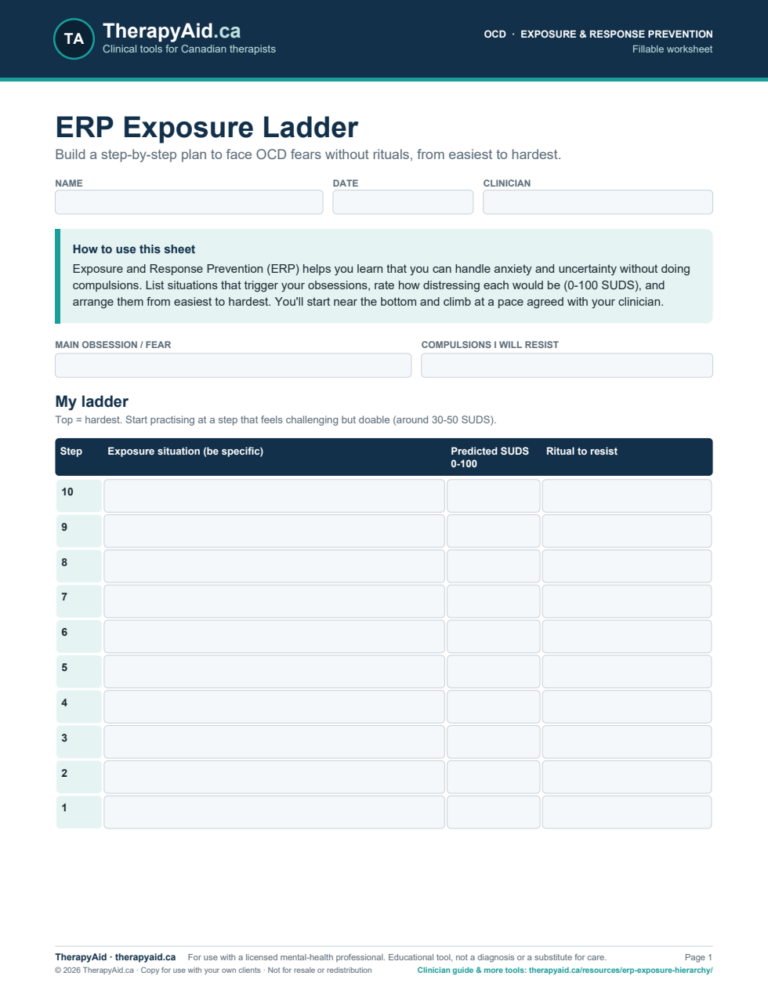
- Before building an ERP hierarchy
- Psychoeducation for families
How to use it in session
- Explain that intrusive thoughts are universal.
- Map a recent episode through each step.
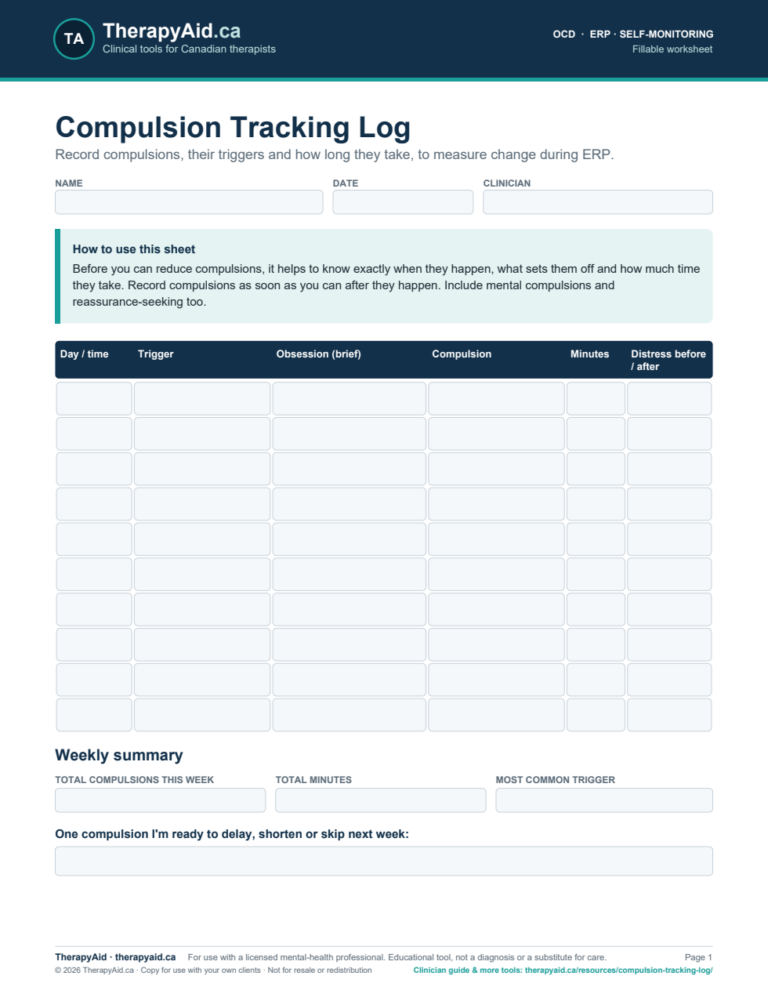
- Include mental compulsions and reassurance-seeking.
- Explore the costs of compulsions.
- Identify the first link to target with ERP.
Clinician tips
- Mental compulsions (reviewing, praying, counting) are easy to miss.
- Avoid giving reassurance about the content of obsessions.
- Involve family members who accommodate compulsions.
Worked example
Sharing with clients
Members can download the PDF to print or email, or copy a private client link from the download box. Your client opens the link and downloads the worksheet on any device. No client account is needed, and nothing your client writes is stored on TherapyAid.
Frequently asked questions
Does having intrusive thoughts mean I want to act on them?
No. Intrusive thoughts in OCD are unwanted and usually go against a person’s values, which is why they cause so much distress.
What is the treatment for OCD?
Exposure and response prevention (ERP), a form of CBT, is the first-line psychological treatment, sometimes combined with medication.
References
Salkovskis, P. M. (1985). Obsessional-compulsive problems: A cognitive-behavioural analysis. Behaviour Research and Therapy, 23(5), 571-583.
Rachman, S. (1997). A cognitive theory of obsessions. Behaviour Research and Therapy, 35(9), 793-802.
Abramowitz, J. S. (2018). Getting over OCD: A 10-step workbook for taking back your life (2nd ed.). Guilford Press.
This worksheet is an educational tool for use by, or under the guidance of, a licensed or registered mental-health professional. It is not a diagnostic instrument or a substitute for clinical judgement. If a client is in crisis in Canada, call or text 9-8-8 or call 9-1-1.