Parts Map: Getting to Know Your Parts
An Internal Family Systems-informed worksheet that guides clients to notice a part, explore its role and fears, check how they feel toward it, and build a simple map of their inner system.
2-page fillable PDF · US Letter (prints on A4) · Internal Family Systems-informed
- Approach / concern
- IFS / Parts Work
- Technique
- Internal Family Systems-informed
- Format
- Fillable PDF, 2 pages (US Letter / A4)
- Access
- Pro and Advanced plans (3-day free trial)
- For
- Licensed clinicians to use with clients
- Updated
- October 2026
Key facts
What is the Parts Map: Getting to Know Your Parts?
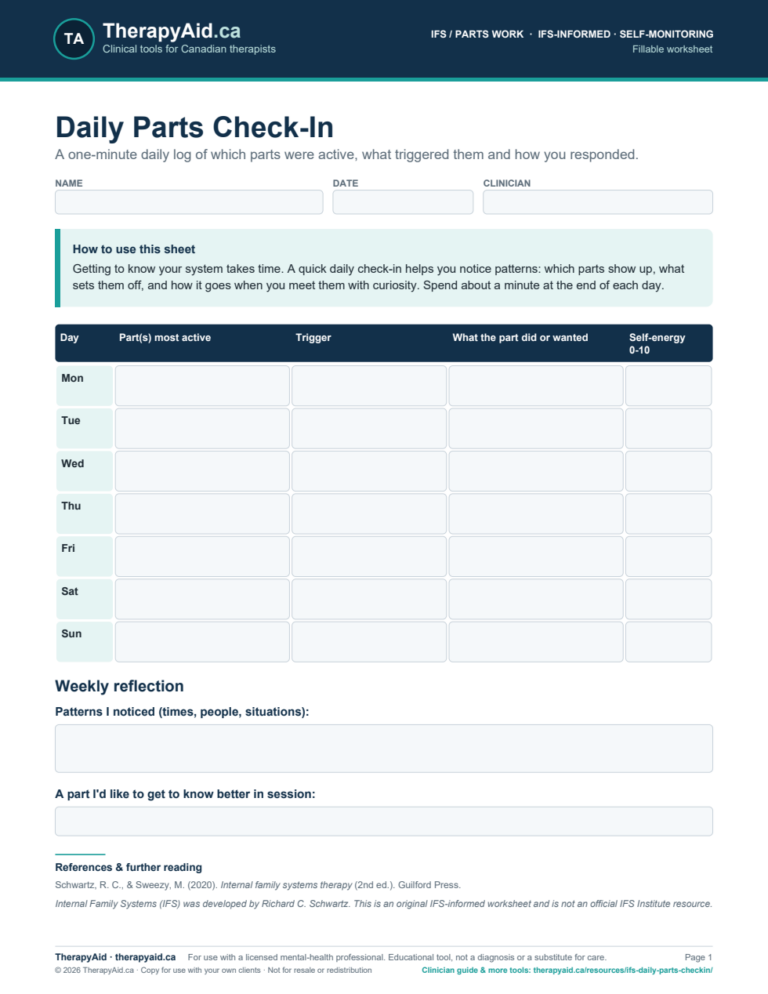
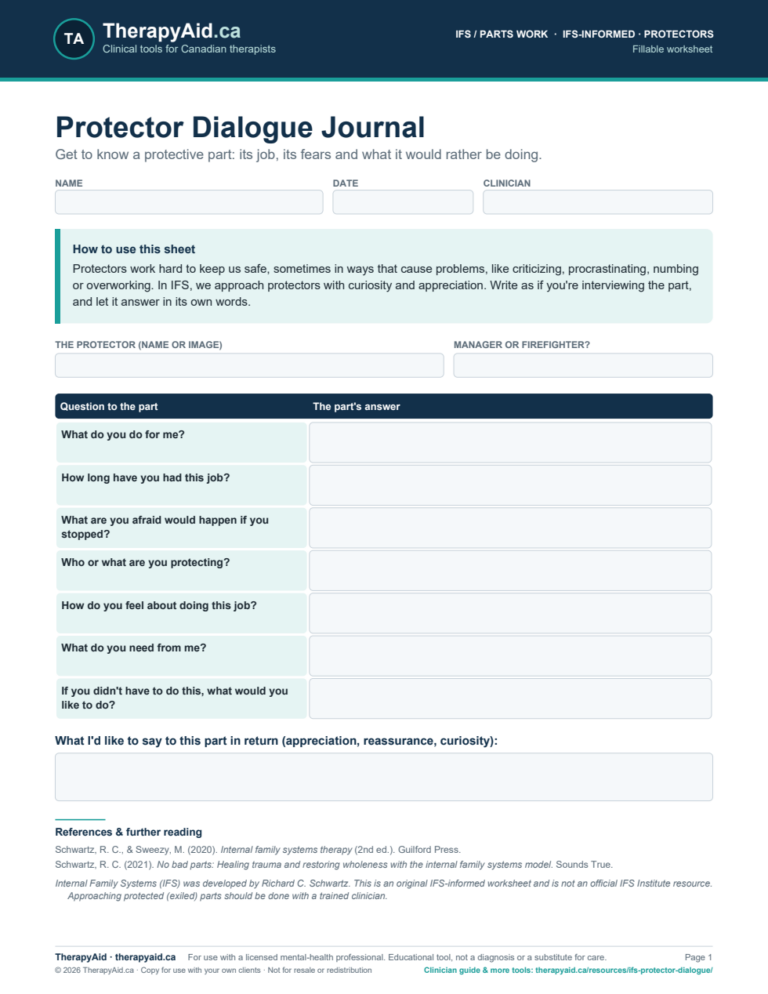
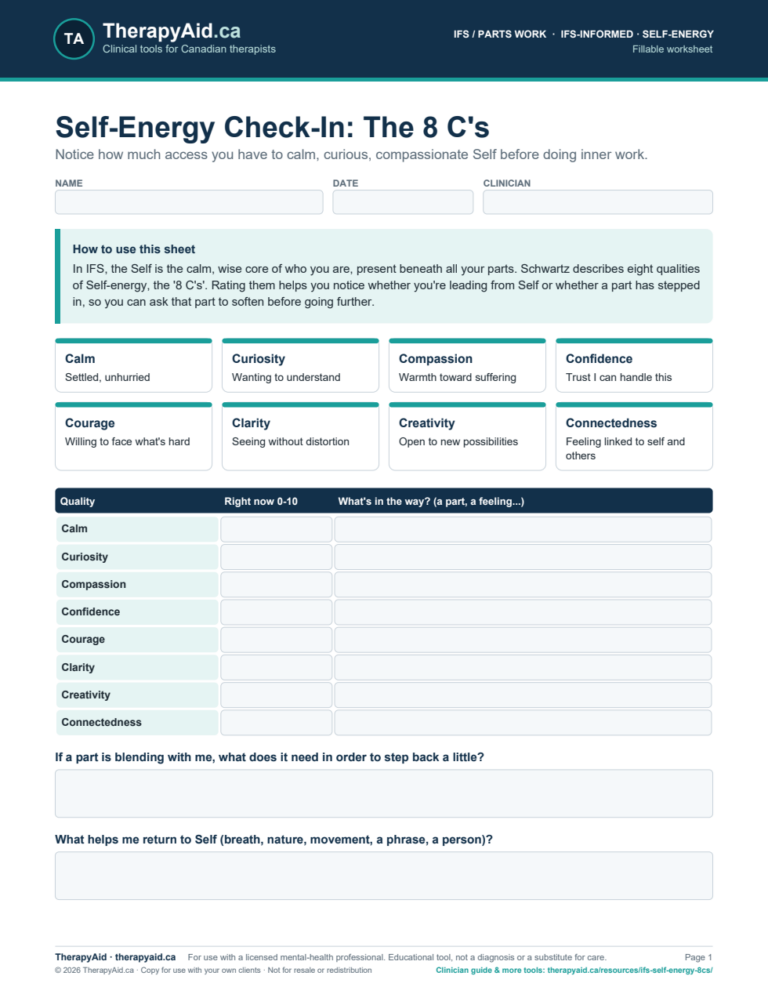
Internal Family Systems, developed by Richard Schwartz, views the psyche as a system of parts. Managers try to keep us safe proactively, firefighters react to distress, and exiles carry painful emotions and memories. At the core is the Self, characterized by qualities such as calm, curiosity, compassion and confidence. Parts work involves approaching parts from Self with curiosity rather than trying to get rid of them.
Why it works
IFS offers a non-pathologizing language that many clients find intuitive and compassionate. Mapping parts helps clients externalize internal conflict (“part of me wants to… and part of me is scared”), reduces shame, and prepares for deeper work with a trained clinician (Schwartz & Sweezy, 2020).
When to use it
- Inner conflict and ambivalence
- Harsh inner critics and perfectionism
- Self-sabotaging habits such as bingeing or procrastination
- Trauma work, during the protector-befriending phase
How to use it in session
- Introduce the parts language with an everyday example.
- Choose a recent reaction and locate it in the body.
- Explore the part’s role and fears using the cards.
- Check for Self-energy with the ‘How do I feel toward it?’ question.
- Add parts to the map over several sessions.
Clinician tips
- Stay with protectors. Don’t push toward exiles without consent and training.
- Encourage clients to thank parts for their intentions.
- Use the client’s own names and images for parts.
Worked example
Sharing with clients
Members can download the PDF to print or email, or copy a private client link from the download box. Your client opens the link and downloads the worksheet on any device. No client account is needed, and nothing your client writes is stored on TherapyAid.
Frequently asked questions
Do I need IFS training to use this sheet?
The sheet is suitable for general parts-awareness work. Deeper IFS processes, especially work with exiles, should be done by clinicians with appropriate training.
Is having parts the same as dissociative identity disorder?
No. IFS considers parts a normal feature of every mind. Clients with dissociative disorders need specialized, carefully paced treatment.
References
Schwartz, R. C., & Sweezy, M. (2020). Internal family systems therapy (2nd ed.). Guilford Press.
Schwartz, R. C. (2021). No bad parts: Healing trauma and restoring wholeness with the internal family systems model. Sounds True.
This worksheet is an educational tool for use by, or under the guidance of, a licensed or registered mental-health professional. It is not a diagnostic instrument or a substitute for clinical judgement. If a client is in crisis in Canada, call or text 9-8-8 or call 9-1-1.