Why Can’t I Sleep When I’m Stressed?
A client handout explaining stress-related insomnia and hyperarousal, factors that keep people wired, wind-down strategies and a personal plan.
1-page fillable PDF · US Letter (prints on A4) · Psychoeducation
- Approach / concern
- Sleep / CBT-I
- Technique
- Psychoeducation
- Format
- Fillable PDF, 1 page (US Letter / A4)
- Access
- Pro and Advanced plans (3-day free trial)
- For
- Licensed clinicians to use with clients
- Updated
- October 2026
Key facts
What is the Why Can’t I Sleep When I’m Stressed??
Stress-related insomnia involves cognitive and physiological hyperarousal: worry, rumination and elevated arousal that are incompatible with sleep. Efforts to force sleep often increase arousal.
Why it works
Harvey’s (2002) cognitive model describes how worry, monitoring and safety behaviours maintain insomnia. The hyperarousal model is supported by physiological and cognitive evidence (Riemann et al., 2010).
When to use it
- Stress-related sleep problems
- Racing mind at night
- Introducing CBT-I
- Students and shift workers
How to use it in session
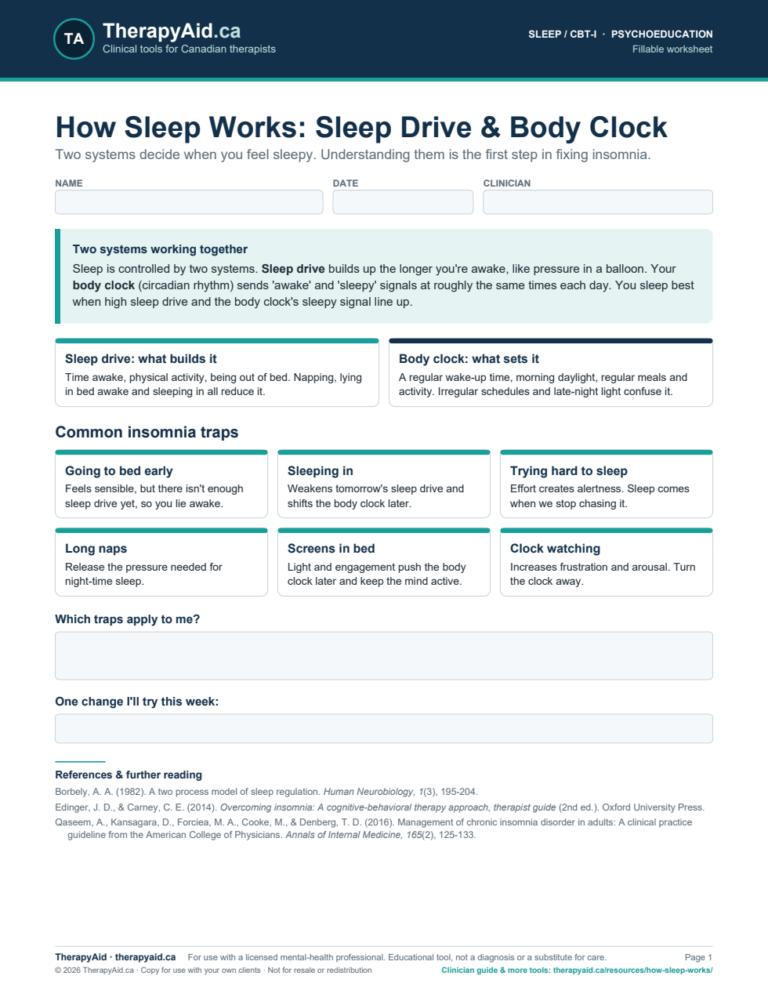
- Explain the stress-sleep link.
- Identify wiring factors.
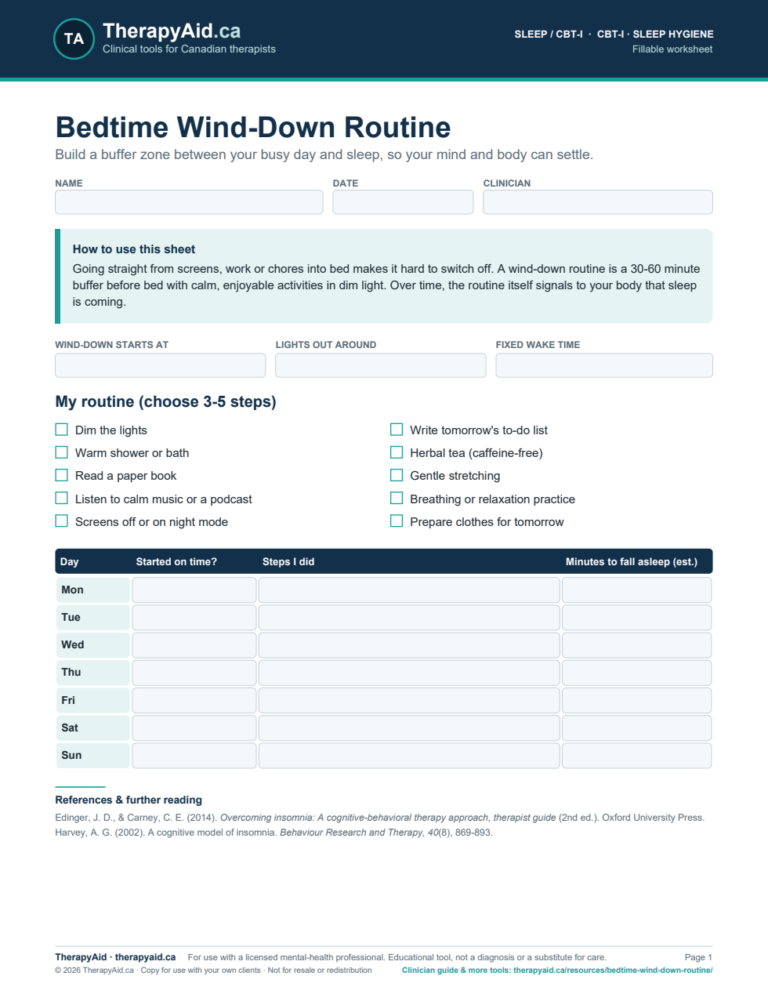
- Plan a wind-down routine.
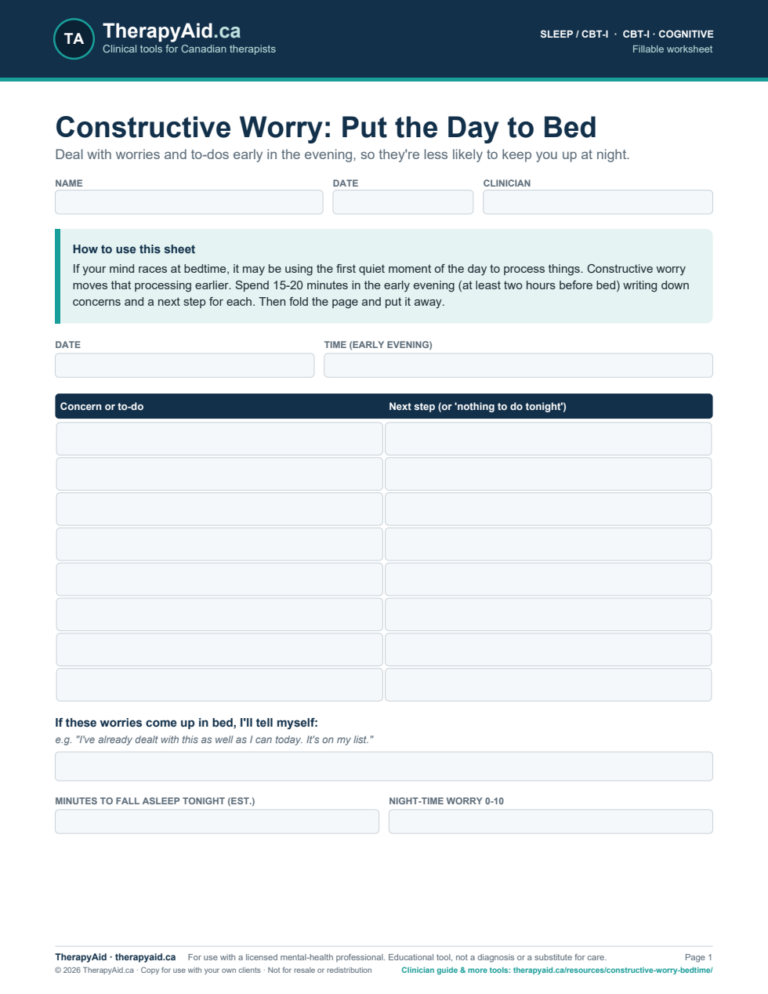
- Move worry earlier in the day.
- Review with a sleep diary.
Clinician tips
- Avoid sleep effort messages.
- Pair with constructive worry.
- Refer for CBT-I when chronic.
Worked example
Sharing with clients
Members can download the PDF to print or email, or copy a private client link from the download box. Your client opens the link and downloads the worksheet on any device. No client account is needed, and nothing your client writes is stored on TherapyAid.
Frequently asked questions
Why am I tired but wired?
Your body may be exhausted while your stress system stays alert.
Should I stay in bed if I can’t sleep?
If you’re awake and frustrated for about 20 minutes, get up and do something calm until sleepy.
References
Harvey, A. G. (2002). A cognitive model of insomnia. Behaviour Research and Therapy, 40(8), 869-893.
Riemann, D., Spiegelhalder, K., Feige, B., Voderholzer, U., Berger, M., Perlis, M., & Nissen, C. (2010). The hyperarousal model of insomnia: A review of the concept and its evidence. Sleep Medicine Reviews, 14(1), 19-31.
This worksheet is an educational tool for use by, or under the guidance of, a licensed or registered mental-health professional. It is not a diagnostic instrument or a substitute for clinical judgement. If a client is in crisis in Canada, call or text 9-8-8 or call 9-1-1.