Bedtime Wind-Down Routine
A sleep worksheet for designing a 30-60 minute pre-bed wind-down routine with chosen calming steps and a 7-day log of adherence and sleep onset.
1-page fillable PDF · US Letter (prints on A4) · CBT-I · Sleep hygiene
- Approach / concern
- Sleep / CBT-I
- Technique
- CBT-I · Sleep hygiene
- Format
- Fillable PDF, 1 page (US Letter / A4)
- Access
- Pro and Advanced plans (3-day free trial)
- For
- Licensed clinicians to use with clients
- Updated
- October 2026
Key facts
What is the Bedtime Wind-Down Routine?
A wind-down routine is a period of relaxing, low-stimulation activities before bed that helps reduce cognitive and physiological arousal. It is commonly included in CBT for insomnia alongside stimulus control and sleep scheduling.
Why it works
Pre-sleep cognitive arousal and worry are key maintaining factors in insomnia (Harvey, 2002). A buffer zone before bed supports the transition to sleep and complements core CBT-I strategies (Edinger & Carney, 2014).
When to use it
- Insomnia and difficulty switching off
- Busy professionals and students
- Clients who work or use screens until bedtime
- Alongside CBT-I
How to use it in session
- Set a fixed wake time and target lights-out.
- Choose three to five calming steps.
- Start the routine at the same time nightly.
- Track adherence and sleep onset.
- Adjust steps that don’t help.
Clinician tips
- Wind-down is not a guarantee of sleep; avoid ‘trying’ to sleep.
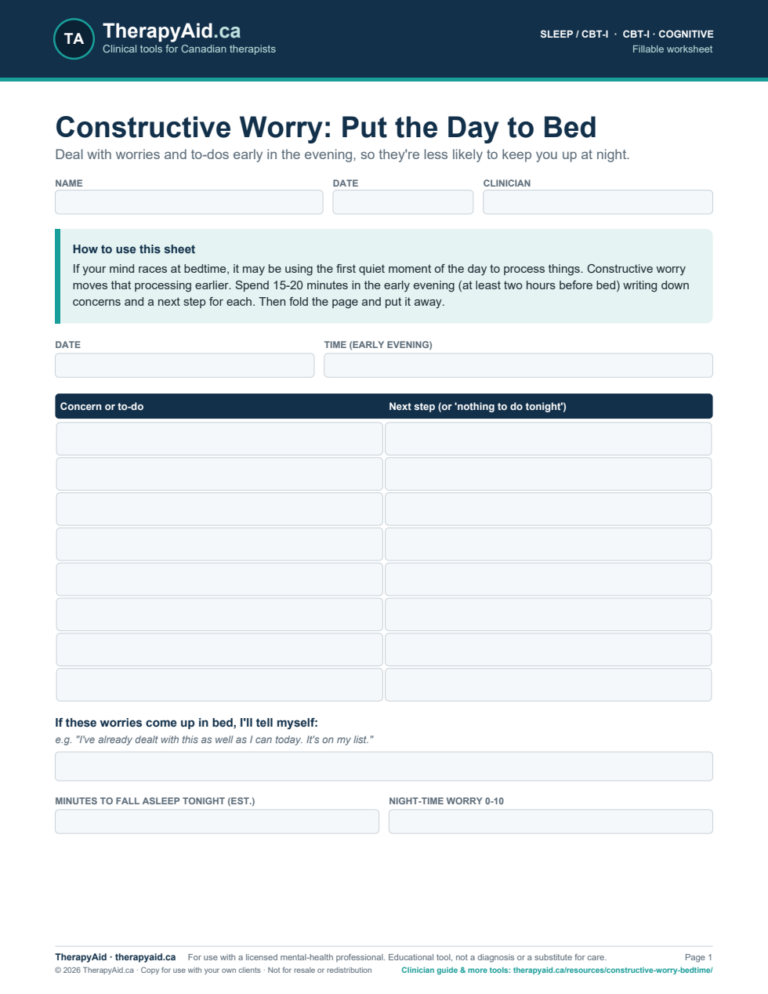
- Write worries or to-dos down early in the routine.
- Keep the bedroom for sleep only.
Worked example
Sharing with clients
Members can download the PDF to print or email, or copy a private client link from the download box. Your client opens the link and downloads the worksheet on any device. No client account is needed, and nothing your client writes is stored on TherapyAid.
Frequently asked questions
How long should a wind-down routine be?
About 30-60 minutes works for most people.
Is it okay to watch TV during wind-down?
Light, familiar viewing may be fine for some people, but stimulating content and phones in bed tend to delay sleep.
References
Edinger, J. D., & Carney, C. E. (2014). Overcoming insomnia: A cognitive-behavioral therapy approach, therapist guide (2nd ed.). Oxford University Press.
Harvey, A. G. (2002). A cognitive model of insomnia. Behaviour Research and Therapy, 40(8), 869-893.
This worksheet is an educational tool for use by, or under the guidance of, a licensed or registered mental-health professional. It is not a diagnostic instrument or a substitute for clinical judgement. If a client is in crisis in Canada, call or text 9-8-8 or call 9-1-1.