Matching Activities to What Matters
A behavioural activation worksheet linking values to activities, rating difficulty and scheduling them, with reflections on mood afterwards.
1-page fillable PDF · US Letter (prints on A4) · Behavioural activation
- Approach / concern
- Depression
- Technique
- Behavioural activation
- Format
- Fillable PDF, 1 page (US Letter / A4)
- Access
- Pro and Advanced plans (3-day free trial)
- For
- Licensed clinicians to use with clients
- Updated
- October 2026
Key facts
What is the Matching Activities to What Matters?
Values-based activity scheduling in behavioural activation helps clients choose meaningful activities, enhancing motivation and reinforcement.
Why it works
Behavioural activation includes identifying valued activities (Martell et al., 2010). ACT similarly emphasizes values-guided action (Hayes et al., 2012).
When to use it
- Depression
- Low motivation
- Behavioural activation
- Values work
How to use it in session
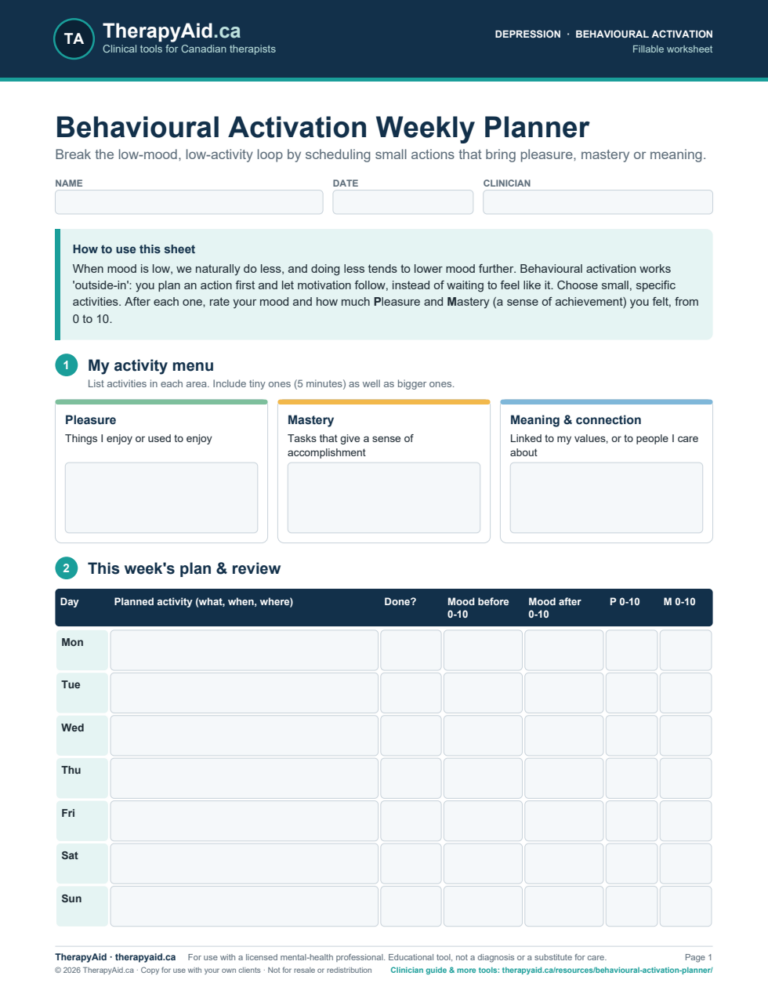
- Identify values.
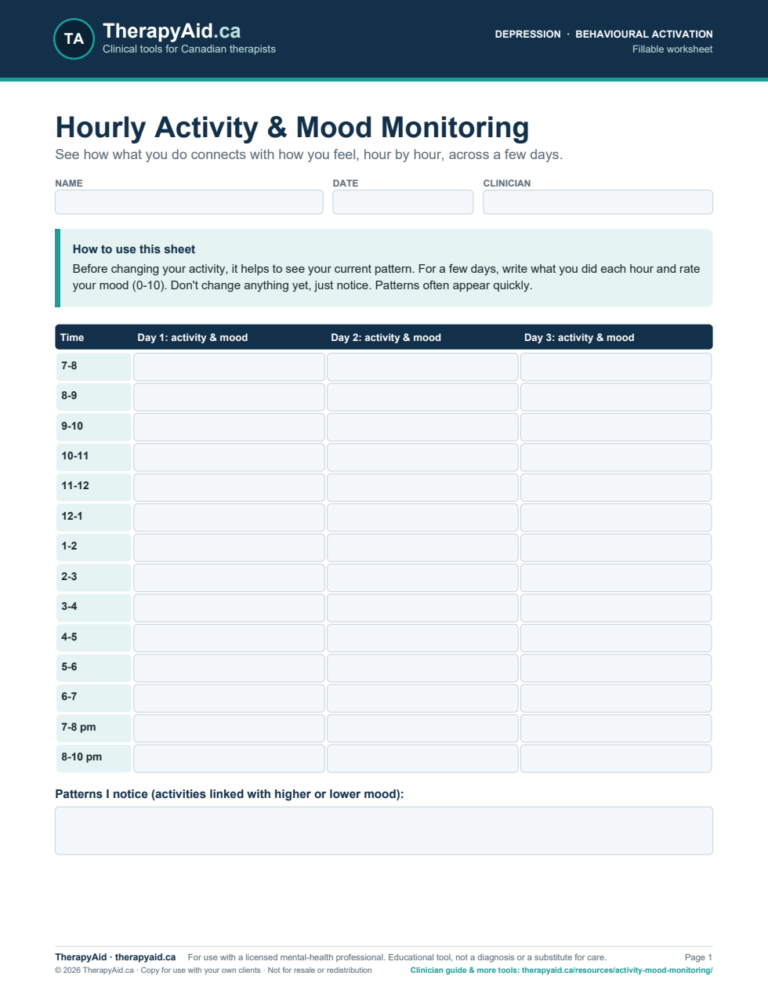
- Brainstorm activities.
- Rate difficulty.
- Schedule easy ones first.
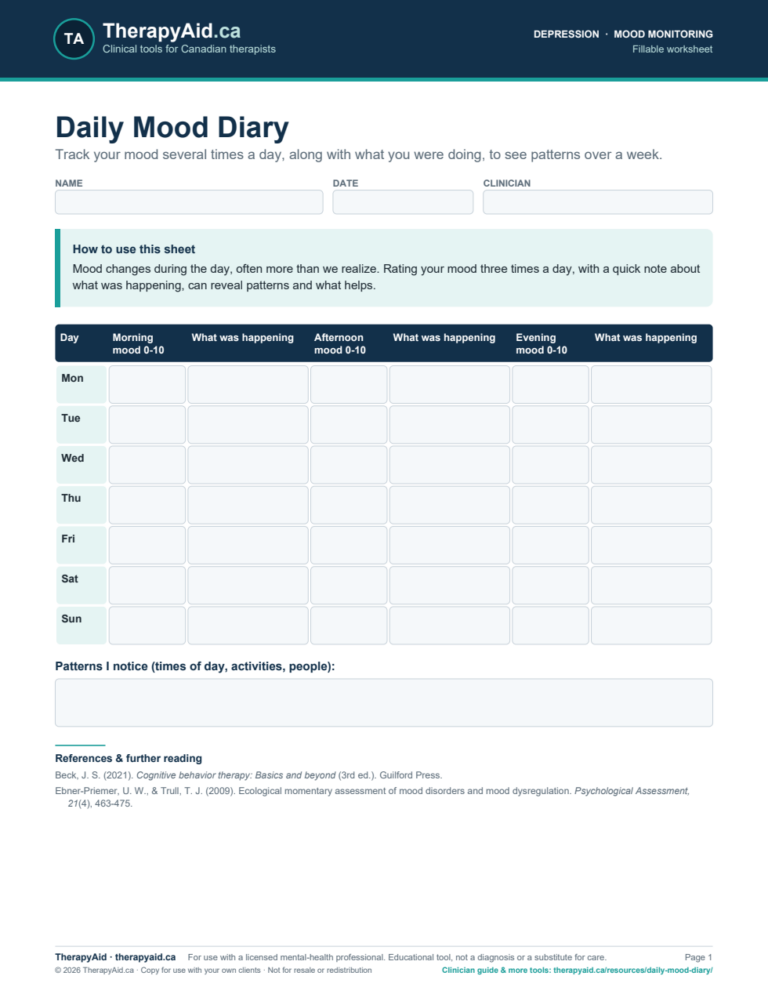
- Reflect on mood.
Clinician tips
- Start with easy activities.
- Act before motivation arrives.
- Note meaning, not just pleasure.
Worked example
Sharing with clients
Members can download the PDF to print or email, or copy a private client link from the download box. Your client opens the link and downloads the worksheet on any device. No client account is needed, and nothing your client writes is stored on TherapyAid.
Frequently asked questions
What if I don’t feel like doing anything?
That’s common in depression; acting first often helps motivation follow.
Why link activities to values?
Values-based activities bring meaning even when pleasure is low.
References
Martell, C. R., Dimidjian, S., & Herman-Dunn, R. (2010). Behavioral activation for depression: A clinician’s guide. Guilford Press.
Hayes, S. C., Strosahl, K. D., & Wilson, K. G. (2012). Acceptance and commitment therapy: The process and practice of mindful change (2nd ed.). Guilford Press.
This worksheet is an educational tool for use by, or under the guidance of, a licensed or registered mental-health professional. It is not a diagnostic instrument or a substitute for clinical judgement. If a client is in crisis in Canada, call or text 9-8-8 or call 9-1-1.