Hourly Activity & Mood Monitoring
A behavioural activation monitoring sheet for logging activities and mood hour by hour across three days, with a reflection on patterns.
2-page fillable PDF · US Letter (prints on A4) · Behavioural activation
- Approach / concern
- Depression
- Technique
- Behavioural activation
- Format
- Fillable PDF, 2 pages (US Letter / A4)
- Access
- Pro and Advanced plans (3-day free trial)
- For
- Licensed clinicians to use with clients
- Updated
- October 2026
Key facts
What is the Hourly Activity & Mood Monitoring?
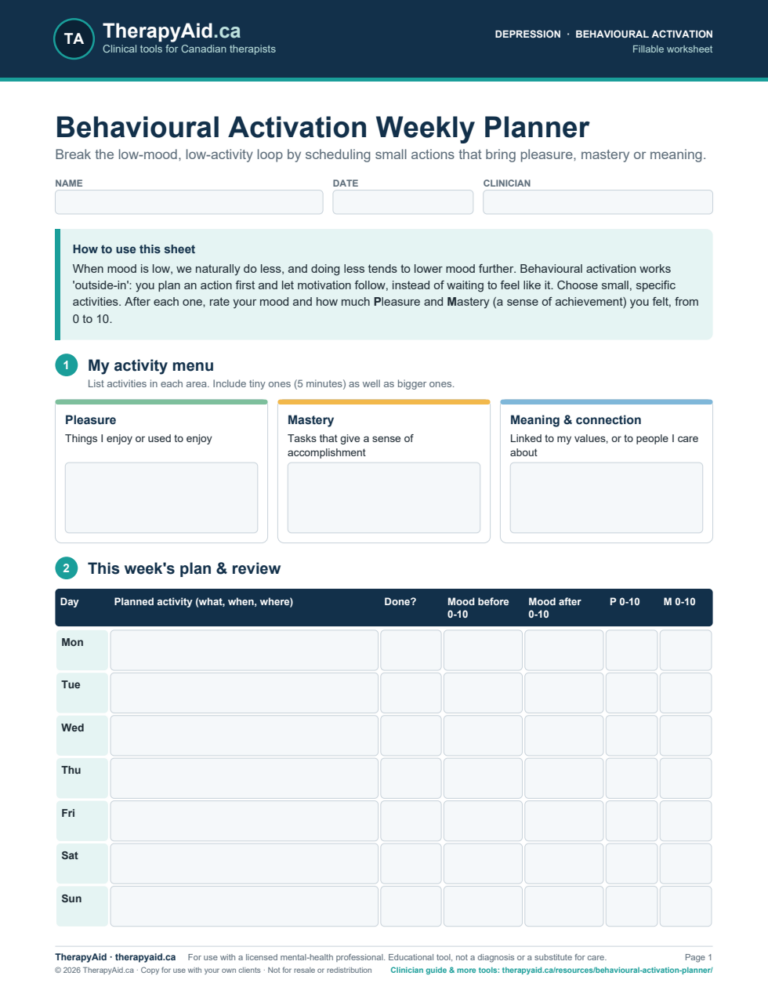
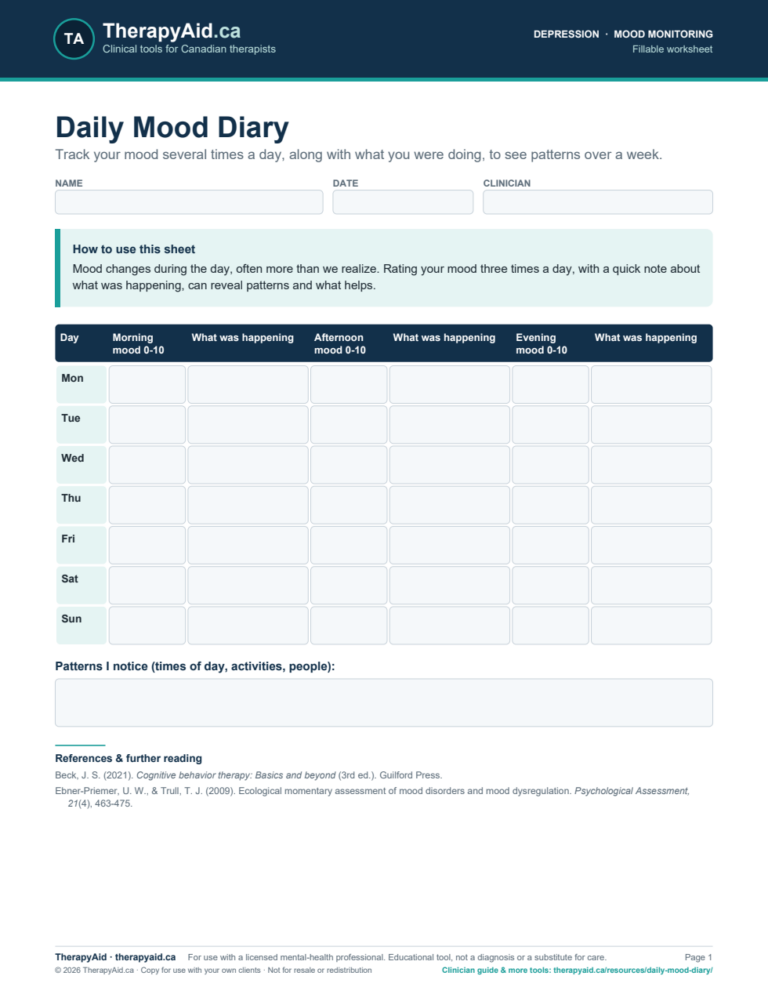
Activity monitoring is the first step of behavioural activation. Clients record what they do each hour and rate their mood, revealing links between activity, avoidance and mood before planning changes.
Why it works
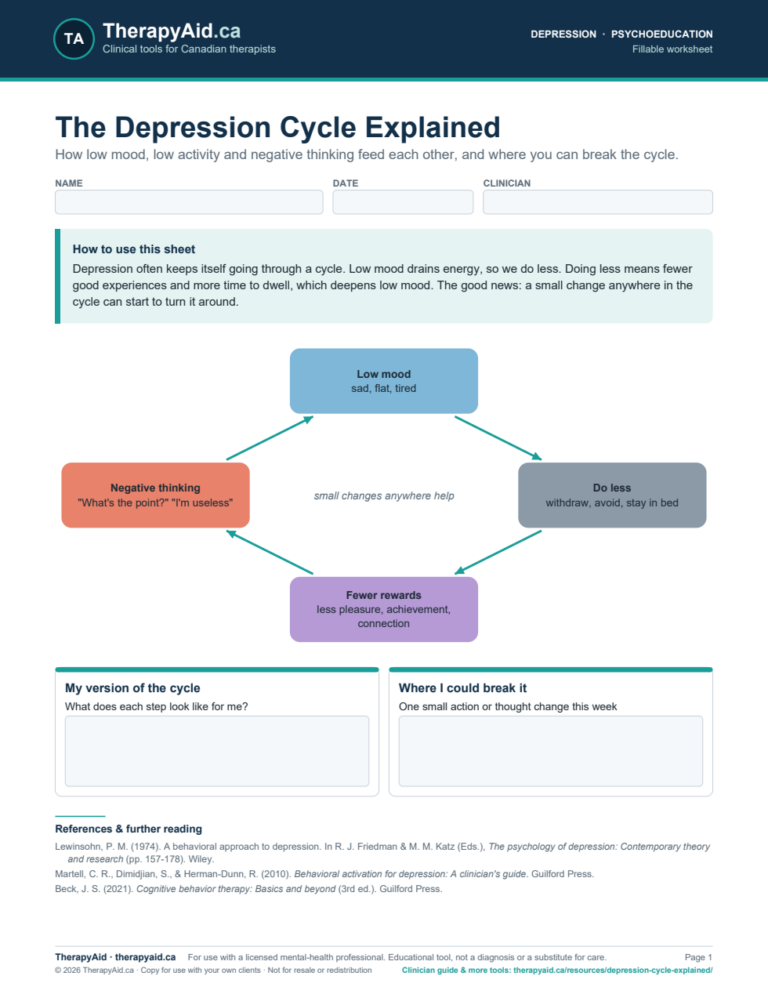
Activity monitoring helps identify patterns of avoidance and sources of reward, guiding activity scheduling in behavioural activation (Martell et al., 2010; Beck, 2021).
When to use it
- Start of behavioural activation
- Depression and low motivation
- Clients unsure what affects their mood
- Burnout and fatigue
How to use it in session
- Explain that monitoring comes before changing.
- Ask the client to log for two or three days.
- Rate mood each hour.
- Review patterns together.
- Use findings to schedule helpful activities.
Clinician tips
- Approximate entries are fine.
- Include time in bed and screen time honestly.
- Look for mastery, pleasure and avoidance patterns.
Worked example
Sharing with clients
Members can download the PDF to print or email, or copy a private client link from the download box. Your client opens the link and downloads the worksheet on any device. No client account is needed, and nothing your client writes is stored on TherapyAid.
Frequently asked questions
How many days should I monitor?
Two to seven days. Even two or three can reveal useful patterns.
What if I forget to fill it in?
Fill in what you remember at the end of the day. Rough estimates are still useful.
References
Martell, C. R., Dimidjian, S., & Herman-Dunn, R. (2010). Behavioral activation for depression: A clinician’s guide. Guilford Press.
Beck, J. S. (2021). Cognitive behavior therapy: Basics and beyond (3rd ed.). Guilford Press.
This worksheet is an educational tool for use by, or under the guidance of, a licensed or registered mental-health professional. It is not a diagnostic instrument or a substitute for clinical judgement. If a client is in crisis in Canada, call or text 9-8-8 or call 9-1-1.