Stepping Back Together: Talking About the Pattern
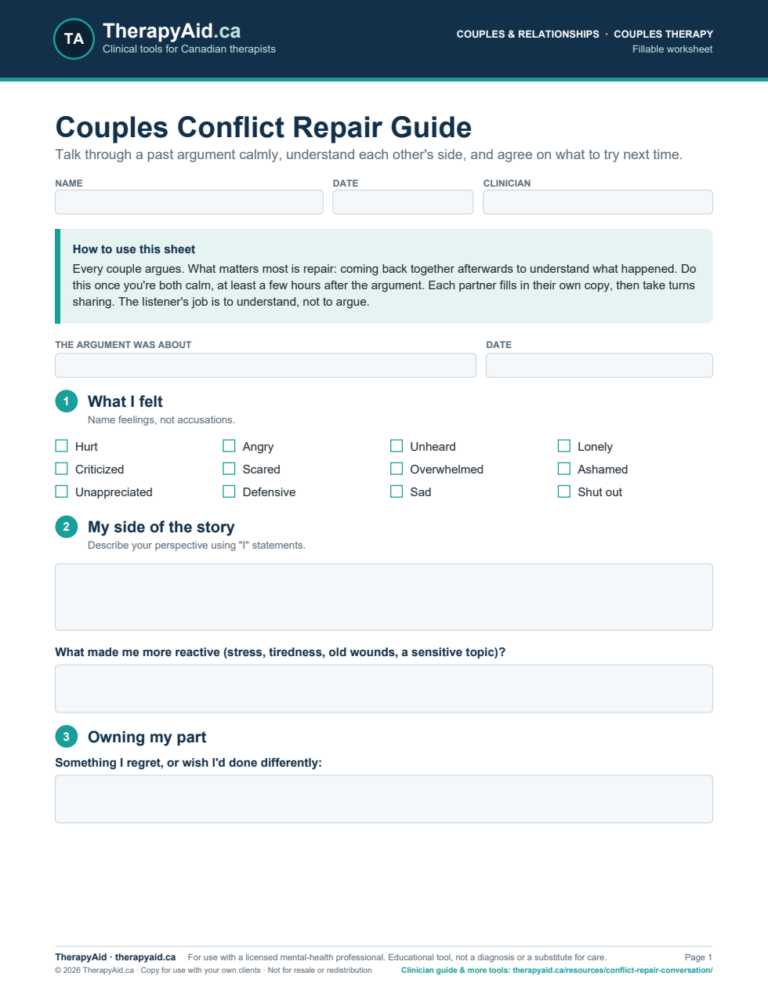
An integrative behavioural couple therapy worksheet describing a conflict pattern from a detached, shared perspective, including each partner's understandable reactions and changes.
1-page fillable PDF · US Letter (prints on A4) · Integrative behavioural couple therapy
- Approach / concern
- Couples & Relationships
- Technique
- Integrative behavioural couple therapy
- Format
- Fillable PDF, 1 page (US Letter / A4)
- Access
- Advanced plan
- For
- Licensed clinicians to use with clients
- Updated
- October 2026
Key facts
What is the Stepping Back Together: Talking About the Pattern?
Unified detachment is an IBCT strategy where partners describe their problematic pattern intellectually and non-blamingly, fostering acceptance and collaboration.
Why it works
Christensen et al. (2014) describe unified detachment and empathic joining as acceptance strategies in IBCT. Gottman and Silver (2015) emphasize softening how conflicts are discussed.
When to use it
- Recurring conflicts
- Blame and defensiveness
- Acceptance-focused couples work
- After a fight debrief
How to use it in session
- Choose a recent conflict.
- Describe it from outside.
- Validate each reaction.
- Map escalation.
- Plan changes.
Clinician tips
- Use humour where appropriate.
- Validate both perspectives.
- Screen for intimate partner violence before conjoint work; these exercises assume both partners feel safe.
Worked example
Sharing with clients
Members can download the PDF to print or email, or copy a private client link from the download box. Your client opens the link and downloads the worksheet on any device. No client account is needed, and nothing your client writes is stored on TherapyAid.
Frequently asked questions
What is unified detachment?
Looking at a conflict pattern together from the outside, without blame.
Does this mean we accept everything?
No. It combines acceptance with specific changes.
References
Christensen, A., Doss, B. D., & Jacobson, N. S. (2014). Reconcilable differences: Rebuild your relationship by rediscovering the partner you love, without losing yourself (2nd ed.). Guilford Press.
Gottman, J. M., & Silver, N. (2015). The seven principles for making marriage work (Rev. ed.). Harmony Books.
This worksheet is an educational tool for use by, or under the guidance of, a licensed or registered mental-health professional. It is not a diagnostic instrument or a substitute for clinical judgement. If a client is in crisis in Canada, call or text 9-8-8 or call 9-1-1.