Couples Conflict Repair Guide
A structured worksheet for couples to process a past argument once calm: naming feelings, sharing perspectives, owning their part, reflecting each other's view and agreeing on a next step.
2-page fillable PDF · US Letter (prints on A4) · Couples therapy
- Approach / concern
- Couples & Relationships
- Technique
- Couples therapy
- Format
- Fillable PDF, 2 pages (US Letter / A4)
- Access
- Advanced plan
- For
- Licensed clinicians to use with clients
- Updated
- October 2026
Key facts
What is the Couples Conflict Repair Guide?
Research on couples suggests that conflict itself is less predictive of relationship outcomes than how partners repair afterwards. This worksheet guides a calm, structured debrief of a specific argument. Each partner reflects separately, then they take turns speaking and listening, with the aim of mutual understanding rather than deciding who was right.
Why it works
Successful repair attempts and soft, non-blaming communication are associated with more stable, satisfying relationships (Gottman & Silver, 2015). Acceptance-based and attachment-focused couples therapies also emphasize understanding the emotions and needs beneath conflict patterns (Christensen et al., 2014; Johnson, 2008).
When to use it
- Couples therapy, as between-session homework
- Premarital counselling
- Couples stuck in repeated arguments
- Co-parenting conflict (adapted)
How to use it in session
- Explain that the aim is understanding, not winning.
- Each partner completes the sheet alone.
- In session, partners take turns sharing while the other listens and then summarizes.
- Highlight shared needs and patterns.
- Agree on one concrete change each for next time.
Clinician tips
- Choose a moderate argument for the first practice, not the biggest wound.
- Watch for criticism or contempt during sharing and slow things down.
- Do not use this sheet where there is intimate partner violence; safety comes first.
Worked example
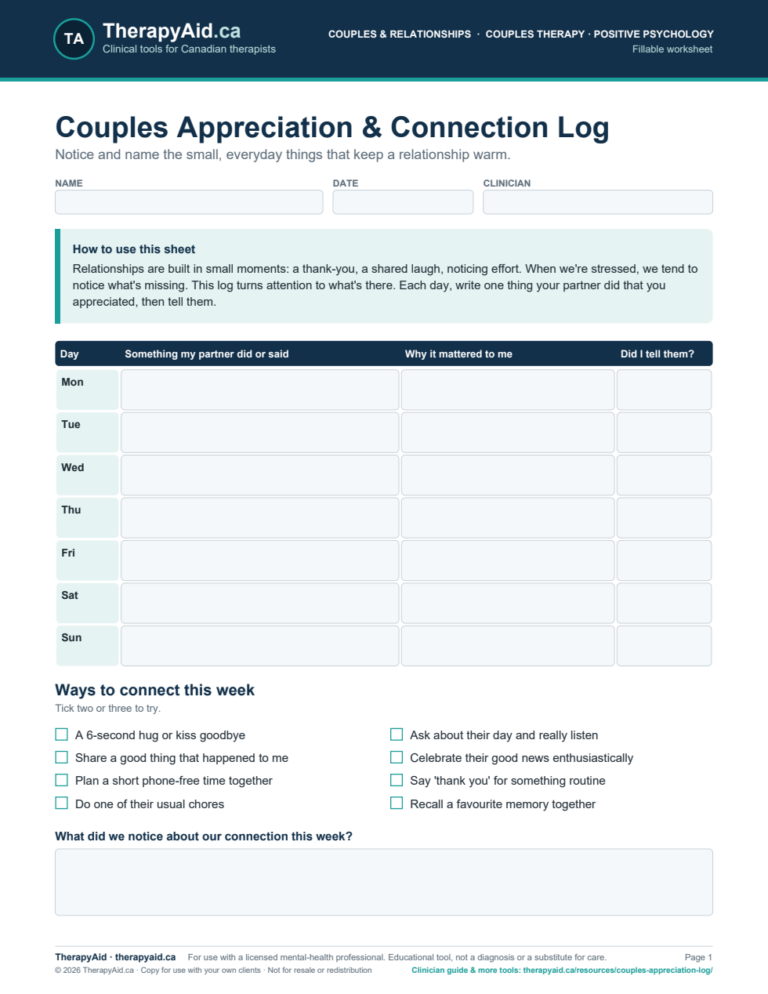
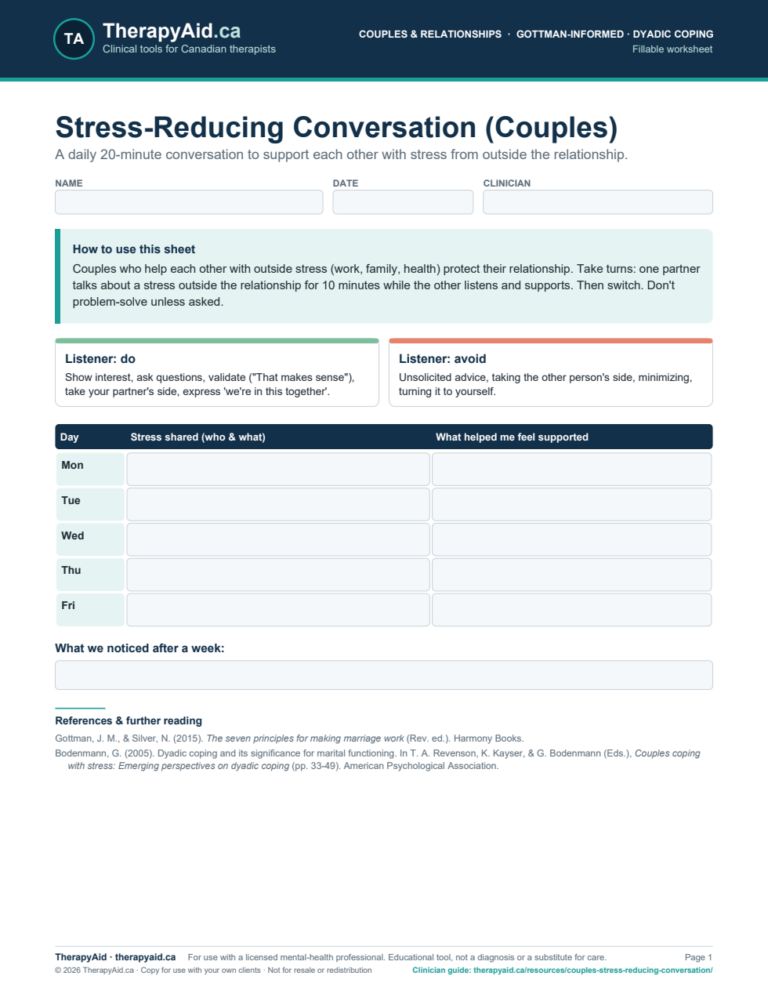
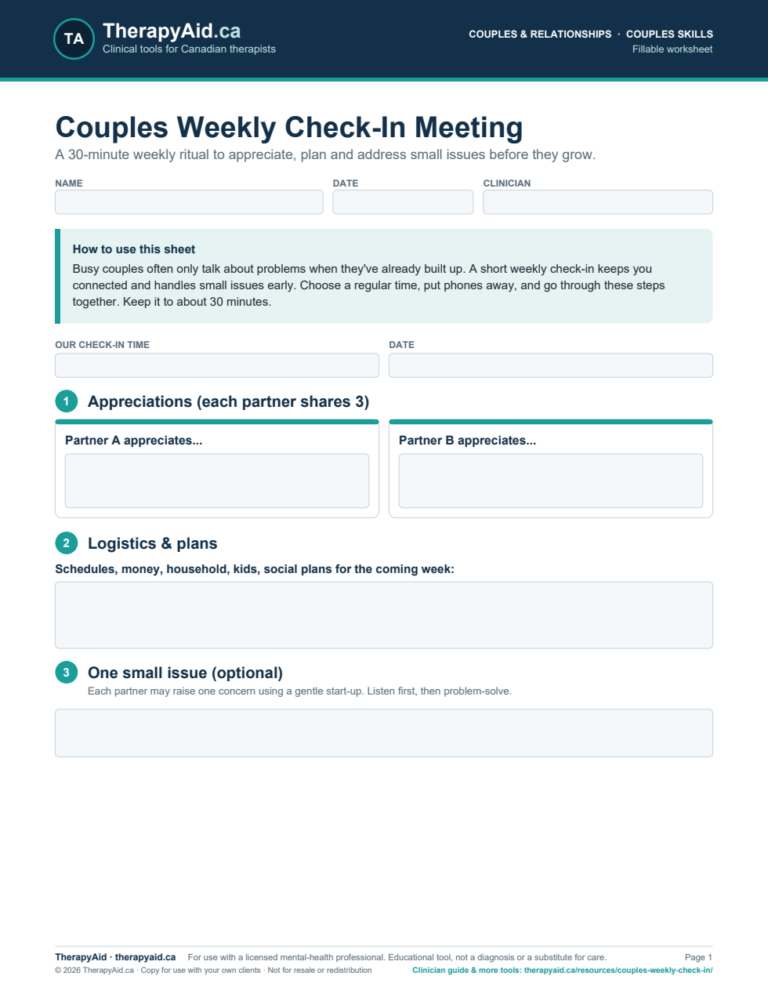
Sharing with clients
Members can download the PDF to print or email, or copy a private client link from the download box. Your client opens the link and downloads the worksheet on any device. No client account is needed, and nothing your client writes is stored on TherapyAid.
Frequently asked questions
What if we start arguing again while doing this?
Pause and take a break. Return to the sheet later, or complete the sharing step in a session with your therapist.
Can one partner use this alone?
The reflection parts can be useful individually, but repair works best when both partners take part.
References
Gottman, J. M., & Silver, N. (2015). The seven principles for making marriage work (Rev. ed.). Harmony Books.
Christensen, A., Doss, B. D., & Jacobson, N. S. (2014). Reconcilable differences: Rebuild your relationship by rediscovering the partner you love, without losing yourself (2nd ed.). Guilford Press.
Johnson, S. M. (2008). Hold me tight: Seven conversations for a lifetime of love. Little, Brown.
This worksheet is an educational tool for use by, or under the guidance of, a licensed or registered mental-health professional. It is not a diagnostic instrument or a substitute for clinical judgement. If a client is in crisis in Canada, call or text 9-8-8 or call 9-1-1.