Triangle Breathing (3-3-3)
A visual guide to triangle breathing (inhale, hold, exhale for three counts each) with step-by-step instructions and a 7-day practice log.
2-page fillable PDF · US Letter (prints on A4) · Breathwork
- Approach / concern
- Somatic
- Technique
- Breathwork
- Format
- Fillable PDF, 2 pages (US Letter / A4)
- Access
- Pro and Advanced plans (3-day free trial)
- For
- Licensed clinicians to use with clients
- Updated
- October 2026
Key facts
What is the Triangle Breathing (3-3-3)?
Triangle breathing is a paced-breathing technique with three equal phases (inhale, hold, exhale), often taught with a triangle image to trace. Its short counts make it accessible for beginners and children.
Why it works
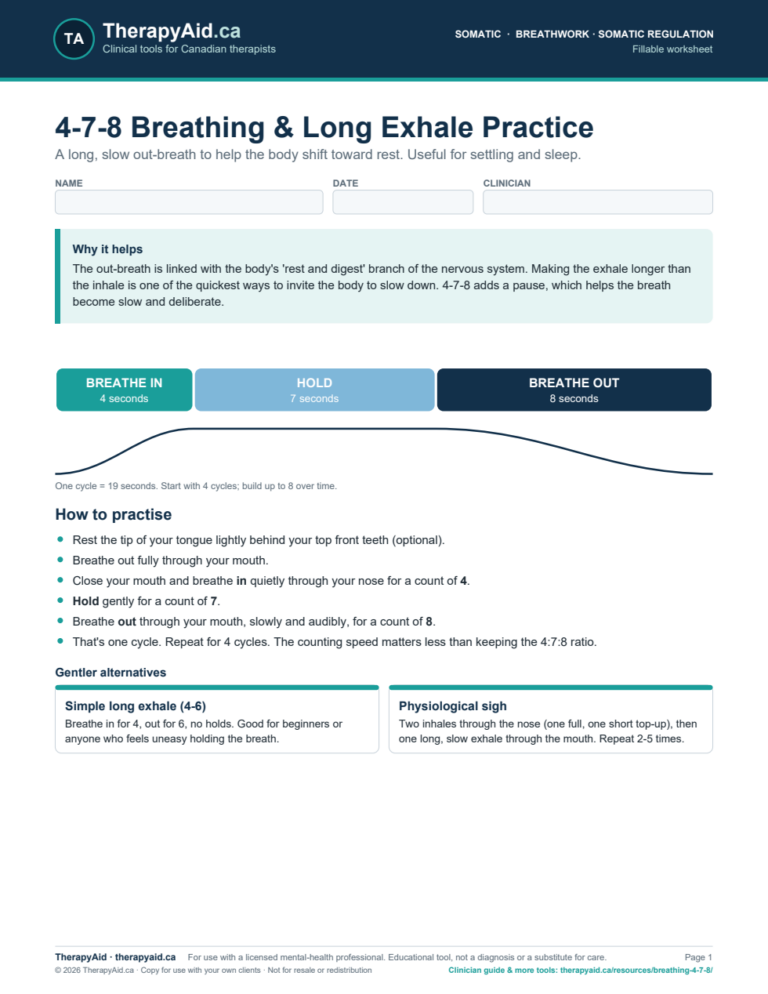
Slow, paced breathing is associated with greater parasympathetic activity and reduced anxiety (Zaccaro et al., 2018), and diaphragmatic breathing practice can reduce negative affect and stress (Ma et al., 2017).
When to use it
- Beginners to breathwork
- Children and teens
- Quick calming before stressful moments
- Clients who find box breathing too long
How to use it in session
- Show the triangle and trace it together.
- Practise five rounds in session.
- Increase counts as comfort grows.
- Assign brief daily practice.
- Track calm before and after.
Clinician tips
- Skip the hold if it feels uncomfortable.
- Children can trace a triangle on their hand or a card.
- Combine with grounding for higher distress.
Worked example
Sharing with clients
Members can download the PDF to print or email, or copy a private client link from the download box. Your client opens the link and downloads the worksheet on any device. No client account is needed, and nothing your client writes is stored on TherapyAid.
Frequently asked questions
How is triangle breathing different from box breathing?
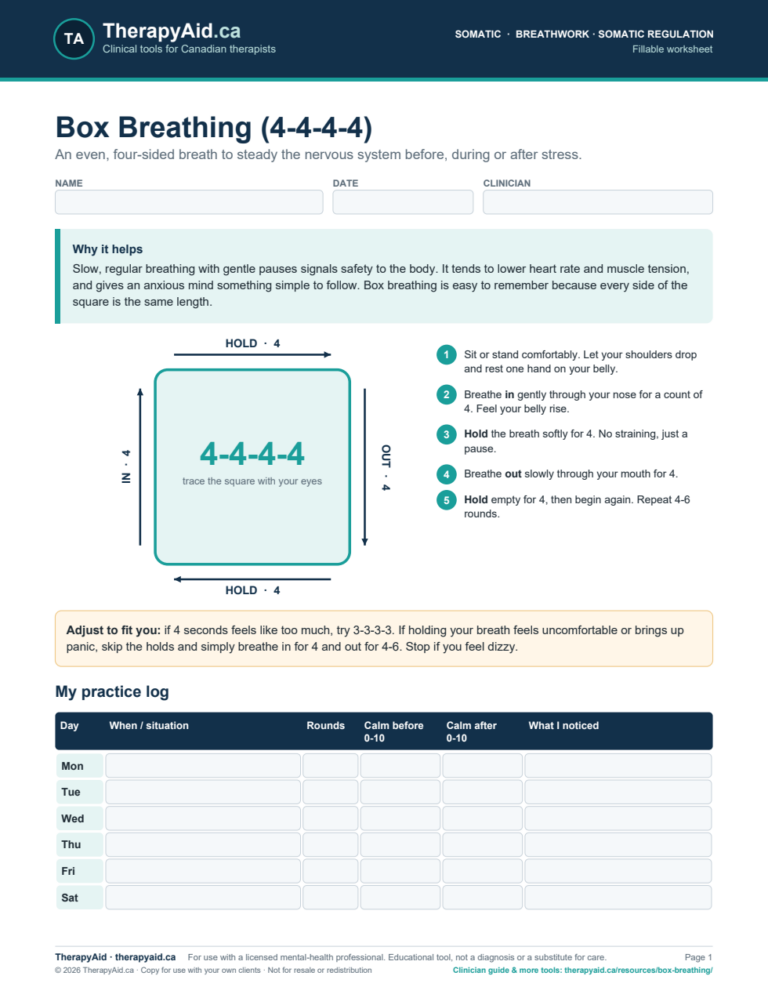
Triangle breathing has three phases (no second hold), making it shorter and simpler.
Can young children do this?
Yes. Use shorter counts and a visual triangle to trace.
References
Zaccaro, A., Piarulli, A., Laurino, M., Garbella, E., Menicucci, D., Neri, B., & Gemignani, A. (2018). How breath-control can change your life: A systematic review on psycho-physiological correlates of slow breathing. Frontiers in Human Neuroscience, 12, 353.
Ma, X., Yue, Z.-Q., Gong, Z.-Q., Zhang, H., Duan, N.-Y., Shi, Y.-T., Wei, G.-X., & Li, Y.-F. (2017). The effect of diaphragmatic breathing on attention, negative affect and stress in healthy adults. Frontiers in Psychology, 8, 874.
This worksheet is an educational tool for use by, or under the guidance of, a licensed or registered mental-health professional. It is not a diagnostic instrument or a substitute for clinical judgement. If a client is in crisis in Canada, call or text 9-8-8 or call 9-1-1.