Box Breathing (4-4-4-4)
A visual, one-page guide to box breathing (4-4-4-4 square breathing) with clear steps, safe adaptations, and a 7-day fillable practice log that tracks calm before and after.
2-page fillable PDF · US Letter (prints on A4) · Breathwork · Somatic regulation
- Approach / concern
- Somatic
- Technique
- Breathwork · Somatic regulation
- Format
- Fillable PDF, 2 pages (US Letter / A4)
- Access
- Pro and Advanced plans (3-day free trial)
- For
- Licensed clinicians to use with clients
- Updated
- October 2026
Key facts
What is the Box Breathing (4-4-4-4)?
Box breathing is a paced-breathing technique with four equal phases: inhale, hold, exhale, hold. Each phase usually lasts four seconds, so one cycle is about 16 seconds, which is close to four breaths per minute. Its simple structure makes it easy to teach and remember, and it is widely used by clinicians, athletes and first responders to manage acute stress.
Why it works
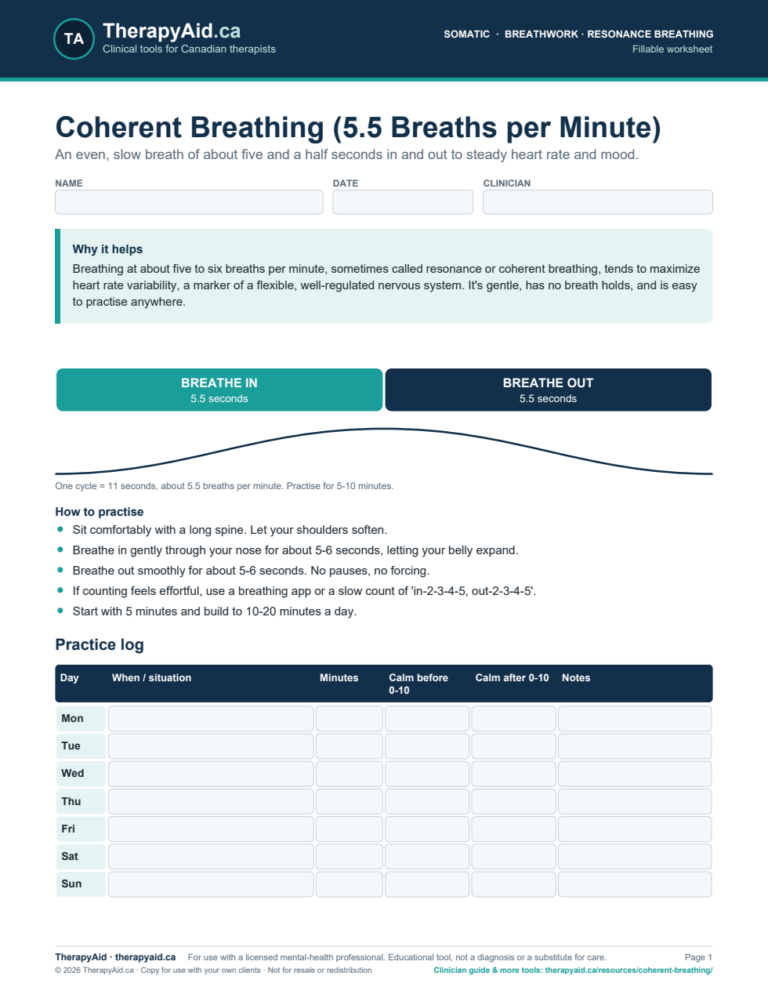
Slow breathing at around six breaths per minute or fewer is linked with increased heart-rate variability, more parasympathetic activity, and reduced anxiety and arousal (Zaccaro et al., 2018; Russo et al., 2017). Diaphragmatic breathing training has also been shown to lower negative affect and cortisol (Ma et al., 2017). The counting component gives an anxious mind a neutral focus.
When to use it
- Acute anxiety or panic symptoms
- Before stressful events such as exams, presentations or medical appointments
- Grounding at the start or end of a session
- Sleep onset difficulties
- Anger and frustration, as part of a pause routine
How to use it in session
- Model the breath in session using the square diagram, counting aloud.
- Practise four to six rounds together and ask the client to rate calm before and after.
- Adjust the count or remove the holds if needed.
- Encourage daily practice when calm, so the skill is available under stress.
- Review the log and link the practice to real situations.
Clinician tips
- Practise when calm first. Skills learned at low arousal are easier to use at high arousal.
- Some trauma survivors find breath holds activating. Offer a simple in-4 / out-6 alternative.
- Tracing a square with a finger on the leg helps clients who find counting hard.
- Pair with the Window of Tolerance sheet to explain why breath affects state.
Worked example
Sharing with clients
Members can download the PDF to print or email, or copy a private client link from the download box. Your client opens the link and downloads the worksheet on any device. No client account is needed, and nothing your client writes is stored on TherapyAid.
Frequently asked questions
How long should a client practise?
Two to five minutes (around four to eight rounds) is enough for most people. Daily practice builds the skill.
Is box breathing safe for everyone?
It is safe for most people. Clients with respiratory or cardiac conditions, or who are pregnant, should use gentle counts without breath holds and check with their physician if unsure.
Is it better than 4-7-8 breathing?
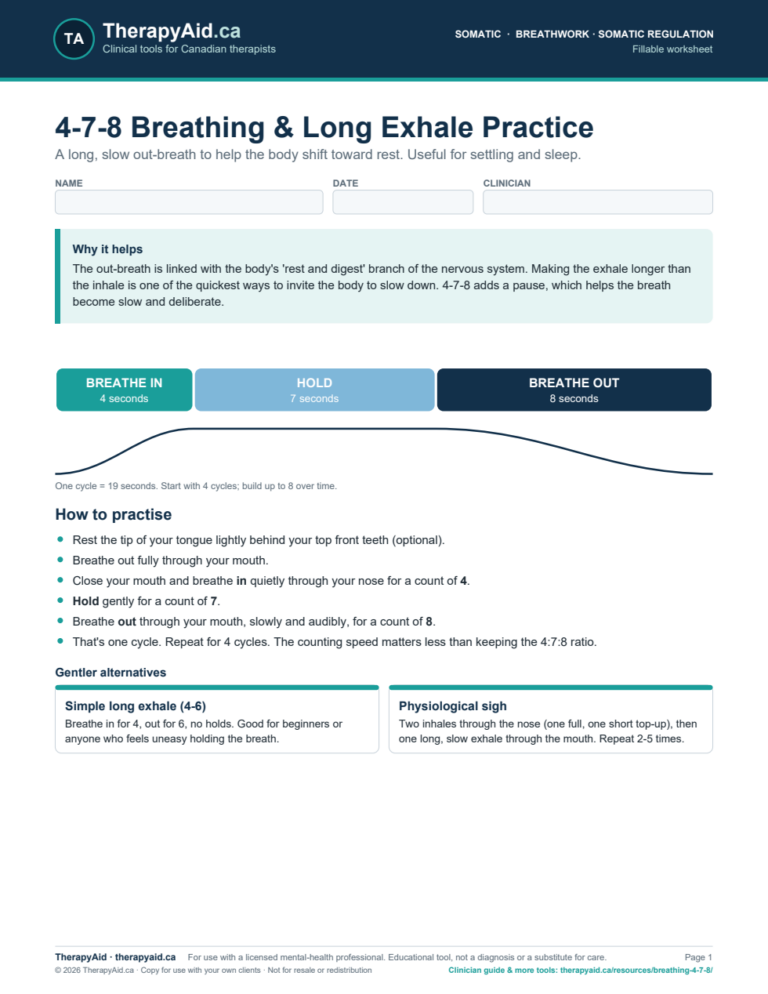
Neither is ‘better’. Box breathing is even and steady; 4-7-8 emphasizes a long exhale, which some clients find more calming. Try both and see which fits.
References
Zaccaro, A., Piarulli, A., Laurino, M., Garbella, E., Menicucci, D., Neri, B., & Gemignani, A. (2018). How breath-control can change your life: A systematic review on psycho-physiological correlates of slow breathing. Frontiers in Human Neuroscience, 12, 353.
Russo, M. A., Santarelli, D. M., & O’Rourke, D. (2017). The physiological effects of slow breathing in the healthy human. Breathe, 13(4), 298-309.
Ma, X., Yue, Z.-Q., Gong, Z.-Q., Zhang, H., Duan, N.-Y., Shi, Y.-T., Wei, G.-X., & Li, Y.-F. (2017). The effect of diaphragmatic breathing on attention, negative affect and stress in healthy adults. Frontiers in Psychology, 8, 874.
This worksheet is an educational tool for use by, or under the guidance of, a licensed or registered mental-health professional. It is not a diagnostic instrument or a substitute for clinical judgement. If a client is in crisis in Canada, call or text 9-8-8 or call 9-1-1.