Collaborative Treatment Plan Template
A clinician treatment plan template with presenting concerns, goals, measurable objectives, interventions, outcome measures, strengths, risk status and signatures.
2-page fillable PDF · US Letter (prints on A4) · Treatment planning
- Approach / concern
- Clinician Tools
- Technique
- Treatment planning
- Format
- Fillable PDF, 2 pages (US Letter / A4)
- Access
- Advanced plan
- For
- Licensed clinicians to use with clients
- Updated
- October 2026
Key facts
What is the Collaborative Treatment Plan Template?
A treatment plan documents agreed therapy goals, measurable objectives, planned interventions and how progress will be tracked. Collaborative planning improves engagement and clarity for both client and clinician.
Why it works
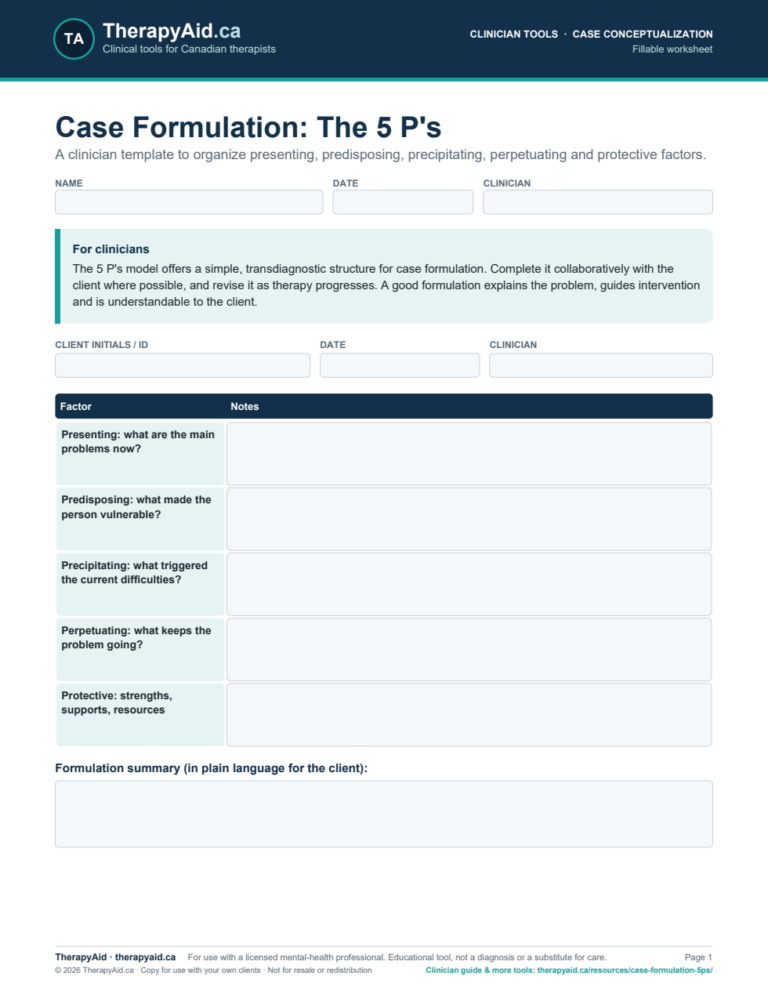
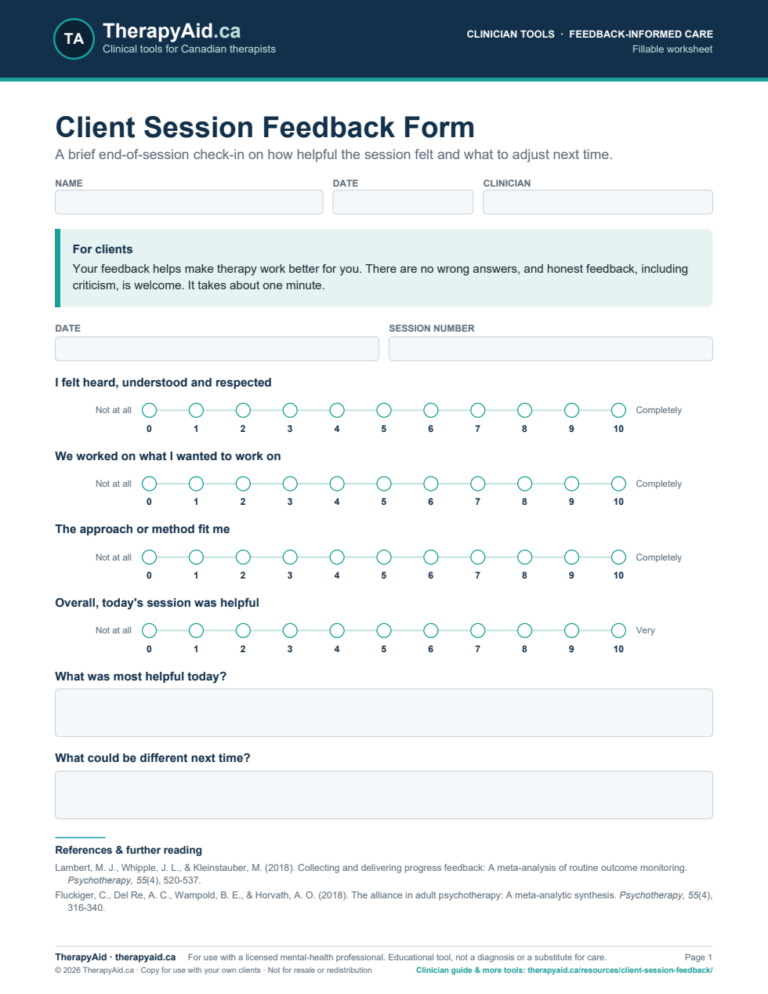
Collaborative case conceptualization links formulation to individualized interventions (Kuyken et al., 2009). Routine progress monitoring improves outcomes, especially for clients not on track (Lambert et al., 2018).
When to use it
- After assessment and formulation
- Insurance or EAP documentation
- Periodic treatment reviews
- Supervision and training
How to use it in session
- Write concerns and goals with the client.
- Make objectives specific and measurable.
- Link interventions to formulation.
- Choose measures (e.g. PHQ-9, GAD-7).
- Set a review date.
Clinician tips
- Follow your regulatory college’s documentation standards.
- Keep language client-friendly.
- Revisit when progress stalls.
Worked example
Sharing with clients
Members can download the PDF to print or email, or copy a private client link from the download box. Your client opens the link and downloads the worksheet on any device. No client account is needed, and nothing your client writes is stored on TherapyAid.
Frequently asked questions
Is this template compliant with my college’s requirements?
It’s a general template. Adapt it to your regulatory body’s documentation standards and privacy laws.
How often should treatment plans be reviewed?
Commonly every 6-12 sessions, or whenever goals or circumstances change.
References
Kuyken, W., Padesky, C. A., & Dudley, R. (2009). Collaborative case conceptualization: Working effectively with clients in cognitive-behavioral therapy. Guilford Press.
Lambert, M. J., Whipple, J. L., & Kleinstauber, M. (2018). Collecting and delivering progress feedback: A meta-analysis of routine outcome monitoring. Psychotherapy, 55(4), 520-537.
This worksheet is an educational tool for use by, or under the guidance of, a licensed or registered mental-health professional. It is not a diagnostic instrument or a substitute for clinical judgement. If a client is in crisis in Canada, call or text 9-8-8 or call 9-1-1.