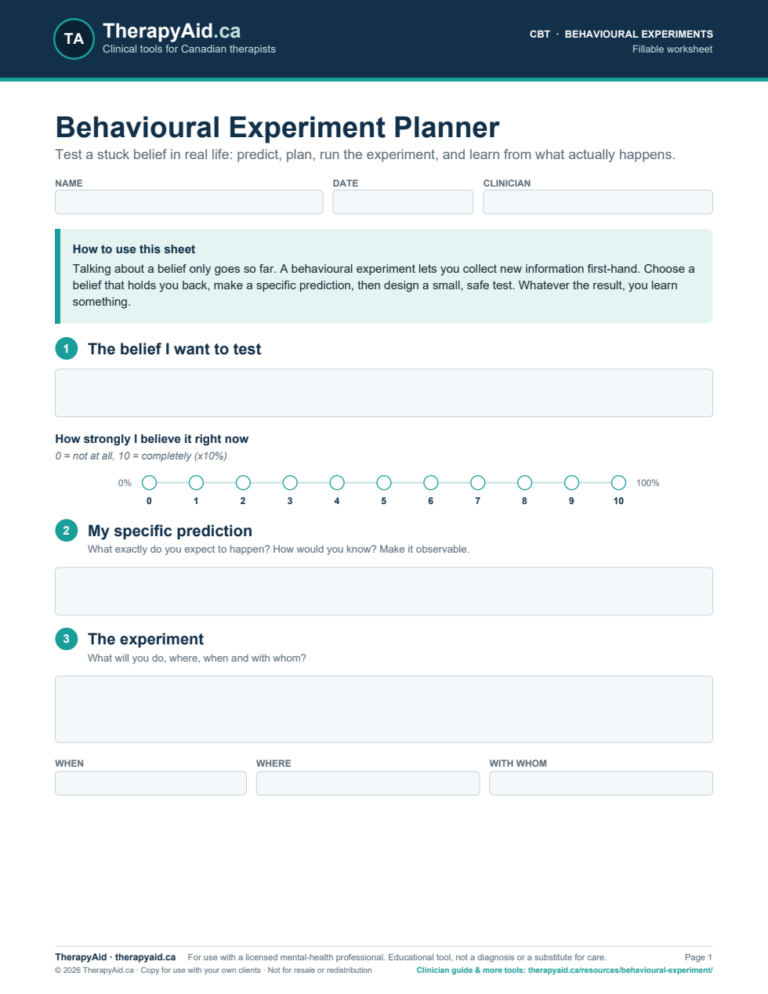
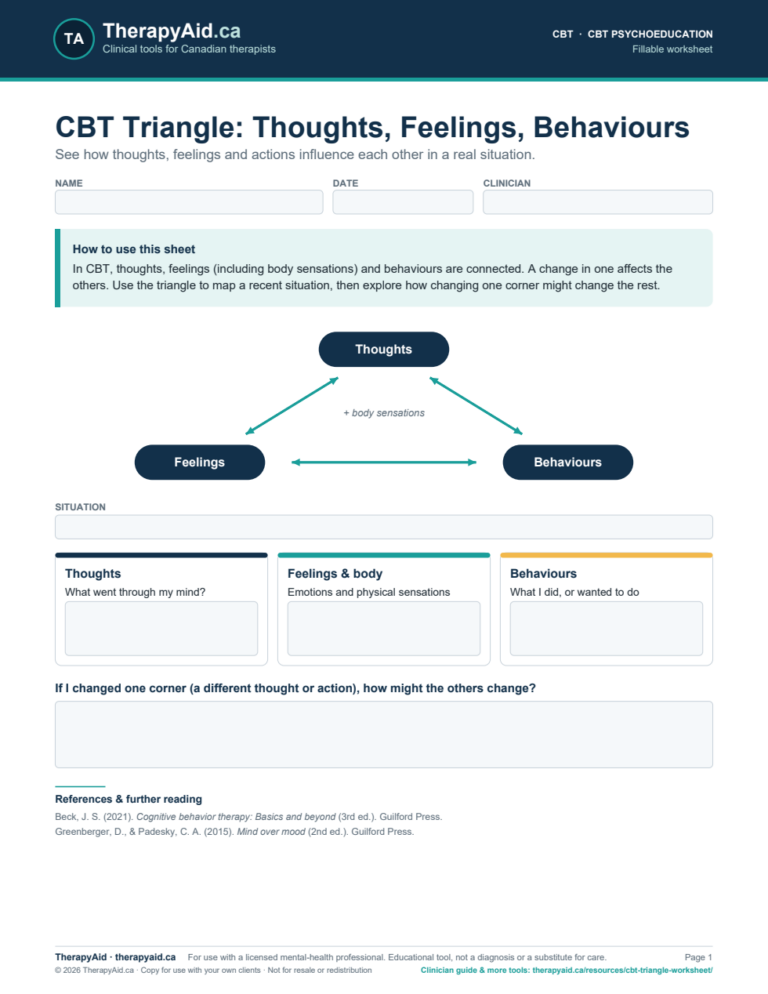
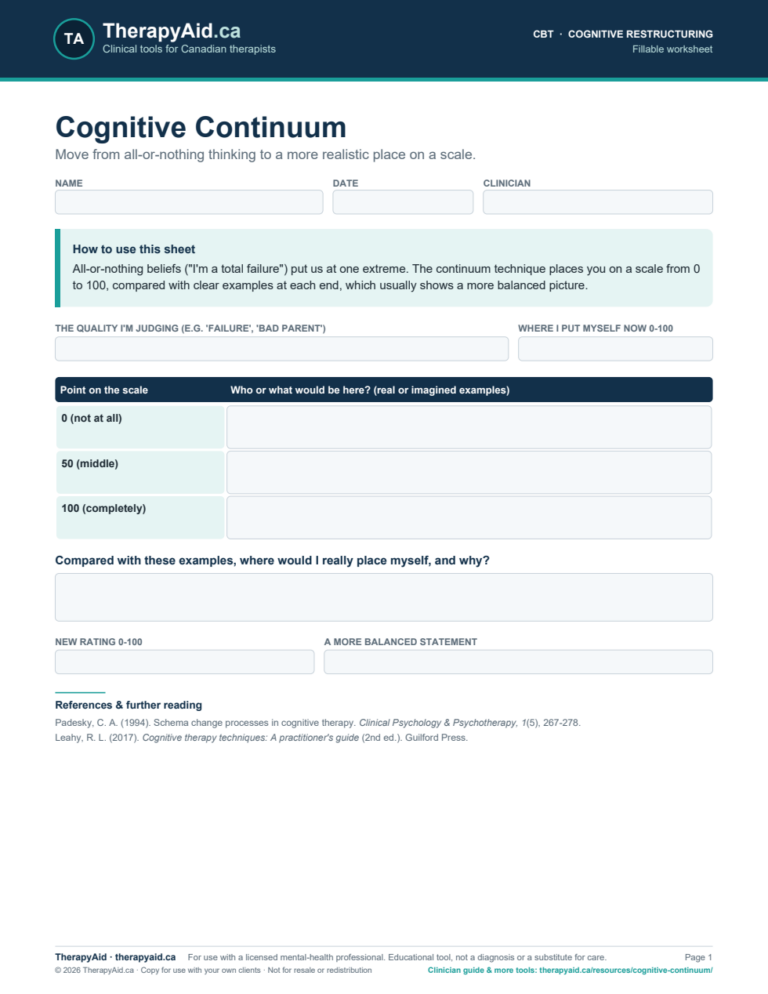
Thought Record
A seven-step cognitive restructuring worksheet that helps clients notice a 'hot' automatic thought, test it against the evidence and arrive at a more balanced, believable alternative.
2-page fillable PDF · US Letter (prints on A4) · Cognitive restructuring
- Approach / concern
- CBT
- Technique
- Cognitive restructuring
- Format
- Fillable PDF, 2 pages (US Letter / A4)
- Access
- Pro and Advanced plans (3-day free trial)
- For
- Licensed clinicians to use with clients
- Updated
- October 2026
Key facts
What is the Thought Record?
The thought record is the core tool of cognitive behavioural therapy (CBT). It is based on Aaron Beck’s cognitive model, which suggests that it is not events alone that shape how we feel, but the meaning we give them. When a situation triggers a quick, automatic interpretation such as “I’m going to fail” or “They think I’m useless”, that thought drives the emotion, the body response and what we do next. A thought record slows this sequence down so the client can see each part separately and then look at the thought with curiosity rather than accepting it as fact.
Why it works
Cognitive restructuring is one of the best-studied interventions in psychotherapy. Meta-analyses of CBT show strong support for anxiety disorders, depression, and many other presenting concerns (Hofmann et al., 2012). Written thought records help clients practise the skill outside the session, and over time the steps become automatic, so clients start to question unhelpful thoughts in real time without needing the page.
When to use it
- Depression and low mood, especially self-critical or hopeless thinking
- Generalized anxiety, social anxiety and health anxiety
- Anger, guilt and shame after a specific trigger
- Low self-esteem and core-belief work (as a step before belief-level work)
- Any client who is ready to look at their thinking after initial stabilization
How to use it in session
- Introduce the cognitive model first using the thoughts-feelings-behaviours triangle on the sheet. Use a recent, moderate example from the client’s week.
- Complete the first three steps (situation, emotions, automatic thoughts) together in session. Many clients only need these three columns for the first week.
- Help the client choose the ‘hot’ thought: the one most connected to the strongest emotion.
- Gather evidence on both sides. Keep interpretations out of the ‘evidence’ boxes and gently redirect to facts.
- Write a balanced thought that includes both sides of the evidence. It should feel believable, not just positive.
- Re-rate the emotions. Even a 10-20 point drop is a meaningful change worth naming.
- Assign one or two thought records between sessions and review them at the start of the next appointment.
Clinician tips
- If a client struggles to find the thought, ask about the images or meanings: “What was the worst part about that?” or “What did that say about you?”
- Pair this sheet with the Cognitive Distortions guide so clients can label the thinking trap in Step 5.
- Avoid ‘positive thinking’. A balanced thought that the client believes at 60% is more useful than a cheerful one they believe at 5%.
- For clients with trauma histories, check that they are within their window of tolerance before doing evidence-gathering about painful beliefs.
- When the same hot thought keeps appearing, move to downward-arrow or core-belief work.
Worked example
Sharing with clients
Members can download the PDF to print or email, or copy a private client link from the download box. Your client opens the link and downloads the worksheet on any device. No client account is needed, and nothing your client writes is stored on TherapyAid.
Frequently asked questions
How many thought records should a client complete each week?
Most clinicians start with one to three per week. Quality matters more than quantity. One careful record reviewed in session is more useful than five rushed ones.
What is the difference between a feeling and a thought?
Feelings are usually one word (sad, scared, angry). If a client writes “I feel like I’m a failure”, that is a thought. Move it to the automatic thoughts box.
Can clients fill this out on a phone?
Yes. The PDF is fillable, so clients can type into each box in any PDF reader, save it, and bring it to session or print it.
Is this sheet suitable for teens?
Yes, for most adolescents aged 13 and over. For younger clients a simpler three-column version (situation, thought, feeling) is usually a better place to start.
References
Beck, J. S. (2021). Cognitive behavior therapy: Basics and beyond (3rd ed.). Guilford Press.
Greenberger, D., & Padesky, C. A. (2015). Mind over mood: Change how you feel by changing the way you think (2nd ed.). Guilford Press.
Burns, D. D. (1980). Feeling good: The new mood therapy. William Morrow.
Hofmann, S. G., Asnaani, A., Vonk, I. J. J., Sawyer, A. T., & Fang, A. (2012). The efficacy of cognitive behavioral therapy: A review of meta-analyses. Cognitive Therapy and Research, 36(5), 427-440.
This worksheet is an educational tool for use by, or under the guidance of, a licensed or registered mental-health professional. It is not a diagnostic instrument or a substitute for clinical judgement. If a client is in crisis in Canada, call or text 9-8-8 or call 9-1-1.