CBT Triangle: Thoughts, Feelings, Behaviours
A foundational CBT worksheet with the cognitive triangle diagram, fillable boxes for thoughts, feelings and behaviours in a situation, and a reflection on change.
1-page fillable PDF · US Letter (prints on A4) · CBT psychoeducation
- Approach / concern
- CBT
- Technique
- CBT psychoeducation
- Format
- Fillable PDF, 1 page (US Letter / A4)
- Access
- Pro and Advanced plans (3-day free trial)
- For
- Licensed clinicians to use with clients
- Updated
- October 2026
Key facts
What is the CBT Triangle: Thoughts, Feelings, Behaviours?
The CBT (cognitive) triangle illustrates the interconnection of thoughts, emotions and behaviours. It’s typically the first model introduced in cognitive behavioural therapy to show how changing thinking or behaviour can change how we feel.
Why it works
The cognitive model underpins CBT, one of the most evidence-based psychotherapies (Beck, 2021). Simple, visual models help clients understand and engage with treatment (Greenberger & Padesky, 2015).
When to use it
- First sessions of CBT
- Teens and adults new to therapy
- Groups and psychoeducation
- Before thought records
How to use it in session
- Explain the triangle with a neutral example.
- Map a recent situation together.
- Highlight the connections.
- Explore changing one corner.
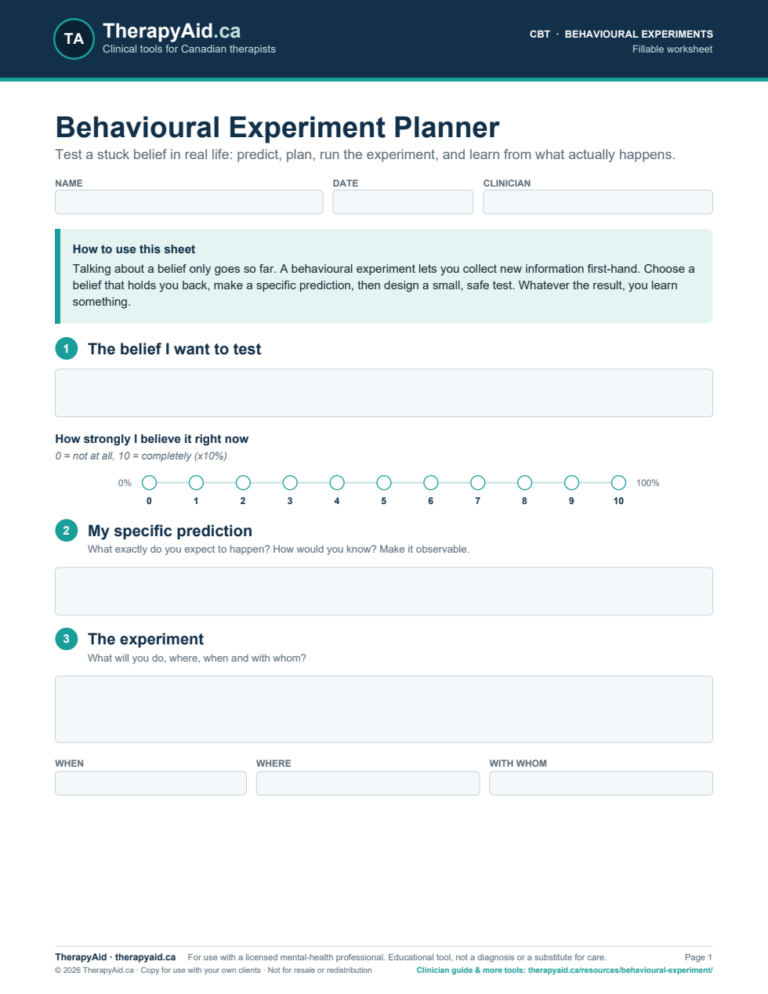
- Introduce thought records or behavioural experiments next.
Clinician tips
- Include body sensations with feelings.
- Use client-generated examples.
- Keep it simple at first.
Worked example
Sharing with clients
Members can download the PDF to print or email, or copy a private client link from the download box. Your client opens the link and downloads the worksheet on any device. No client account is needed, and nothing your client writes is stored on TherapyAid.
Frequently asked questions
Do thoughts always come first?
Not necessarily. Each corner influences the others; the triangle is a loop rather than a straight line.
Is this suitable for children?
Yes, with simple language and examples, from about age 8.
References
Beck, J. S. (2021). Cognitive behavior therapy: Basics and beyond (3rd ed.). Guilford Press.
Greenberger, D., & Padesky, C. A. (2015). Mind over mood (2nd ed.). Guilford Press.
This worksheet is an educational tool for use by, or under the guidance of, a licensed or registered mental-health professional. It is not a diagnostic instrument or a substitute for clinical judgement. If a client is in crisis in Canada, call or text 9-8-8 or call 9-1-1.