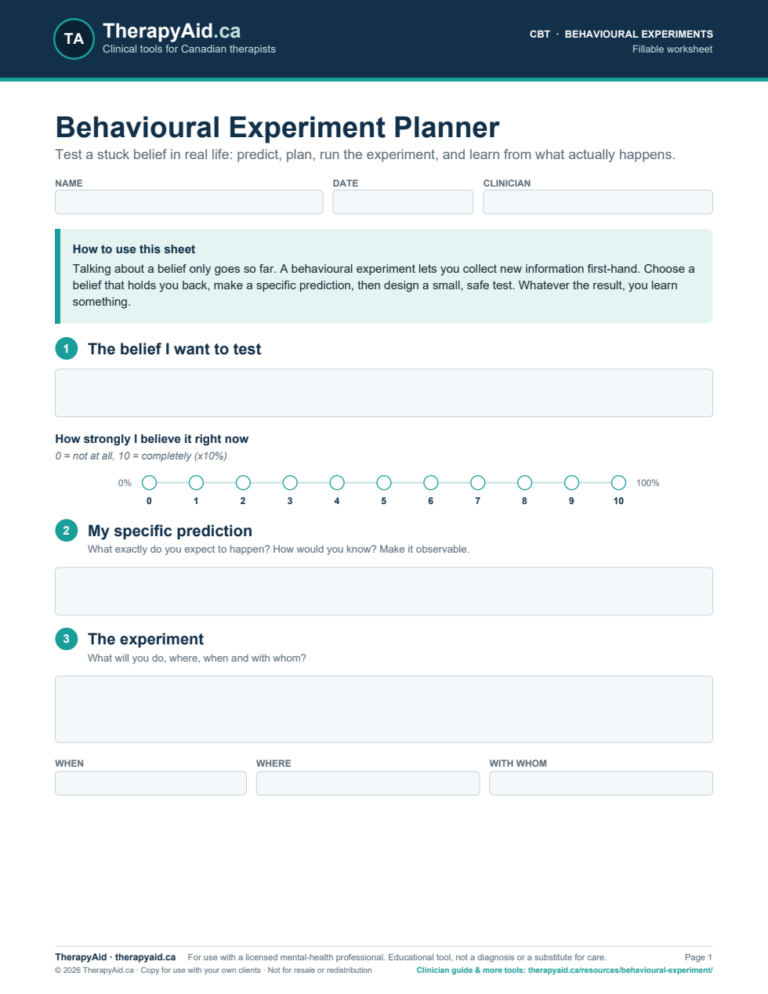
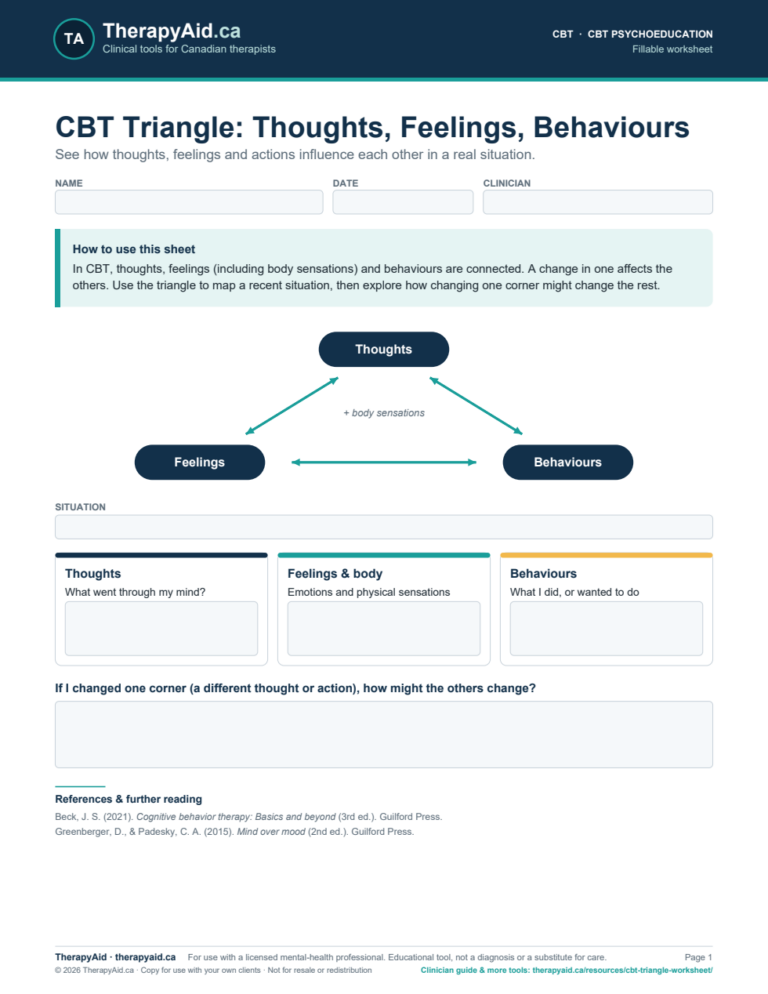
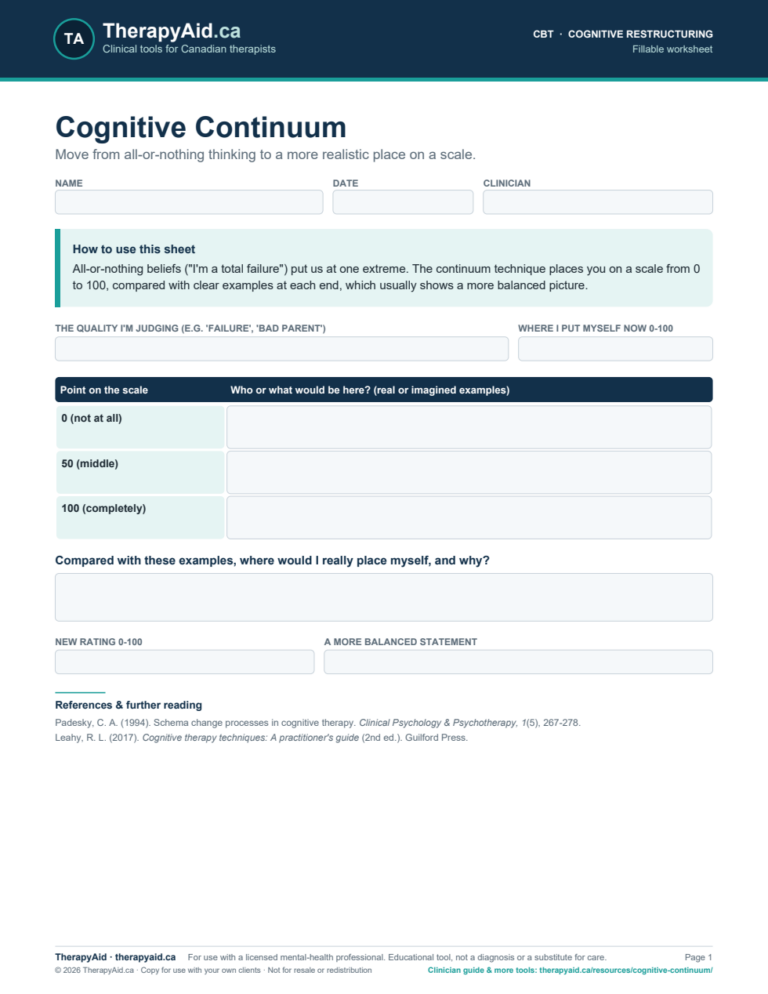
Survey Experiment: What Do Others Really Think?
A behavioural experiment worksheet testing beliefs about others' views or experiences by designing and running a survey, then re-rating the belief.
1-page fillable PDF · US Letter (prints on A4) · Behavioural experiment
- Approach / concern
- CBT
- Technique
- Behavioural experiment
- Format
- Fillable PDF, 1 page (US Letter / A4)
- Access
- Pro and Advanced plans (3-day free trial)
- For
- Licensed clinicians to use with clients
- Updated
- October 2026
Key facts
What is the Survey Experiment: What Do Others Really Think??
Surveys are a type of behavioural experiment that gather information from others to test beliefs about norms, judgements or shared experiences.
Why it works
The Oxford guide describes surveys as a valuable behavioural experiment method (Bennett-Levy et al., 2004). Testing predictions with evidence is central to CBT (Beck, 2021).
When to use it
- Social anxiety
- Shame and perfectionism
- Beliefs about being abnormal
- Group therapy
How to use it in session
- Identify the belief.
- Design a clear question.
- Choose respondents.
- Collect answers.
- Reflect and re-rate.
Clinician tips
- Therapists can help collect responses anonymously.
- Ask neutral questions.
- Include a range of people.
Worked example
Sharing with clients
Members can download the PDF to print or email, or copy a private client link from the download box. Your client opens the link and downloads the worksheet on any device. No client account is needed, and nothing your client writes is stored on TherapyAid.
Frequently asked questions
Who should I survey?
People you trust, colleagues, or an anonymous group your therapist helps reach.
What if responses confirm my belief?
That’s useful information; you can then problem-solve.
References
Bennett-Levy, J., Butler, G., Fennell, M., Hackmann, A., Mueller, M., & Westbrook, D. (Eds.). (2004). Oxford guide to behavioural experiments in cognitive therapy. Oxford University Press.
Beck, J. S. (2021). Cognitive behavior therapy: Basics and beyond (3rd ed.). Guilford Press.
This worksheet is an educational tool for use by, or under the guidance of, a licensed or registered mental-health professional. It is not a diagnostic instrument or a substitute for clinical judgement. If a client is in crisis in Canada, call or text 9-8-8 or call 9-1-1.