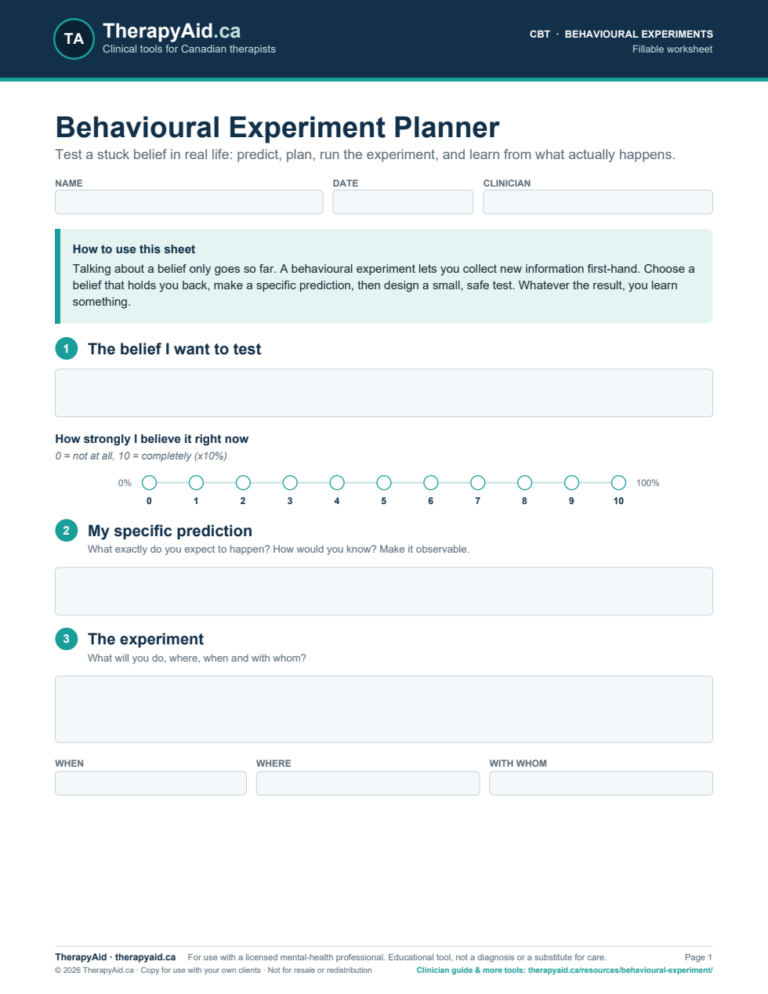
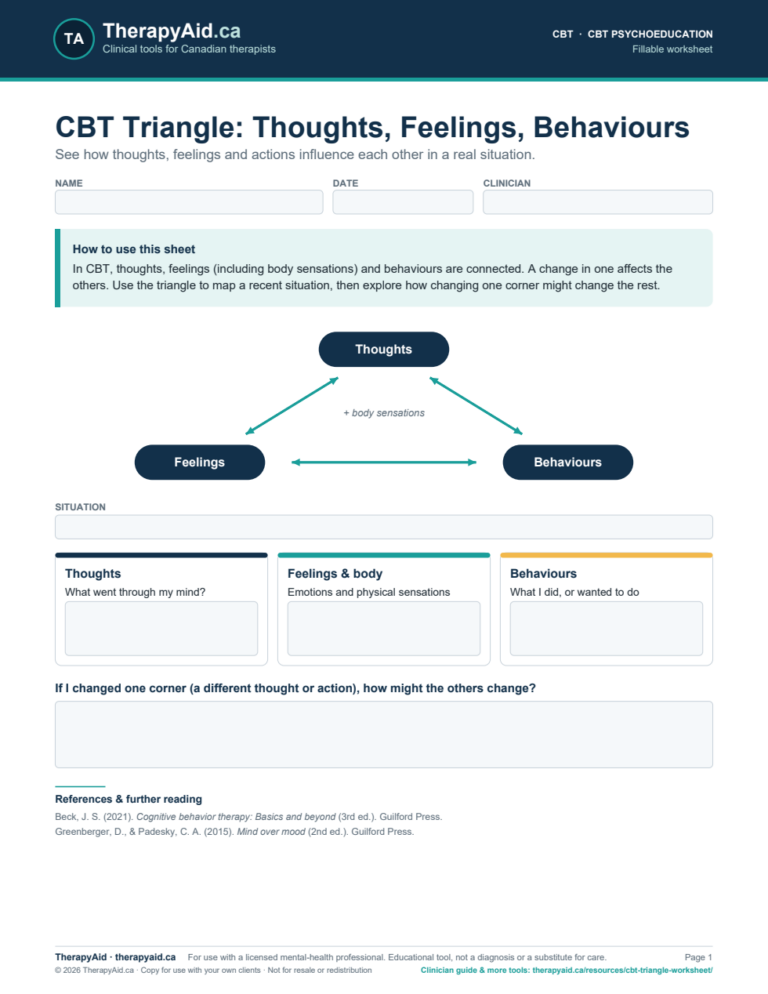
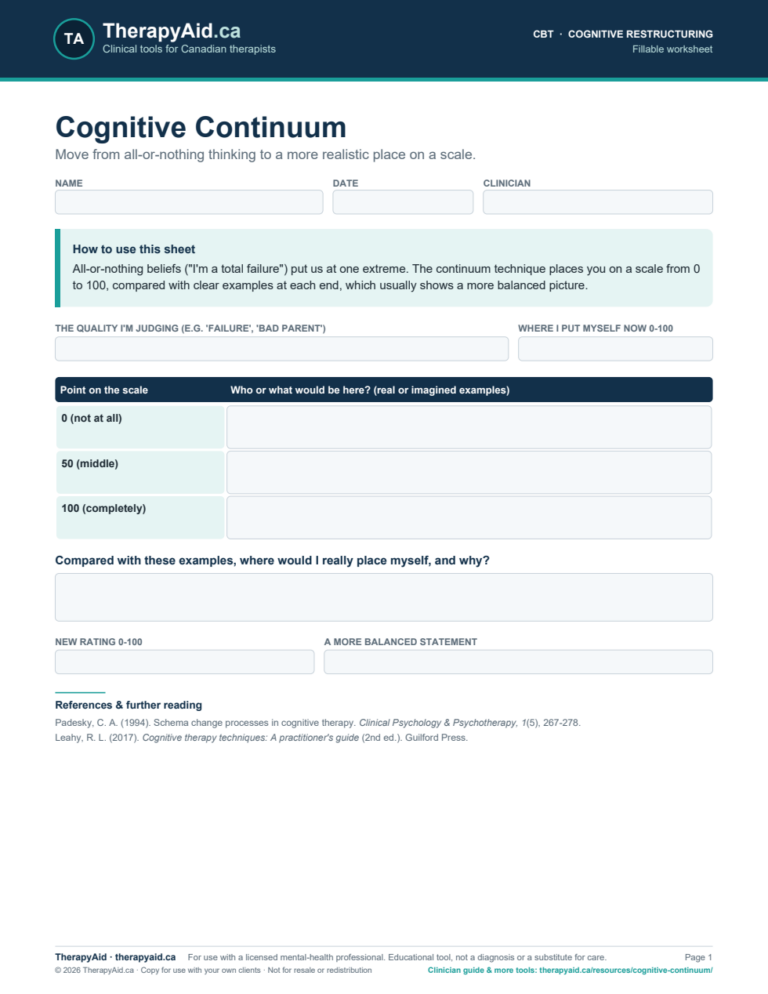
Socratic Questions for Challenging Thoughts
A CBT worksheet with eight Socratic questions for examining an upsetting thought, with before-and-after belief ratings and a balanced alternative.
1-page fillable PDF · US Letter (prints on A4) · Cognitive restructuring
- Approach / concern
- CBT
- Technique
- Cognitive restructuring
- Format
- Fillable PDF, 1 page (US Letter / A4)
- Access
- Pro and Advanced plans (3-day free trial)
- For
- Licensed clinicians to use with clients
- Updated
- October 2026
Key facts
What is the Socratic Questions for Challenging Thoughts?
Socratic questioning is a collaborative style of questioning used in CBT to help clients examine thoughts, consider evidence and discover alternative perspectives for themselves, rather than being told what to think.
Why it works
The Socratic method is a cornerstone of CBT practice (Clark & Egan, 2015). Padesky emphasized guided discovery, helping clients reach their own conclusions, as more effective than persuasion (Padesky, 1993).
When to use it
- Cognitive restructuring
- Clients who find thought records too structured
- Between-session self-help
- Groups and psychoeducation
How to use it in session
- Choose one specific thought.
- Rate belief strength.
- Work through questions that feel relevant.
- Develop a balanced thought.
- Re-rate belief.
Clinician tips
- Curiosity matters more than ‘winning’ the argument.
- Don’t use every question every time.
- Pair with the Thinking Traps guide.
Worked example
Sharing with clients
Members can download the PDF to print or email, or copy a private client link from the download box. Your client opens the link and downloads the worksheet on any device. No client account is needed, and nothing your client writes is stored on TherapyAid.
Frequently asked questions
What is Socratic questioning?
A way of asking open, curious questions that help someone examine their own thinking and reach their own conclusions.
Can I use these on my own?
Yes. Many people keep the questions handy as a quick self-help tool.
References
Clark, G. I., & Egan, S. J. (2015). The Socratic method in cognitive behavioural therapy: A narrative review. Cognitive Therapy and Research, 39(6), 863-879.
Padesky, C. A. (1993, September). Socratic questioning: Changing minds or guiding discovery? Keynote address at the European Congress of Behavioural and Cognitive Therapies, London.
Beck, J. S. (2021). Cognitive behavior therapy: Basics and beyond (3rd ed.). Guilford Press.
This worksheet is an educational tool for use by, or under the guidance of, a licensed or registered mental-health professional. It is not a diagnostic instrument or a substitute for clinical judgement. If a client is in crisis in Canada, call or text 9-8-8 or call 9-1-1.