Sleep Hygiene Checklist
A sleep hygiene checklist covering daily habits and bedroom environment, with a table for choosing and reviewing two or three changes.
1-page fillable PDF · US Letter (prints on A4) · Sleep hygiene
- Approach / concern
- Sleep / CBT-I
- Technique
- Sleep hygiene
- Format
- Fillable PDF, 1 page (US Letter / A4)
- Access
- Pro and Advanced plans (3-day free trial)
- For
- Licensed clinicians to use with clients
- Updated
- October 2026
Key facts
What is the Sleep Hygiene Checklist?
Sleep hygiene refers to behavioural and environmental practices that promote good sleep, such as regular schedules, limiting caffeine and alcohol, and a comfortable sleep environment. It is commonly offered as a foundation for better sleep.
Why it works
Sleep hygiene practices are associated with sleep quality, but as a standalone treatment they are less effective than full CBT-I (Irish et al., 2015). They are best used as one component of CBT-I (Edinger & Carney, 2014).
When to use it
- General sleep complaints
- Alongside CBT-I
- Teens and students
- Shift workers (adapted)
How to use it in session
- Review the checklist together.
- Highlight what the client already does well.
- Choose two or three changes.
- Track for two weeks.
- Move to core CBT-I strategies if insomnia persists.
Clinician tips
- Avoid overloading clients with rules.
- Set realistic expectations: hygiene alone rarely fixes chronic insomnia.
- Fixed wake time is the most important habit.
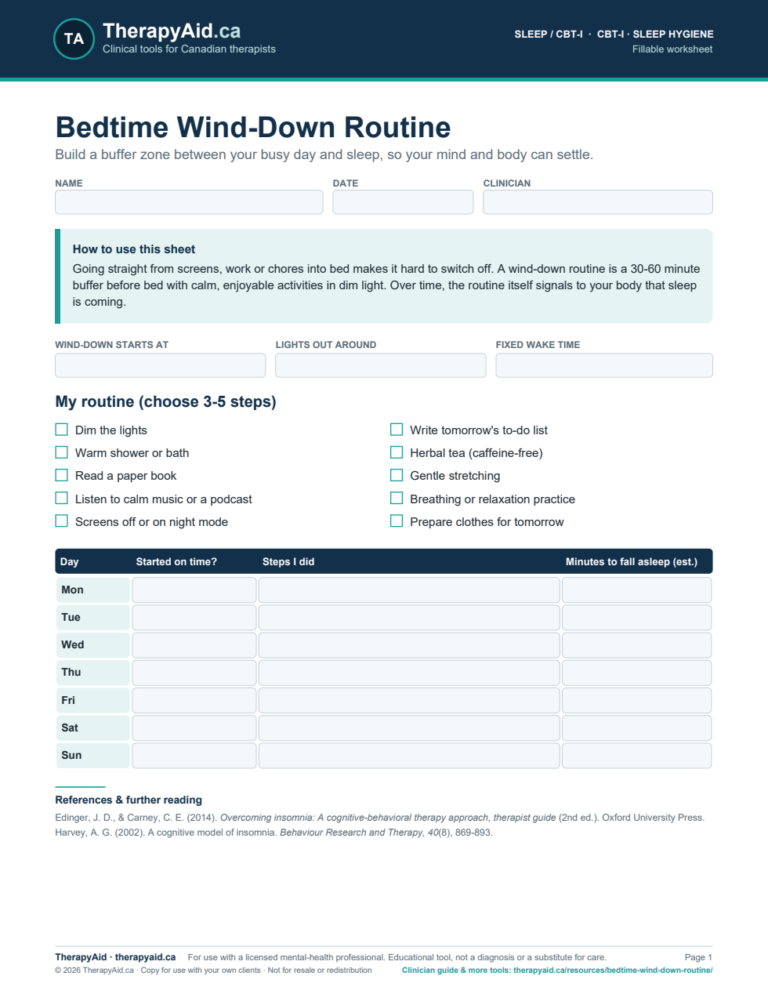
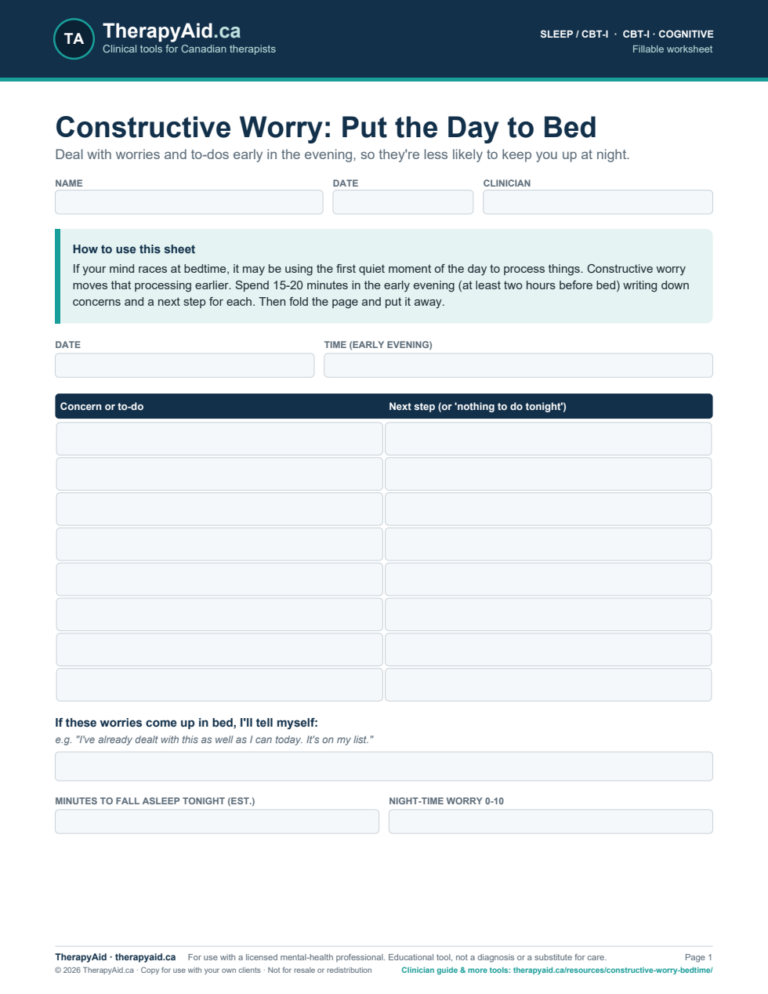
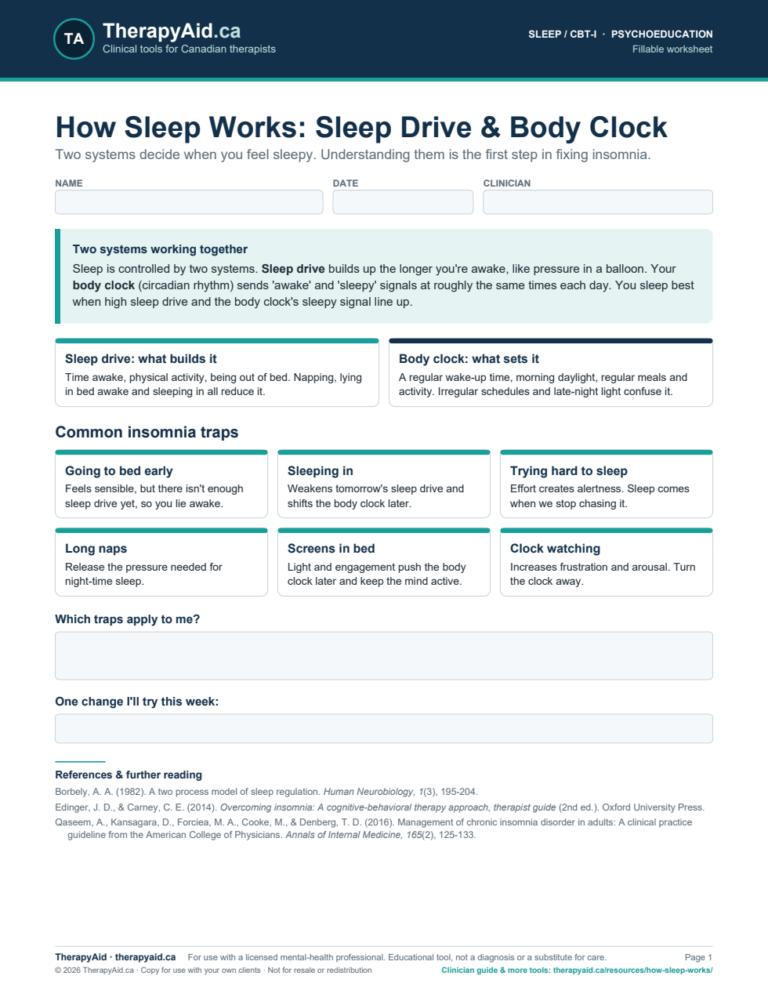
Worked example
Sharing with clients
Members can download the PDF to print or email, or copy a private client link from the download box. Your client opens the link and downloads the worksheet on any device. No client account is needed, and nothing your client writes is stored on TherapyAid.
Frequently asked questions
Is sleep hygiene enough to treat insomnia?
Usually not on its own. CBT-I, which includes sleep scheduling and stimulus control, is the recommended treatment.
What’s the most important sleep habit?
A consistent wake time, every day, is one of the most helpful.
References
Irish, L. A., Kline, C. E., Gunn, H. E., Buysse, D. J., & Hall, M. H. (2015). The role of sleep hygiene in promoting public health: A review of empirical evidence. Sleep Medicine Reviews, 22, 23-36.
Edinger, J. D., & Carney, C. E. (2014). Overcoming insomnia: A cognitive-behavioral therapy approach, therapist guide (2nd ed.). Oxford University Press.
This worksheet is an educational tool for use by, or under the guidance of, a licensed or registered mental-health professional. It is not a diagnostic instrument or a substitute for clinical judgement. If a client is in crisis in Canada, call or text 9-8-8 or call 9-1-1.