Being a Secure Base for Each Other
An attachment-informed worksheet rating secure-base behaviours in relationships, planning ways to increase them and noting what helps one feel secure.
1-page fillable PDF · US Letter (prints on A4) · Attachment-informed · Couples
- Approach / concern
- Attachment
- Technique
- Attachment-informed · Couples
- Format
- Fillable PDF, 1 page (US Letter / A4)
- Access
- Pro and Advanced plans (3-day free trial)
- For
- Licensed clinicians to use with clients
- Updated
- October 2026
Key facts
What is the Being a Secure Base for Each Other?
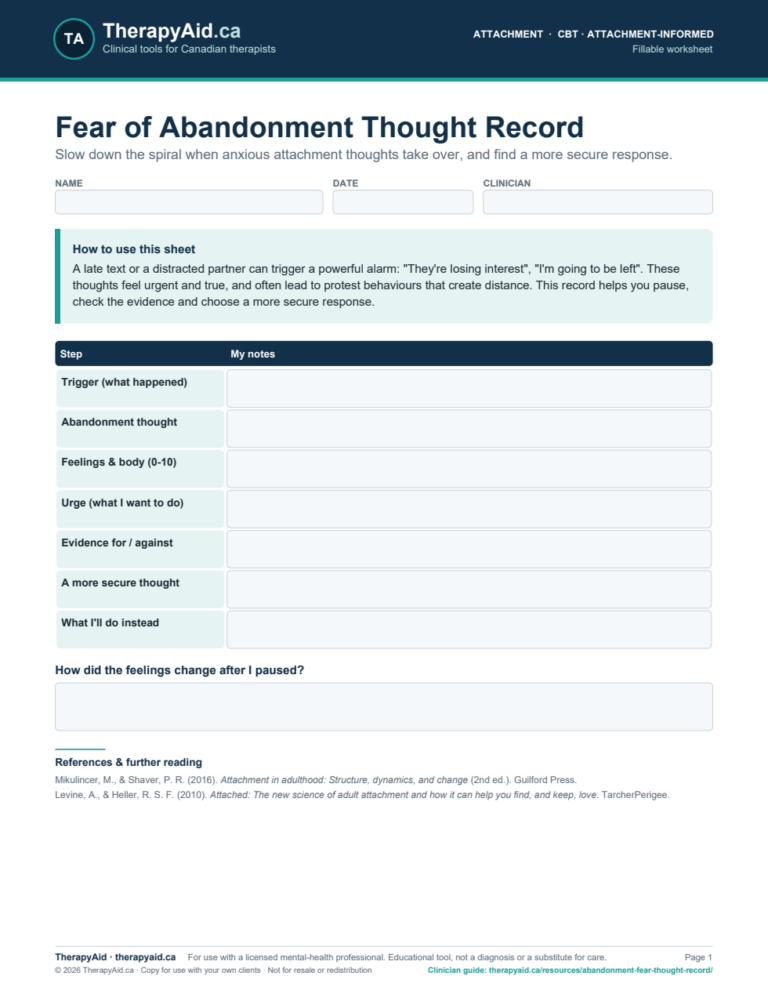
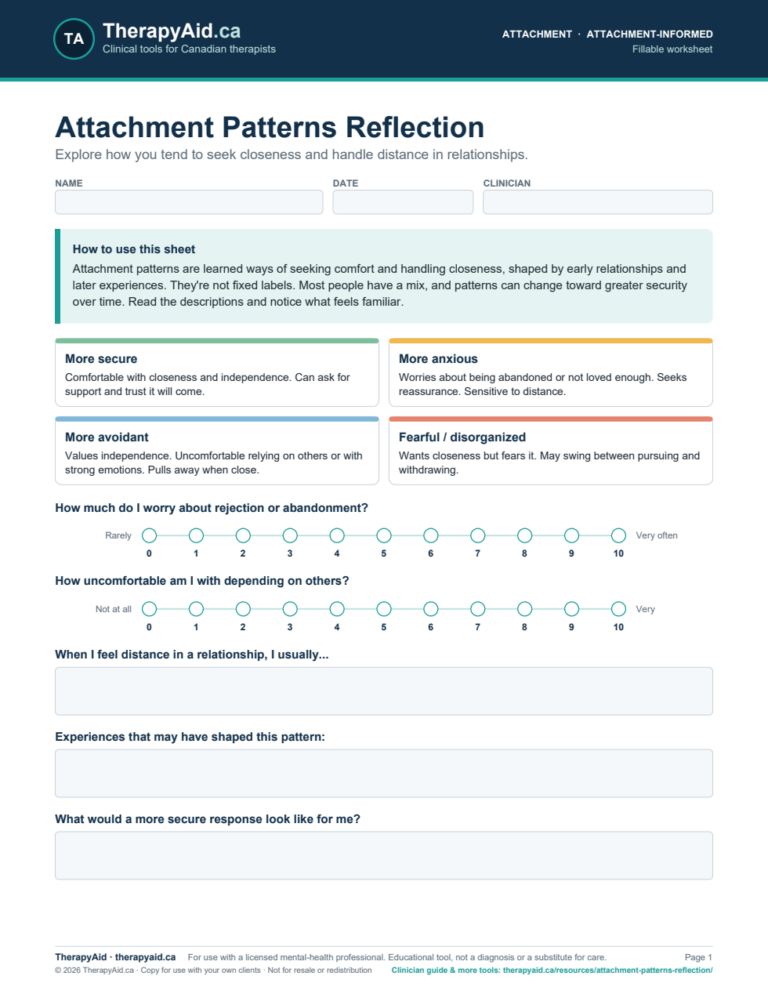
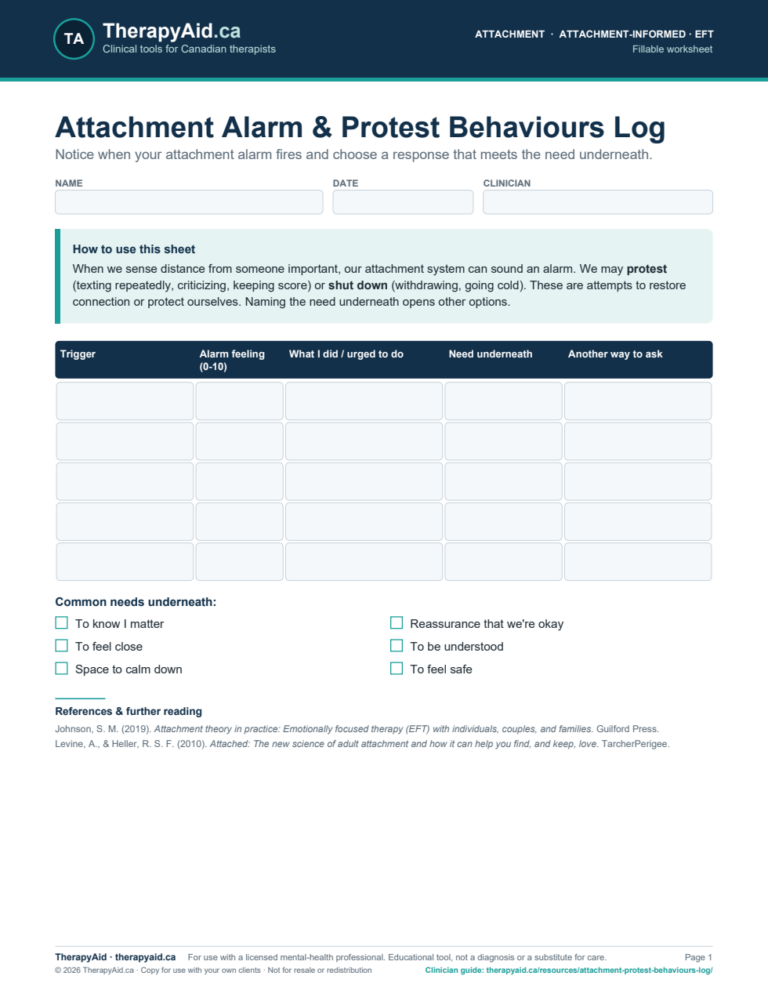
Secure relationships are built on accessibility, responsiveness and engagement, plus support for exploration. These behaviours can be developed intentionally.
Why it works
Johnson (2008) describes accessibility, responsiveness and engagement as key to secure bonds. Partners can serve as secure bases supporting growth (Mikulincer & Shaver, 2016).
When to use it
- Couples therapy
- Building security after insecure patterns
- Parenting adaptations
- Relationship education
How to use it in session
- Rate behaviours.
- Choose areas to grow.
- Plan specific actions.
- Share what helps.
- Review together.
Clinician tips
- Keep actions concrete.
- Notice partners’ efforts.
- Adapt for friendships and family.
Worked example
Sharing with clients
Members can download the PDF to print or email, or copy a private client link from the download box. Your client opens the link and downloads the worksheet on any device. No client account is needed, and nothing your client writes is stored on TherapyAid.
Frequently asked questions
Can adults become more secure?
Yes. Responsive relationships can strengthen security over time.
What is a secure base?
A person who offers comfort when needed and encourages you to explore and grow.
References
Johnson, S. M. (2008). Hold me tight: Seven conversations for a lifetime of love. Little, Brown.
Mikulincer, M., & Shaver, P. R. (2016). Attachment in adulthood: Structure, dynamics, and change (2nd ed.). Guilford Press.
This worksheet is an educational tool for use by, or under the guidance of, a licensed or registered mental-health professional. It is not a diagnostic instrument or a substitute for clinical judgement. If a client is in crisis in Canada, call or text 9-8-8 or call 9-1-1.