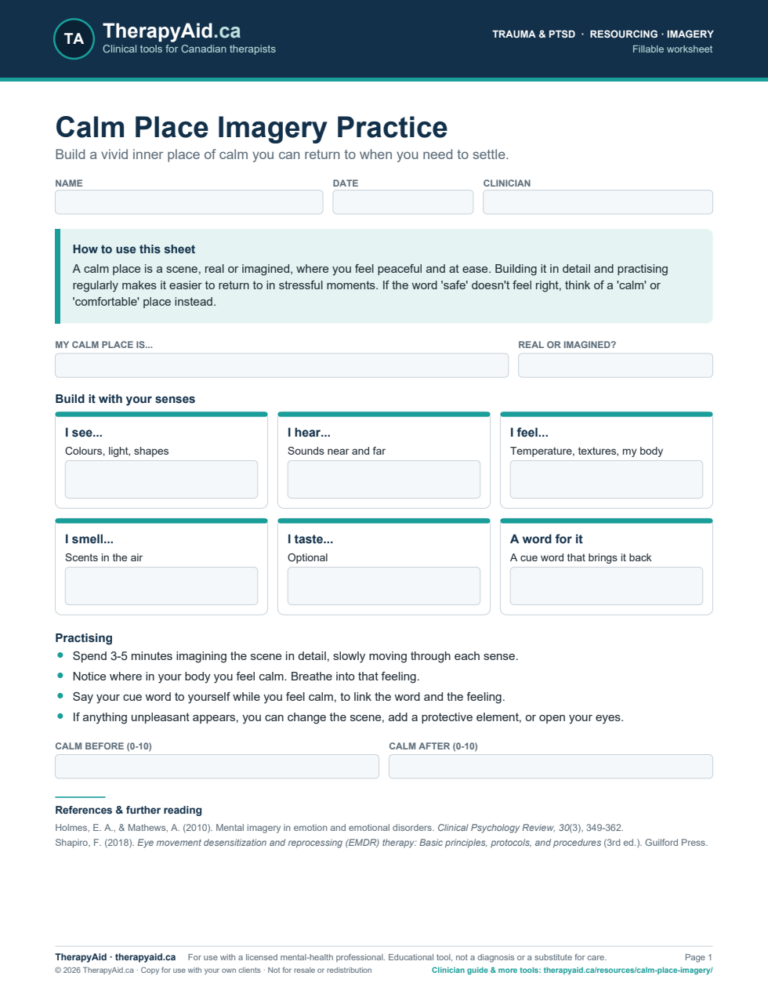
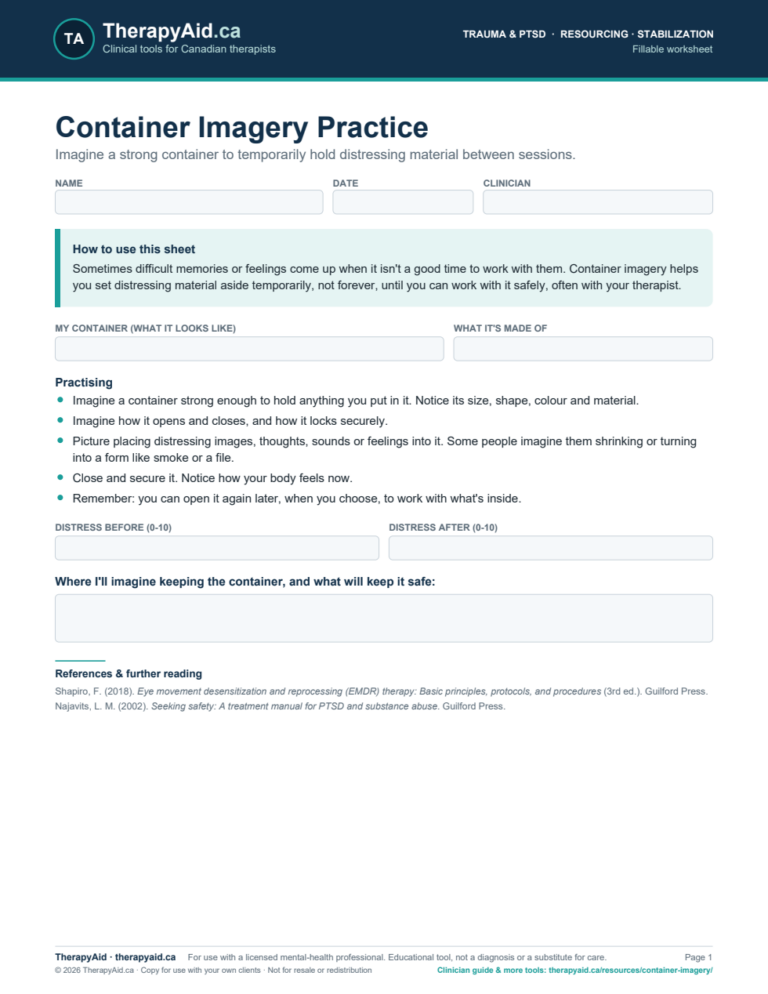
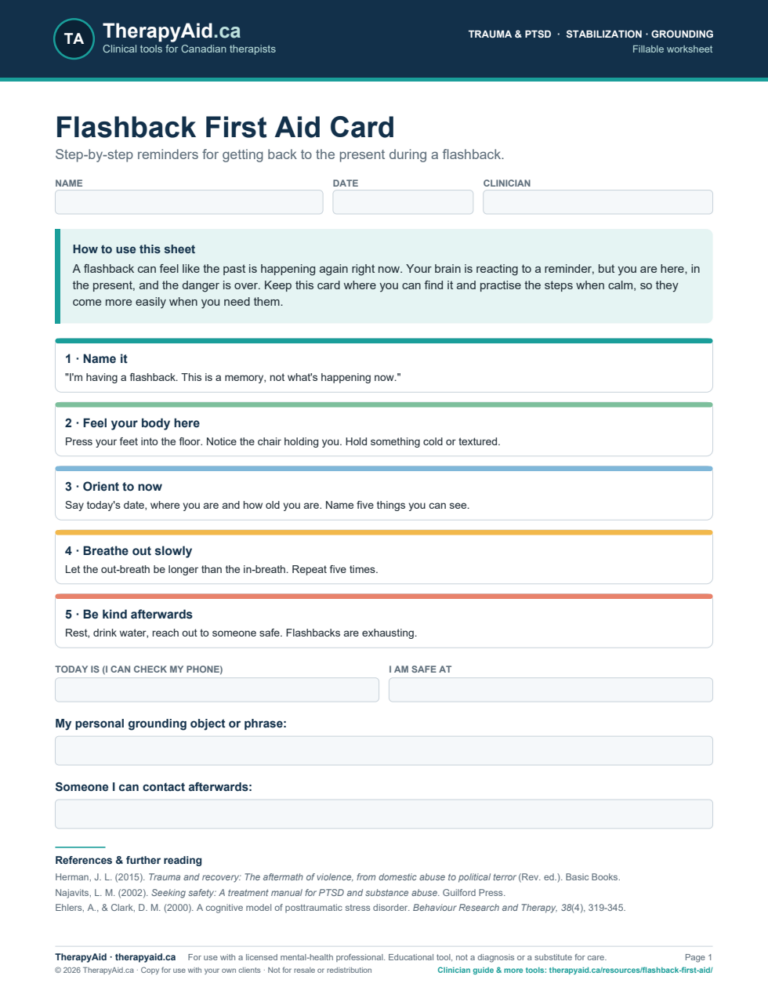
PTSD In-Vivo Exposure Hierarchy
A prolonged-exposure style hierarchy of safe avoided situations rated by distress, with a practice log of distress levels and learning.
1-page fillable PDF · US Letter (prints on A4) · Prolonged exposure
- Approach / concern
- Trauma & PTSD
- Technique
- Prolonged exposure
- Format
- Fillable PDF, 1 page (US Letter / A4)
- Access
- Pro and Advanced plans (3-day free trial)
- For
- Licensed clinicians to use with clients
- Updated
- October 2026
Key facts
What is the PTSD In-Vivo Exposure Hierarchy?
In-vivo exposure helps people with PTSD approach safe situations they avoid, reducing fear and avoidance and correcting beliefs about danger and coping.
Why it works
Prolonged exposure is a well-established PTSD treatment that includes in-vivo exposure (Foa et al., 2007). Inhibitory learning approaches emphasize violating expectancies during exposure (Craske et al., 2014).
When to use it
- PTSD with avoidance
- After stabilization
- Prolonged exposure therapy
- Trauma-focused CBT
How to use it in session
- List safe avoided situations.
- Rate distress.
- Order from low to high.
- Practise repeatedly.
- Log learning.
Clinician tips
- Only objectively safe situations.
- Drop safety behaviours over time.
- Focus on what was learned.
Worked example
Sharing with clients
Members can download the PDF to print or email, or copy a private client link from the download box. Your client opens the link and downloads the worksheet on any device. No client account is needed, and nothing your client writes is stored on TherapyAid.
Frequently asked questions
Is exposure safe?
Yes, when it targets safe situations and is planned with a trained clinician.
What if my distress doesn’t drop?
Learning that you can tolerate distress is valuable too. Discuss with your therapist.
References
Foa, E. B., Hembree, E. A., & Rothbaum, B. O. (2007). Prolonged exposure therapy for PTSD: Emotional processing of traumatic experiences. Therapist guide. Oxford University Press.
Craske, M. G., Treanor, M., Conway, C. C., Zbozinek, T., & Vervliet, B. (2014). Maximizing exposure therapy: An inhibitory learning approach. Behaviour Research and Therapy, 58, 10-23.
This worksheet is an educational tool for use by, or under the guidance of, a licensed or registered mental-health professional. It is not a diagnostic instrument or a substitute for clinical judgement. If a client is in crisis in Canada, call or text 9-8-8 or call 9-1-1.