Flashback First Aid Card
A pocket-style trauma stabilization card with five steps for managing flashbacks: naming, body grounding, orienting, slow breathing and aftercare, plus personal fields.
1-page fillable PDF · US Letter (prints on A4) · Stabilization · Grounding
- Approach / concern
- Trauma & PTSD
- Technique
- Stabilization · Grounding
- Format
- Fillable PDF, 1 page (US Letter / A4)
- Access
- Pro and Advanced plans (3-day free trial)
- For
- Licensed clinicians to use with clients
- Updated
- October 2026
Key facts
What is the Flashback First Aid Card?
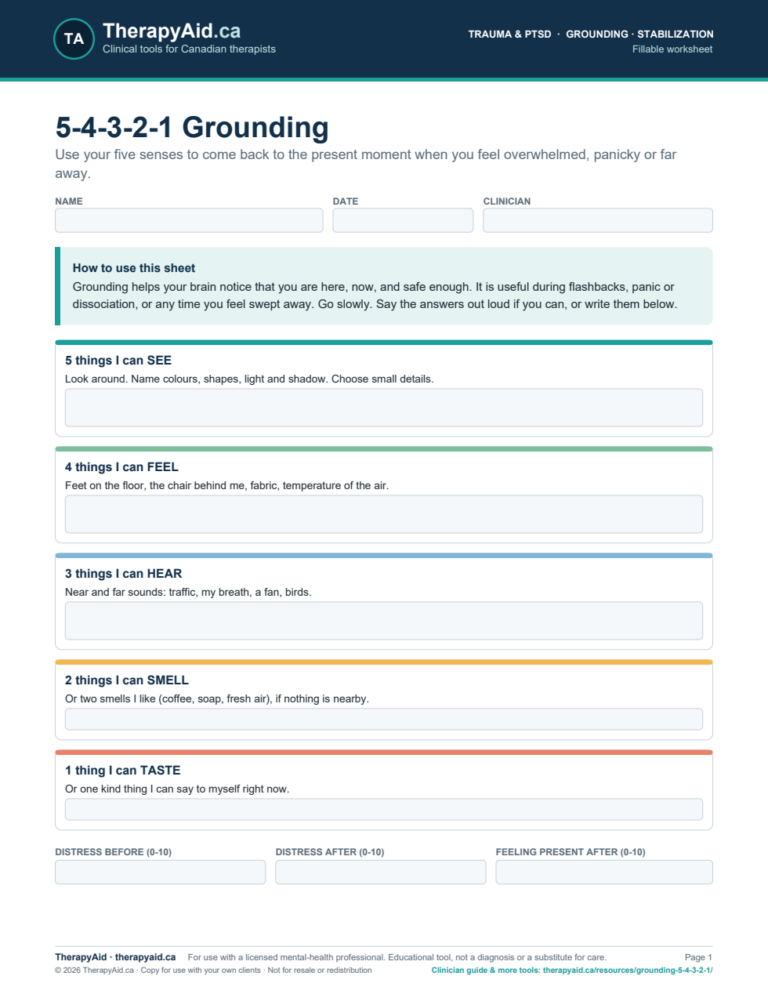
Flashbacks are vivid, intrusive re-experiencing of traumatic memories that can feel as though the event is happening in the present. In cognitive models of PTSD, they arise because trauma memories are poorly integrated and easily triggered by cues (Ehlers & Clark, 2000). Grounding and orienting strategies help re-establish present-moment awareness.
Why it works
Stabilization skills are the first phase of trauma treatment and help clients feel safer and more in control (Herman, 2015). Simple, rehearsed steps are easier to use when thinking is impaired by high arousal (Najavits, 2002).
When to use it
- PTSD and complex trauma
- Clients with intrusive memories
- Early stabilization phase
- Crisis and safety planning
How to use it in session
- Explain why flashbacks happen in plain language.
- Practise each step in session when calm.
- Personalize the grounding object and phrase.
- Suggest keeping the card in a wallet or phone.
- Review after any flashback to refine.
Clinician tips
- Practice when calm is essential.
- Encourage self-compassion after flashbacks.
- Persistent flashbacks call for trauma-focused treatment.
Worked example
Sharing with clients
Members can download the PDF to print or email, or copy a private client link from the download box. Your client opens the link and downloads the worksheet on any device. No client account is needed, and nothing your client writes is stored on TherapyAid.
Frequently asked questions
Can flashbacks be stopped?
Grounding can shorten and soften them. Trauma-focused therapies such as CPT, PE or EMDR can reduce how often they happen.
What’s the difference between a memory and a flashback?
A memory feels like the past; a flashback feels like the past is happening now, often with strong body sensations.
References
Herman, J. L. (2015). Trauma and recovery: The aftermath of violence, from domestic abuse to political terror (Rev. ed.). Basic Books.
Najavits, L. M. (2002). Seeking safety: A treatment manual for PTSD and substance abuse. Guilford Press.
Ehlers, A., & Clark, D. M. (2000). A cognitive model of posttraumatic stress disorder. Behaviour Research and Therapy, 38(4), 319-345.
This worksheet is an educational tool for use by, or under the guidance of, a licensed or registered mental-health professional. It is not a diagnostic instrument or a substitute for clinical judgement. If a client is in crisis in Canada, call or text 9-8-8 or call 9-1-1.