Postpartum Support Plan
A practical planning worksheet completed during pregnancy to organize help with meals, chores and night feeds, protect sleep, identify emotional supports and early warning signs after birth.
2-page fillable PDF · US Letter (prints on A4) · Support planning
- Approach / concern
- Perinatal & Postpartum
- Technique
- Support planning
- Format
- Fillable PDF, 2 pages (US Letter / A4)
- Access
- Pro and Advanced plans (3-day free trial)
- For
- Licensed clinicians to use with clients
- Updated
- October 2026
Key facts
What is the Postpartum Support Plan?
A postpartum support plan prepares new parents for the practical and emotional demands of the weeks after birth. Planning in advance makes it easier to accept help, protects sleep and identifies who to contact if mood changes.
Why it works
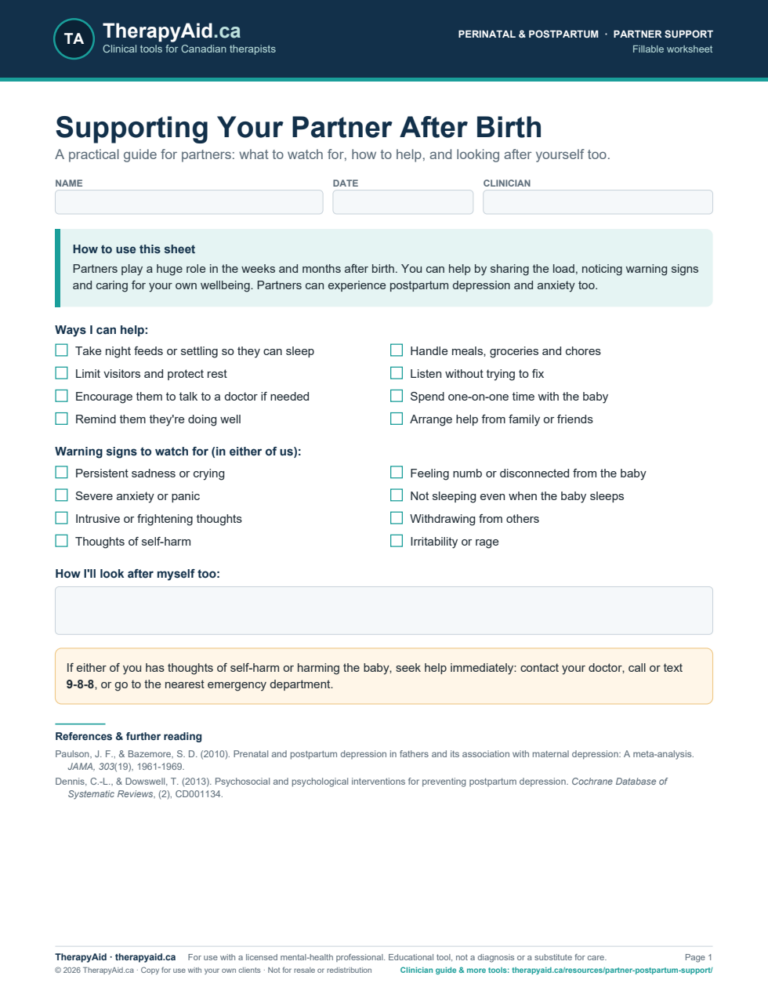
Social support and practical help are protective factors for perinatal mental health, and psychosocial interventions can reduce the risk of postpartum depression (Dennis & Dowswell, 2013). Advance planning reduces the burden of asking for help when parents are exhausted.
When to use it
- Third trimester of pregnancy
- Clients with previous postpartum depression or anxiety
- Parents with limited family support
- Adoptive and surrogate families (adapted)
How to use it in session
- Introduce the plan in the third trimester.
- Complete it with the partner and key supports if possible.
- Be specific about names, tasks and frequency.
- Identify warning signs and professional contacts.
- Share copies and review after birth.
Clinician tips
- Encourage asking for specific help (“Could you bring dinner on Tuesdays?”).
- Discuss visitor boundaries in advance.
- Plan for the non-birthing parent’s wellbeing too.
Worked example
Sharing with clients
Members can download the PDF to print or email, or copy a private client link from the download box. Your client opens the link and downloads the worksheet on any device. No client account is needed, and nothing your client writes is stored on TherapyAid.
Frequently asked questions
When is the best time to make this plan?
Around 28-34 weeks of pregnancy, when there is still energy and time to arrange support.
What if we don’t have family nearby?
Include community resources such as public health nurses, parent groups, postpartum doulas and online peer support.
References
Dennis, C.-L., & Dowswell, T. (2013). Psychosocial and psychological interventions for preventing postpartum depression. Cochrane Database of Systematic Reviews, (2), CD001134.
O’Hara, M. W., & McCabe, J. E. (2013). Postpartum depression: Current status and future directions. Annual Review of Clinical Psychology, 9, 379-407.
This worksheet is an educational tool for use by, or under the guidance of, a licensed or registered mental-health professional. It is not a diagnostic instrument or a substitute for clinical judgement. If a client is in crisis in Canada, call or text 9-8-8 or call 9-1-1.