Rest Plan for New Parents
A perinatal rest plan scheduling night duty and protected sleep blocks for parents across a week, with rest helpers.
1-page fillable PDF · US Letter (prints on A4) · Perinatal sleep · Mental health
- Approach / concern
- Perinatal & Postpartum
- Technique
- Perinatal sleep · Mental health
- Format
- Fillable PDF, 1 page (US Letter / A4)
- Access
- Pro and Advanced plans (3-day free trial)
- For
- Licensed clinicians to use with clients
- Updated
- October 2026
Key facts
What is the Rest Plan for New Parents?
Sleep deprivation in the postpartum period is linked with mood symptoms. Sharing night care and protecting sleep blocks can support parental mental health.
Why it works
Behavioural approaches support healthy infant sleep over time (Mindell et al., 2006). Postpartum depression is common and influenced by stressors including sleep loss (O’Hara & McCabe, 2013).
When to use it
- New parents
- Postpartum depression and anxiety
- Partners sharing care
- Parents of twins or high-needs babies
How to use it in session
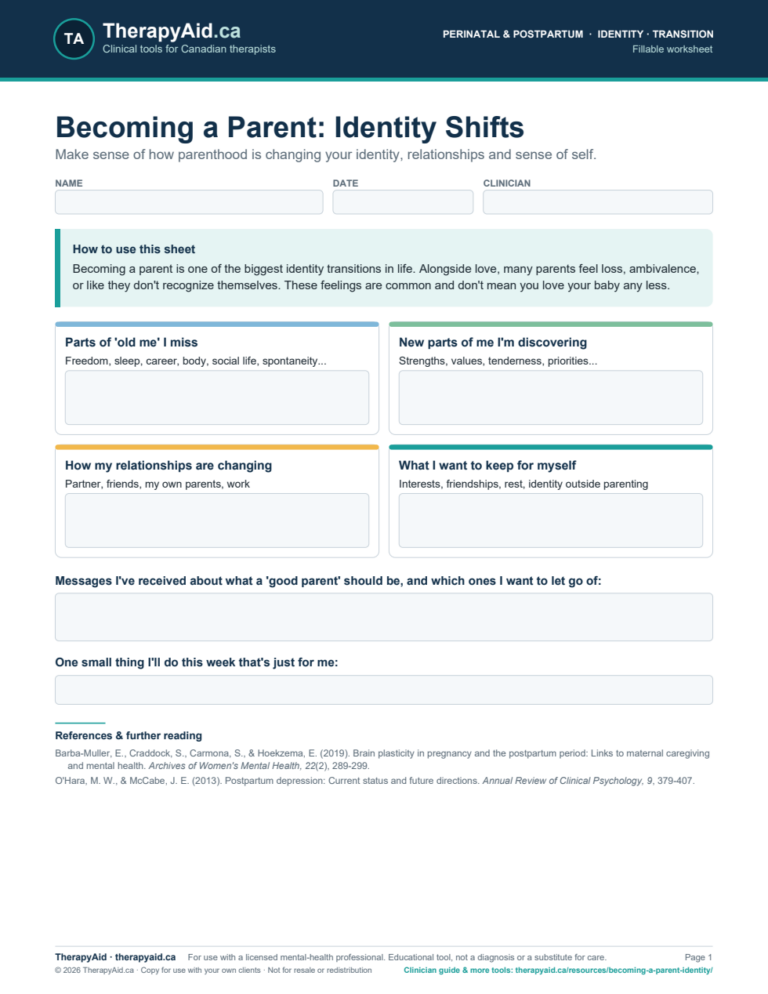
- Plan shifts.
- Protect sleep blocks.
- Track rest.
- Use helpers.
- Adjust weekly.
Clinician tips
- Adapt for breastfeeding (e.g. pumping or partner settling).
- Follow safe sleep guidance for babies.
- Screen for postpartum mood disorders.
Worked example
Sharing with clients
Members can download the PDF to print or email, or copy a private client link from the download box. Your client opens the link and downloads the worksheet on any device. No client account is needed, and nothing your client writes is stored on TherapyAid.
Frequently asked questions
How can we get more sleep with a newborn?
Taking shifts and protecting a block of sleep for each parent helps.
Is sleep loss linked to postpartum depression?
Yes. Protecting sleep is an important part of perinatal mental health.
References
Mindell, J. A., Kuhn, B., Lewin, D. S., Meltzer, L. J., & Sadeh, A. (2006). Behavioral treatment of bedtime problems and night wakings in infants and young children. Sleep, 29(10), 1263-1276.
O’Hara, M. W., & McCabe, J. E. (2013). Postpartum depression: Current status and future directions. Annual Review of Clinical Psychology, 9, 379-407.
This worksheet is an educational tool for use by, or under the guidance of, a licensed or registered mental-health professional. It is not a diagnostic instrument or a substitute for clinical judgement. If a client is in crisis in Canada, call or text 9-8-8 or call 9-1-1.