Pain Flare Plan
A chronic pain self-management worksheet for planning flare-ups in advance: early signs, calming strategies, activity adjustment, helpful thoughts, supports, things to avoid and return to routine.
2-page fillable PDF · US Letter (prints on A4) · Pain self-management
- Approach / concern
- Chronic Pain
- Technique
- Pain self-management
- Format
- Fillable PDF, 2 pages (US Letter / A4)
- Access
- Pro and Advanced plans (3-day free trial)
- For
- Licensed clinicians to use with clients
- Updated
- October 2026
Key facts
What is the Pain Flare Plan?
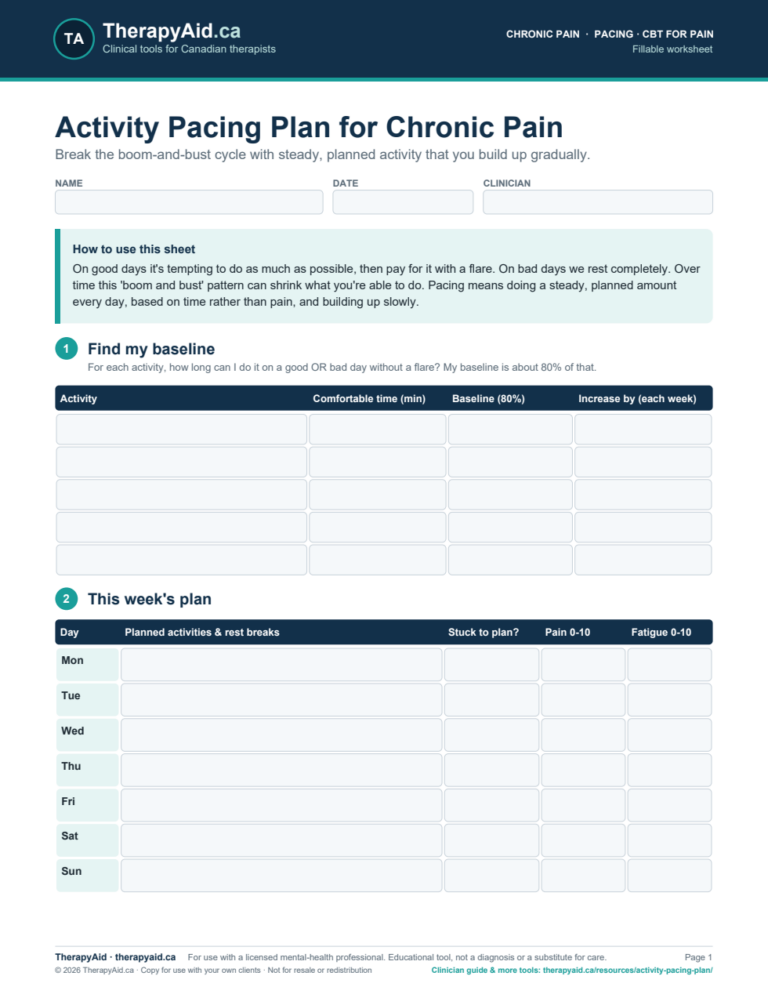
A flare plan is a written self-management plan prepared in advance for periods of increased pain. It helps people respond calmly, avoid unhelpful extremes such as total rest or overexertion, and return to their usual activity plan.
Why it works
CBT for chronic pain teaches self-management skills including pacing, relaxation and cognitive coping, and is effective for reducing pain-related distress and disability (Ehde et al., 2014). Planning for flares supports consistent pacing (Nielson et al., 2013).
When to use it
- Chronic musculoskeletal pain
- Fibromyalgia and headache disorders
- After injury with persistent pain
- Alongside physiotherapy
How to use it in session
- Complete the plan when pain is stable.
- Identify early flare signs.
- Choose strategies in each of the four areas.
- List things to avoid and red flags for medical review.
- Review and update after each flare.
Clinician tips
- Keep the plan visible (fridge, phone).
- Coordinate red flags with the client’s physician.
- Normalize flares to reduce fear and catastrophizing.
Worked example
Sharing with clients
Members can download the PDF to print or email, or copy a private client link from the download box. Your client opens the link and downloads the worksheet on any device. No client account is needed, and nothing your client writes is stored on TherapyAid.
Frequently asked questions
Should I rest completely during a flare?
Short rest can help, but complete rest for long periods usually leads to more stiffness and deconditioning. Reduce activity rather than stopping.
When should I see a doctor about pain?
If you notice new or different symptoms, or red flags your doctor has identified.
References
Nielson, W. R., Jensen, M. P., Karsdorp, P. A., & Vlaeyen, J. W. S. (2013). Activity pacing in chronic pain: Concepts, evidence, and future directions. The Clinical Journal of Pain, 29(5), 461-468.
Ehde, D. M., Dillworth, T. M., & Turner, J. A. (2014). Cognitive-behavioral therapy for individuals with chronic pain: Efficacy, innovations, and directions for research. American Psychologist, 69(2), 153-166.
This worksheet is an educational tool for use by, or under the guidance of, a licensed or registered mental-health professional. It is not a diagnostic instrument or a substitute for clinical judgement. If a client is in crisis in Canada, call or text 9-8-8 or call 9-1-1.