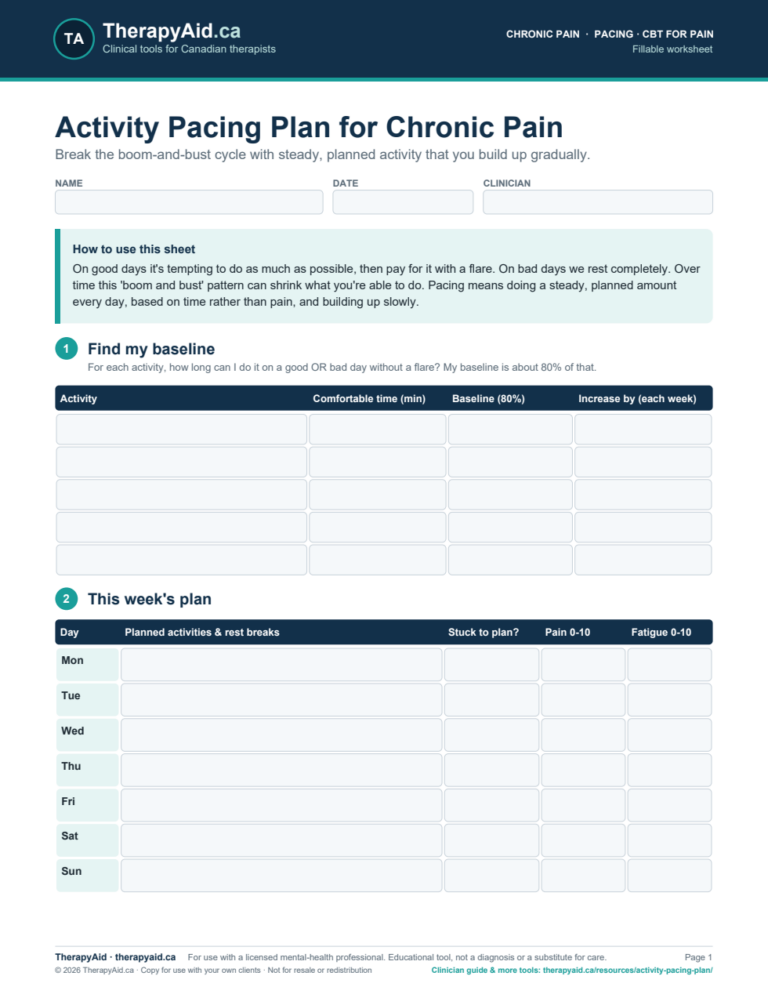
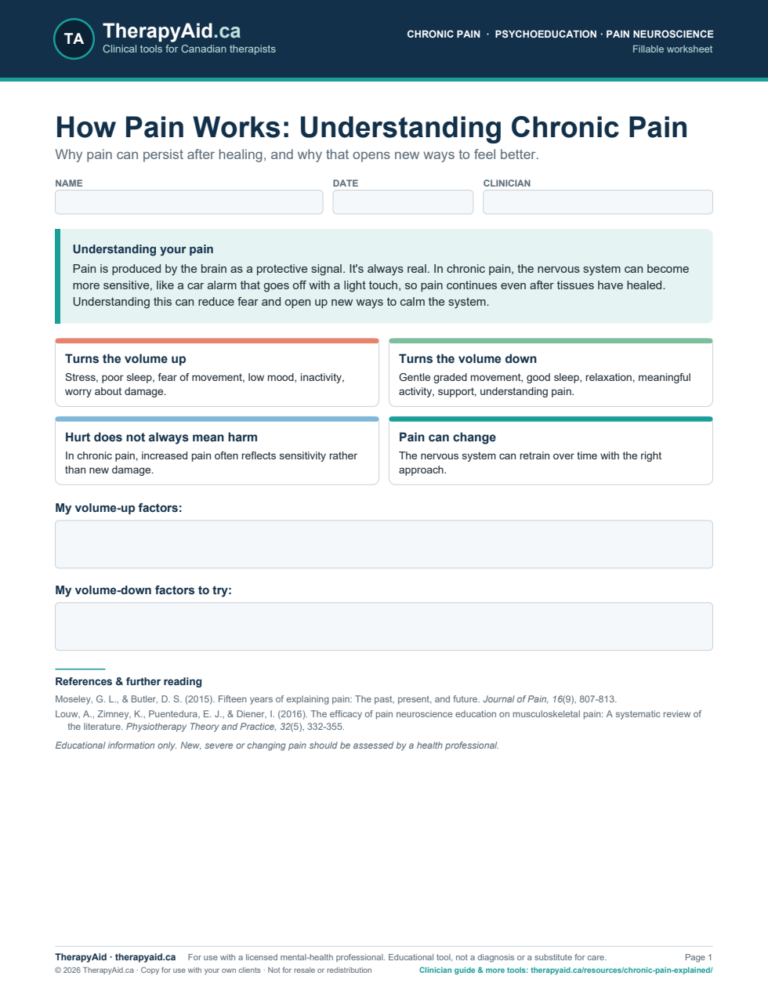
Movement Fear Ladder (Pain-Related Fear)
A chronic pain graded-exposure worksheet ranking feared movements and activities, with predictions and a practice record of outcomes and fear ratings.
2-page fillable PDF · US Letter (prints on A4) · Graded exposure
- Approach / concern
- Chronic Pain
- Technique
- Graded exposure
- Format
- Fillable PDF, 2 pages (US Letter / A4)
- Access
- Pro and Advanced plans (3-day free trial)
- For
- Licensed clinicians to use with clients
- Updated
- October 2026
Key facts
What is the Movement Fear Ladder (Pain-Related Fear)?
The fear-avoidance model proposes that pain catastrophizing leads to fear of movement and avoidance, which increase disability. Graded exposure in vivo gradually confronts feared movements to reduce fear and improve function.
Why it works
The fear-avoidance model is well established in chronic musculoskeletal pain (Vlaeyen & Linton, 2000). Graded exposure reduced pain-related fear and disability in early experimental studies (Vlaeyen et al., 2001).
When to use it
- Chronic low back and musculoskeletal pain
- Fear of re-injury
- Avoidance limiting daily activities
- Alongside physiotherapy
How to use it in session
- Identify avoided movements and activities.
- Rate fear and order the ladder.
- Coordinate with medical and physio guidance.
- Practise steps and test predictions.
- Progress gradually.
Clinician tips
- Ensure medical clearance and no red flags.
- Distinguish hurt from harm.
- Combine with pacing and pain thought reframing.
Worked example
Sharing with clients
Members can download the PDF to print or email, or copy a private client link from the download box. Your client opens the link and downloads the worksheet on any device. No client account is needed, and nothing your client writes is stored on TherapyAid.
Frequently asked questions
Is it safe to do movements I’m afraid of?
Only with medical guidance. For many chronic pain conditions, gradual movement is safe and helpful.
Will this make my pain worse?
Some temporary discomfort is common, but graded exposure aims to increase function and reduce fear over time.
References
Vlaeyen, J. W. S., & Linton, S. J. (2000). Fear-avoidance and its consequences in chronic musculoskeletal pain: A state of the art. Pain, 85(3), 317-332.
Vlaeyen, J. W. S., de Jong, J., Geilen, M., Heuts, P. H. T. G., & van Breukelen, G. (2001). Graded exposure in vivo in the treatment of pain-related fear: A replicated single-case experimental design in four patients with chronic low back pain. Behaviour Research and Therapy, 39(2), 151-166.
This worksheet is an educational tool for use by, or under the guidance of, a licensed or registered mental-health professional. It is not a diagnostic instrument or a substitute for clinical judgement. If a client is in crisis in Canada, call or text 9-8-8 or call 9-1-1.