Money Conversations for Couples
A couples worksheet exploring each partner's money history, current meaning and worries, plus agreement, differences and next steps on spending, saving, debt and goals.
1-page fillable PDF · US Letter (prints on A4) · Couples · Communication
- Approach / concern
- Couples & Relationships
- Technique
- Couples · Communication
- Format
- Fillable PDF, 1 page (US Letter / A4)
- Access
- Advanced plan
- For
- Licensed clinicians to use with clients
- Updated
- October 2026
Key facts
What is the Money Conversations for Couples?
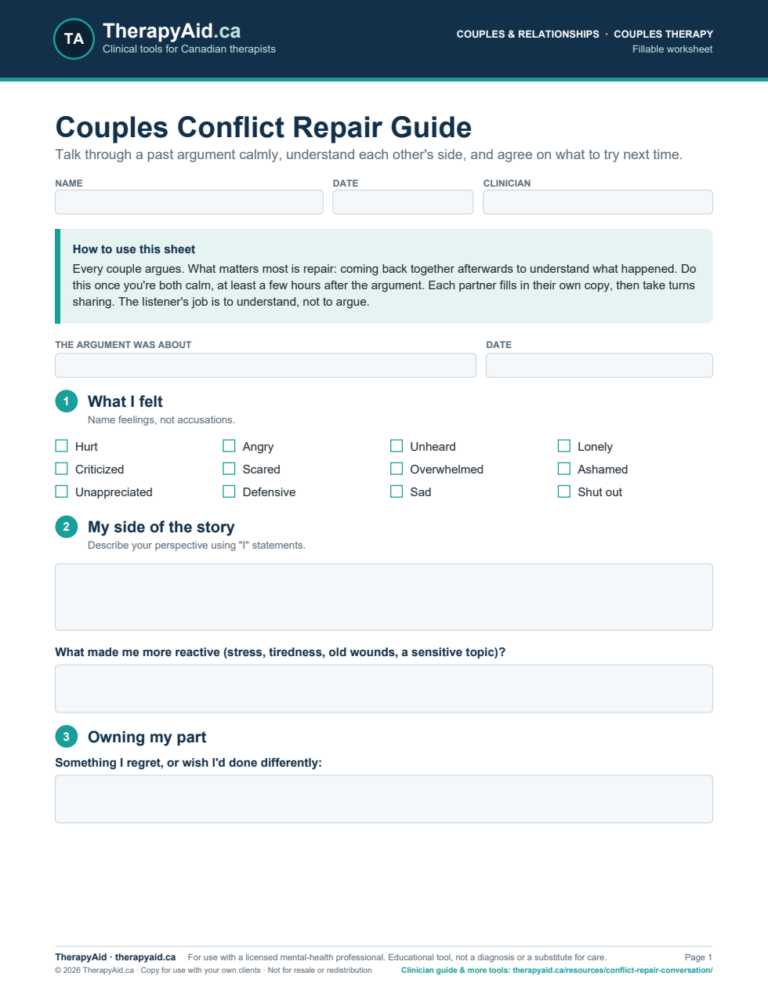
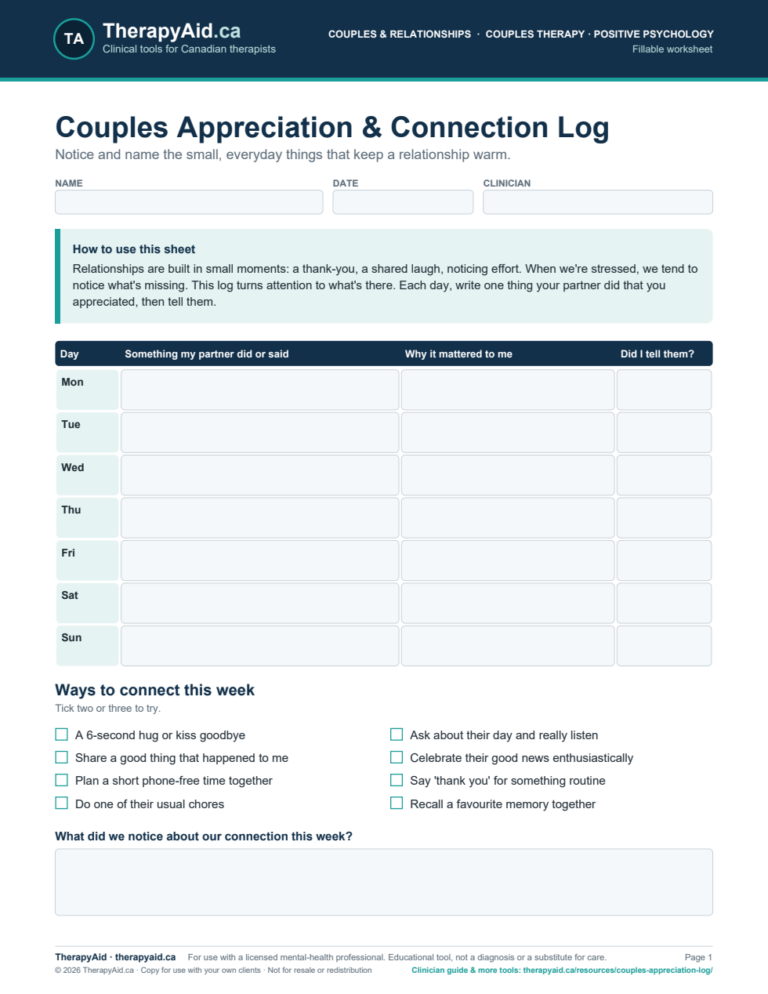
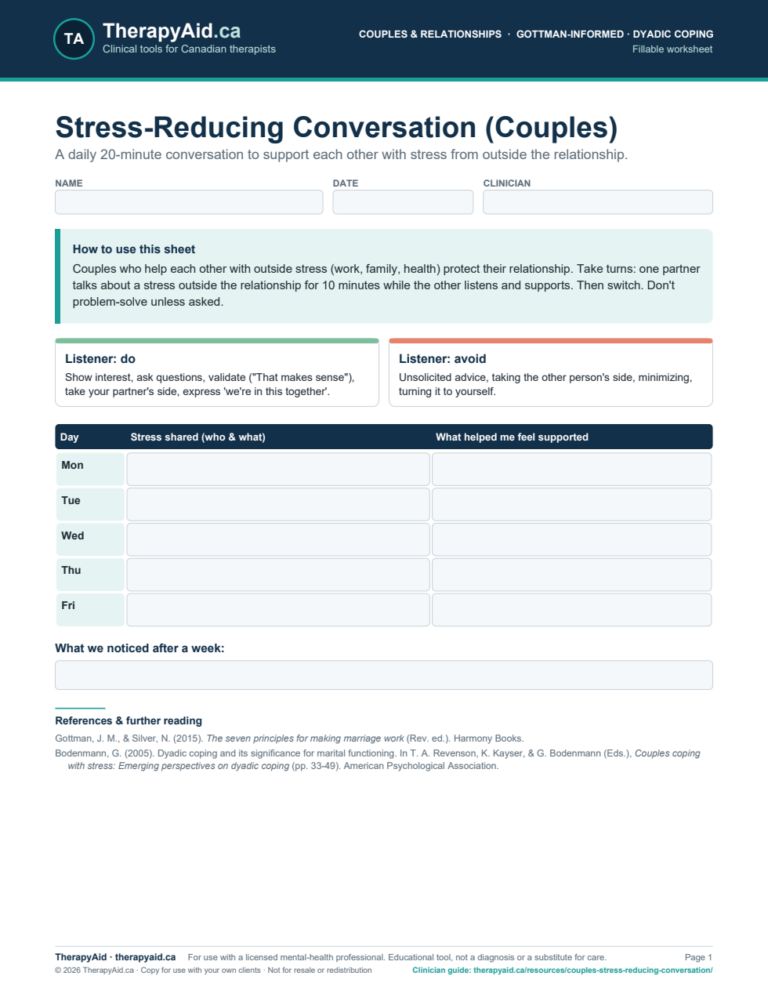
Financial conflict is a common source of couple distress. Exploring money histories and values builds understanding before practical problem-solving.
Why it works
Gottman and Silver (2015) highlight money as a common perpetual issue tied to deeper values. Structured problem-solving helps couples address financial decisions (Markman et al., 2010).
When to use it
- Couples with financial conflict
- Combining finances
- Premarital counselling
- Financial stress
How to use it in session
- Share money stories.
- Name current meanings.
- Identify worries.
- Map agreements and differences.
- Plan next steps.
Clinician tips
- Watch for financial control or abuse.
- Keep it about understanding first.
- Screen for intimate partner violence before conjoint work; these exercises assume both partners feel safe.
Worked example
Sharing with clients
Members can download the PDF to print or email, or copy a private client link from the download box. Your client opens the link and downloads the worksheet on any device. No client account is needed, and nothing your client writes is stored on TherapyAid.
Frequently asked questions
Why do we fight about money so much?
Money connects to deep values and histories, so disagreements can feel personal.
Should couples combine finances?
There’s no single right way; choose what fits your values and situation.
References
Gottman, J. M., & Silver, N. (2015). The seven principles for making marriage work (Rev. ed.). Harmony Books.
Markman, H. J., Stanley, S. M., & Blumberg, S. L. (2010). Fighting for your marriage (3rd ed.). Jossey-Bass.
This worksheet is an educational tool for use by, or under the guidance of, a licensed or registered mental-health professional. It is not a diagnostic instrument or a substitute for clinical judgement. If a client is in crisis in Canada, call or text 9-8-8 or call 9-1-1.