When I Pull Away: Noticing Avoidant Patterns
An attachment-informed worksheet identifying deactivating (avoidant) strategies, what they protect against, their costs and a small step toward closeness.
1-page fillable PDF · US Letter (prints on A4) · Attachment-informed
- Approach / concern
- Attachment
- Technique
- Attachment-informed
- Format
- Fillable PDF, 1 page (US Letter / A4)
- Access
- Pro and Advanced plans (3-day free trial)
- For
- Licensed clinicians to use with clients
- Updated
- October 2026
Key facts
What is the When I Pull Away: Noticing Avoidant Patterns?
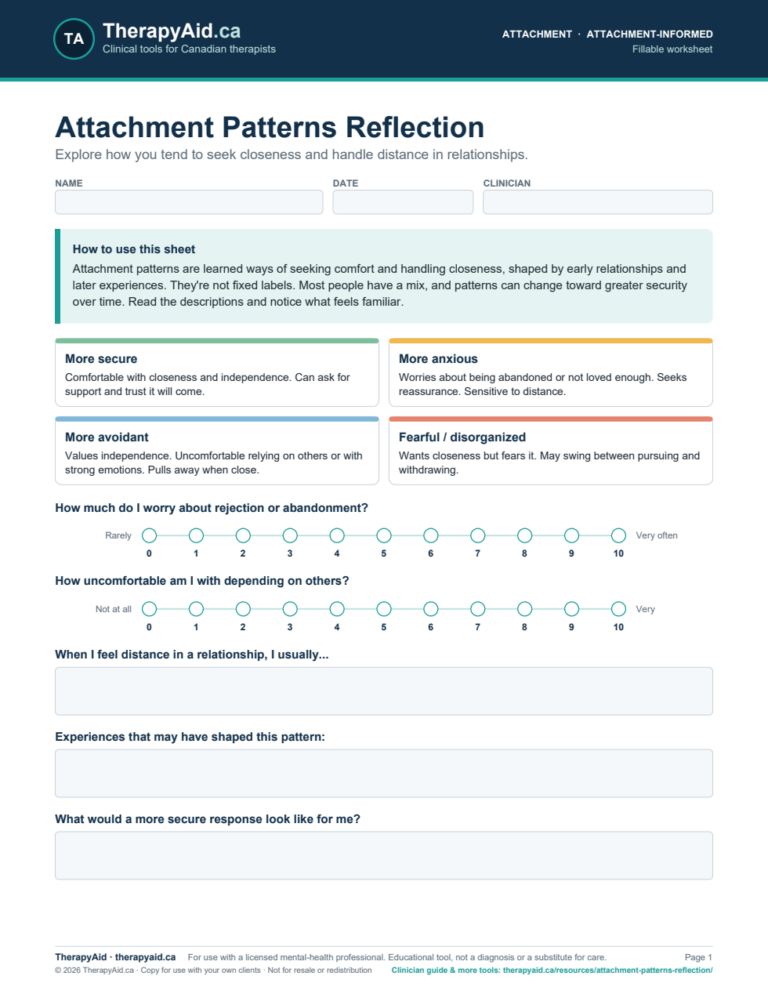
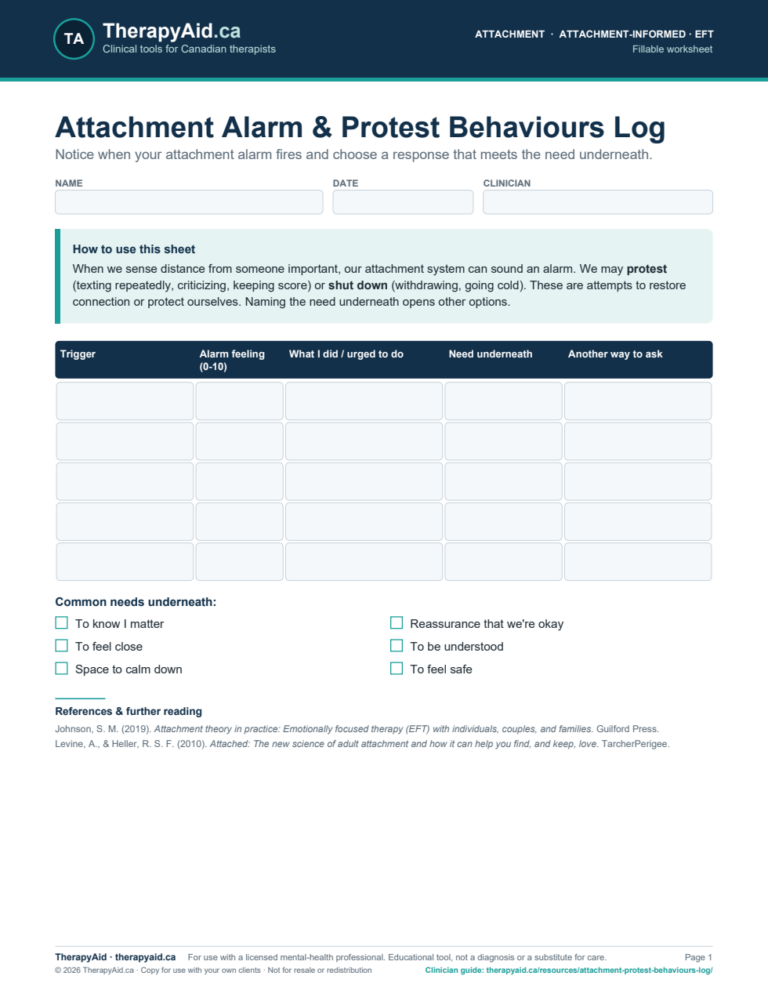
Deactivating strategies minimize attachment needs and emotions to avoid vulnerability. They’re associated with avoidant attachment and can cause relational distance.
Why it works
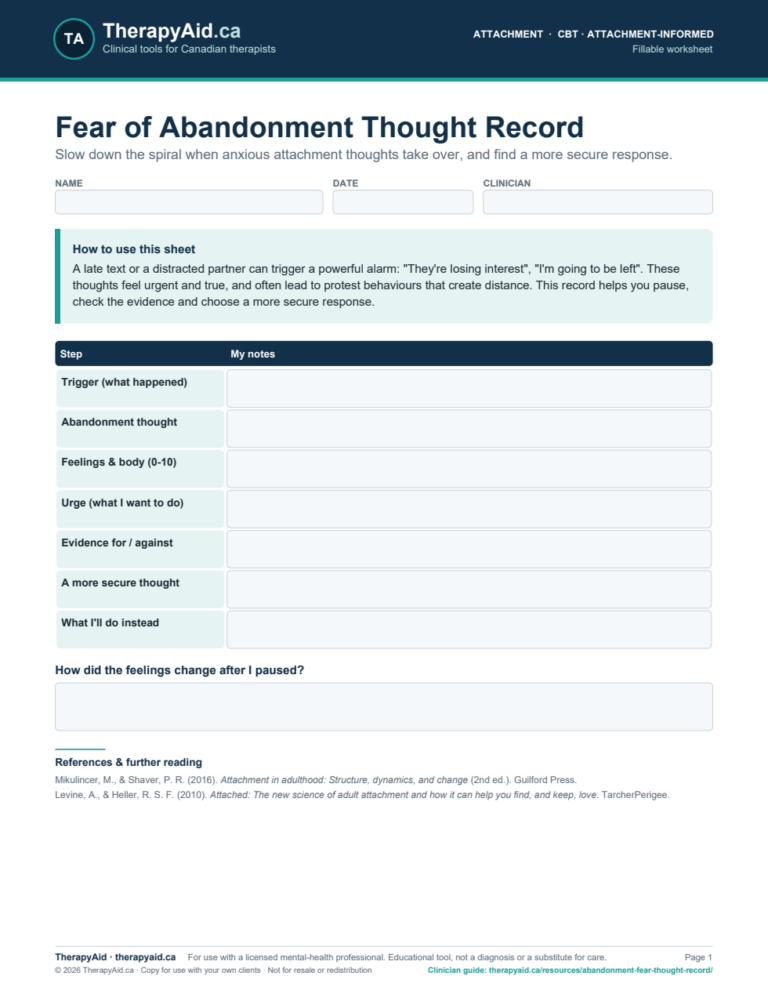
Mikulincer and Shaver (2016) describe deactivating strategies in avoidant attachment. Emotionally focused therapy helps withdrawn partners re-engage (Johnson, 2019).
When to use it
- Avoidant attachment patterns
- Withdrawing partners
- Couples therapy
- Intimacy difficulties
How to use it in session
- Identify strategies.
- Explore protection.
- Weigh costs.
- Choose a small step.
- Reflect.
Clinician tips
- Validate independence as a value.
- Go slowly.
- Avoid pathologizing.
Worked example
Sharing with clients
Members can download the PDF to print or email, or copy a private client link from the download box. Your client opens the link and downloads the worksheet on any device. No client account is needed, and nothing your client writes is stored on TherapyAid.
Frequently asked questions
Is it bad to need space?
No. Space is healthy; it becomes a problem when it prevents closeness you want.
Can avoidant patterns change?
Yes, with awareness, safe relationships and practice.
References
Mikulincer, M., & Shaver, P. R. (2016). Attachment in adulthood: Structure, dynamics, and change (2nd ed.). Guilford Press.
Johnson, S. M. (2019). Attachment theory in practice: Emotionally focused therapy (EFT) with individuals, couples, and families. Guilford Press.
This worksheet is an educational tool for use by, or under the guidance of, a licensed or registered mental-health professional. It is not a diagnostic instrument or a substitute for clinical judgement. If a client is in crisis in Canada, call or text 9-8-8 or call 9-1-1.