DBT at a Glance: Clinician Quick Guide
A one-page clinician quick guide to DBT summarizing the four skill modules, treatment modes and acceptance-change dialectic.
1-page fillable PDF · US Letter (prints on A4) · Clinician quick guide
- Approach / concern
- DBT
- Technique
- Clinician quick guide
- Format
- Fillable PDF, 1 page (US Letter / A4)
- Access
- Pro and Advanced plans (3-day free trial)
- For
- Licensed clinicians to use with clients
- Updated
- October 2026
Key facts
What is the DBT at a Glance: Clinician Quick Guide?
Dialectical behaviour therapy is a comprehensive cognitive-behavioural treatment integrating acceptance-based strategies with change strategies, organized around skills modules and treatment modes.
Why it works
DBT’s skills are detailed in Linehan’s (2015) manual. A Cochrane review found DBT among the psychotherapies with evidence for borderline personality disorder (Storebø et al., 2020).
When to use it
- Emotion dysregulation
- Self-harm and suicidality (with appropriate training)
- Skills groups
- Adolescent DBT
How to use it in session
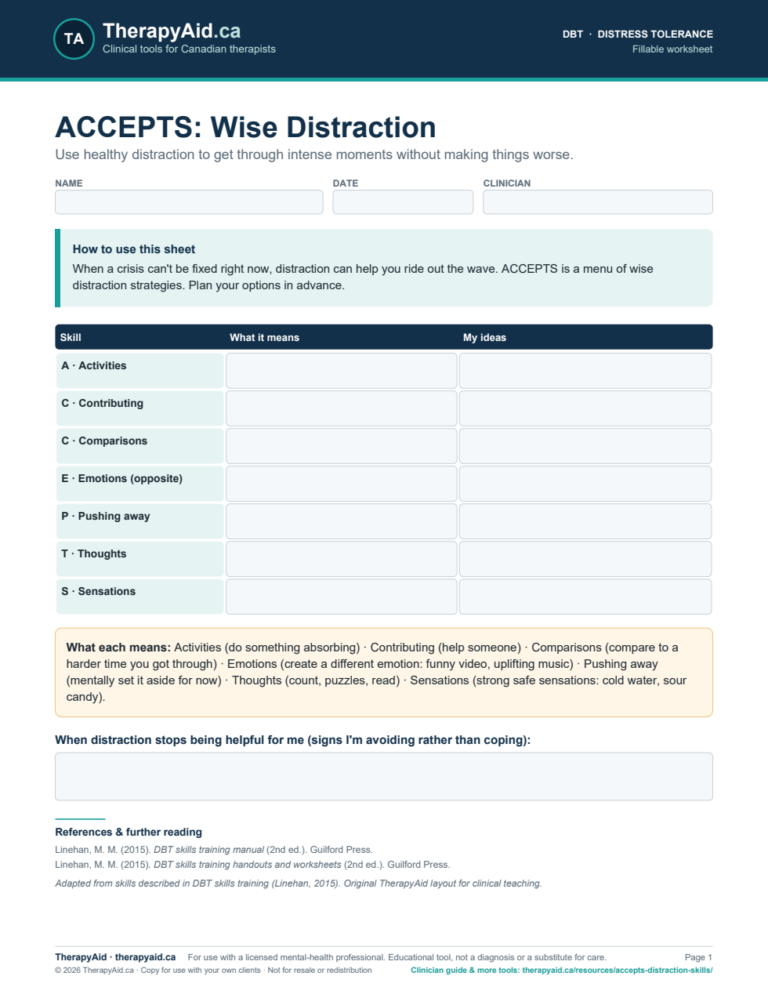
- Review modules.
- Choose skills for the presenting problem.
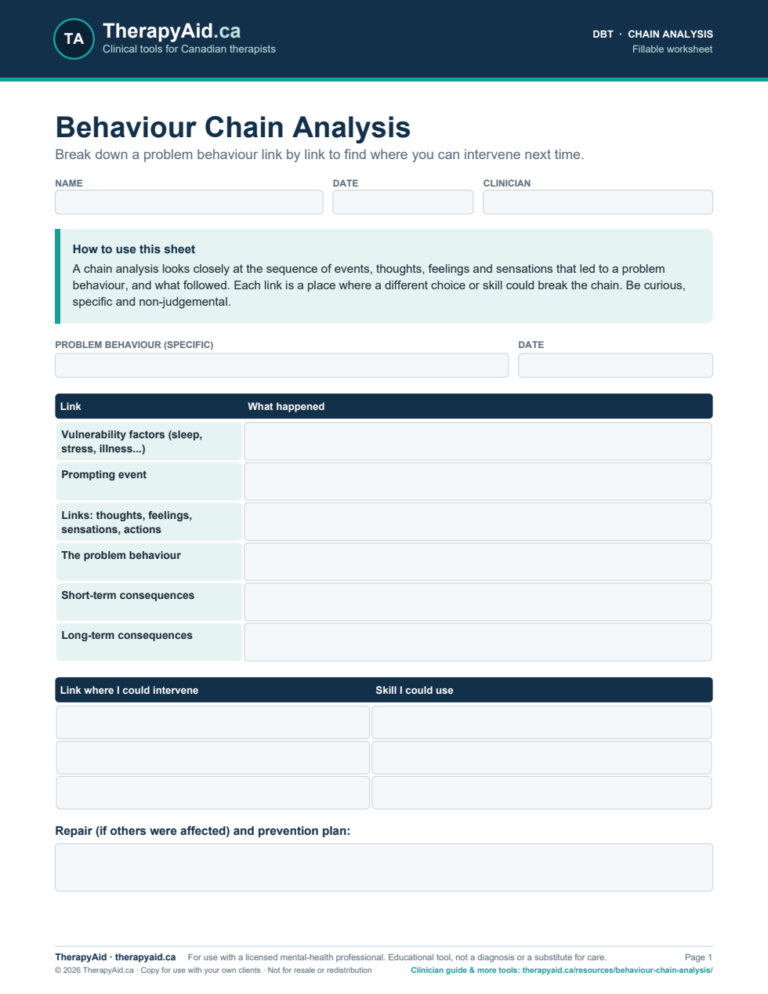
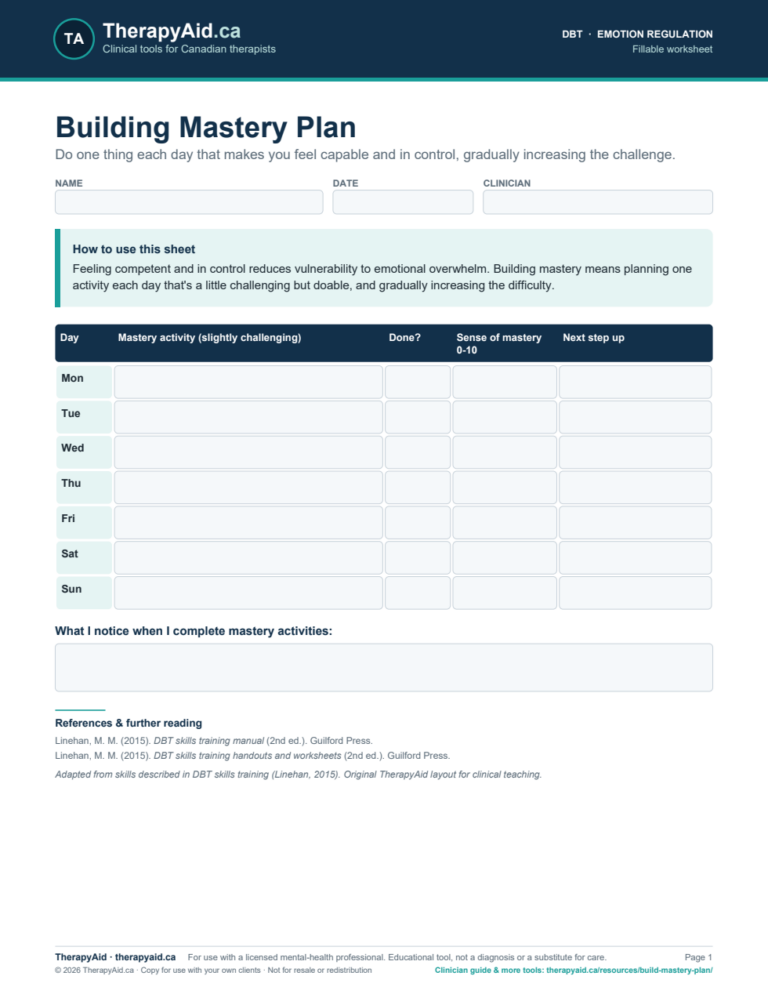
- Link to worksheets.
- Use diary cards and chain analysis.
- Plan generalization.
Clinician tips
- DBT-informed skills work is not full DBT.
- Consult with peers for high-risk clients.
- Validate before pushing change.
Worked example
Sharing with clients
Members can download the PDF to print or email, or copy a private client link from the download box. Your client opens the link and downloads the worksheet on any device. No client account is needed, and nothing your client writes is stored on TherapyAid.
Frequently asked questions
Can I use DBT skills without full DBT?
Many clinicians teach DBT skills; comprehensive DBT includes additional modes and training.
Who benefits from DBT skills?
People with intense emotions, impulsivity, self-harm or relationship difficulties.
References
Linehan, M. M. (2015). DBT skills training manual (2nd ed.). Guilford Press.
Storebø, O. J., Stoffers-Winterling, J. M., Völlm, B. A., Kongerslev, M. T., Mattivi, J. T., Jørgensen, M. S., et al. (2020). Psychological therapies for people with borderline personality disorder. Cochrane Database of Systematic Reviews, (5), CD012955.
This worksheet is an educational tool for use by, or under the guidance of, a licensed or registered mental-health professional. It is not a diagnostic instrument or a substitute for clinical judgement. If a client is in crisis in Canada, call or text 9-8-8 or call 9-1-1.