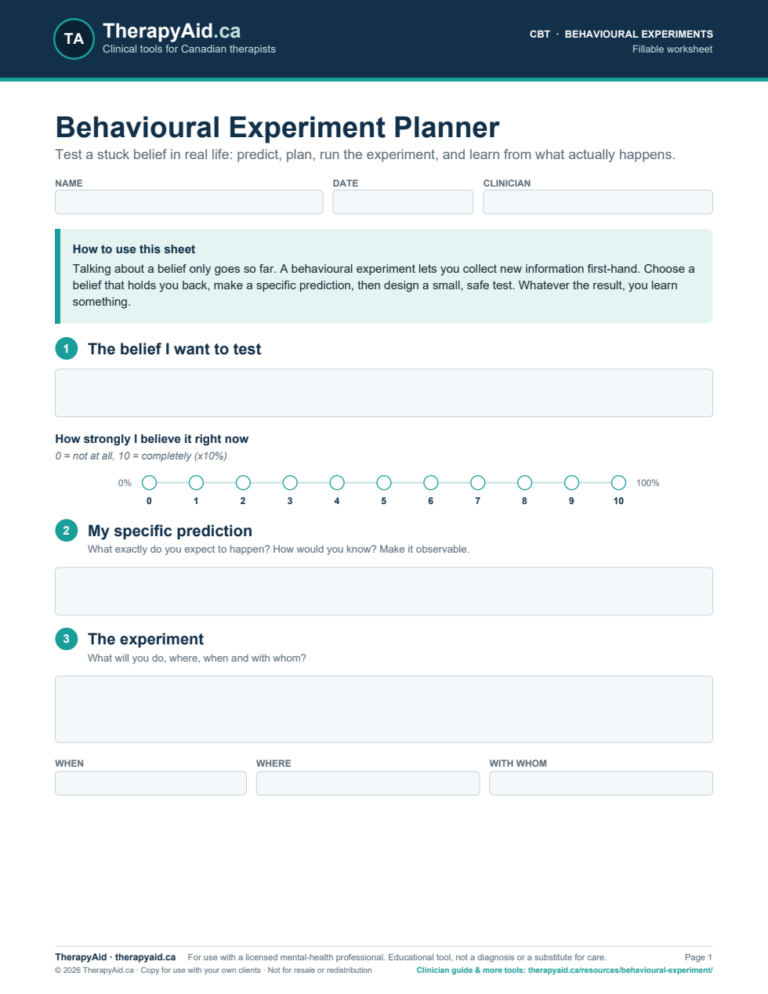
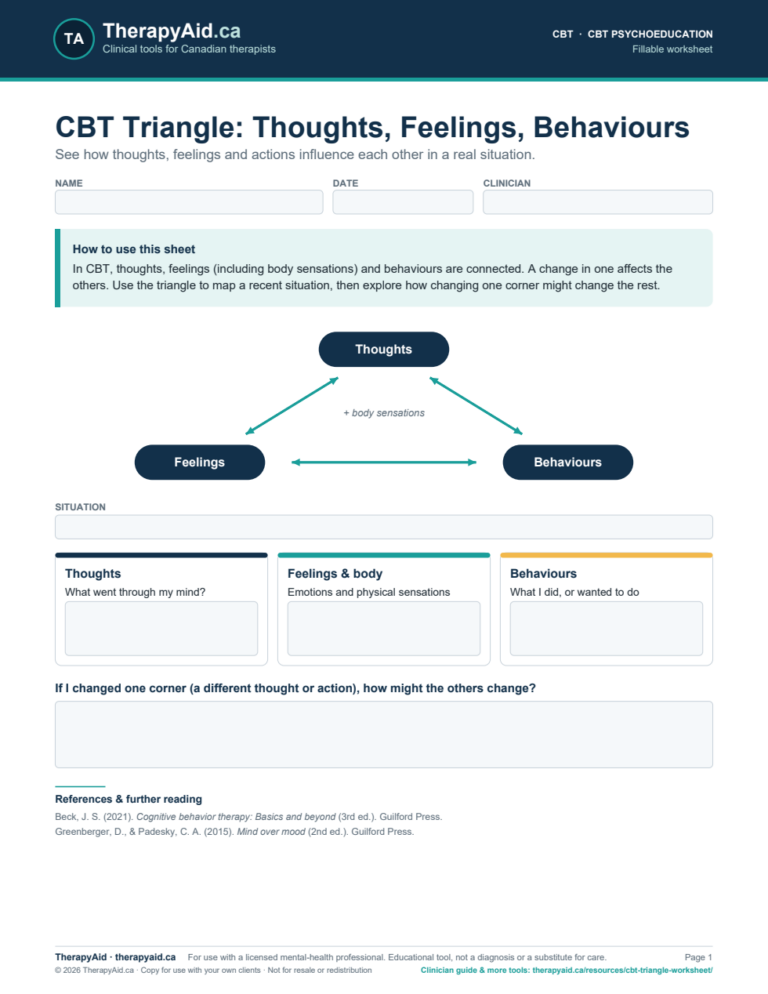
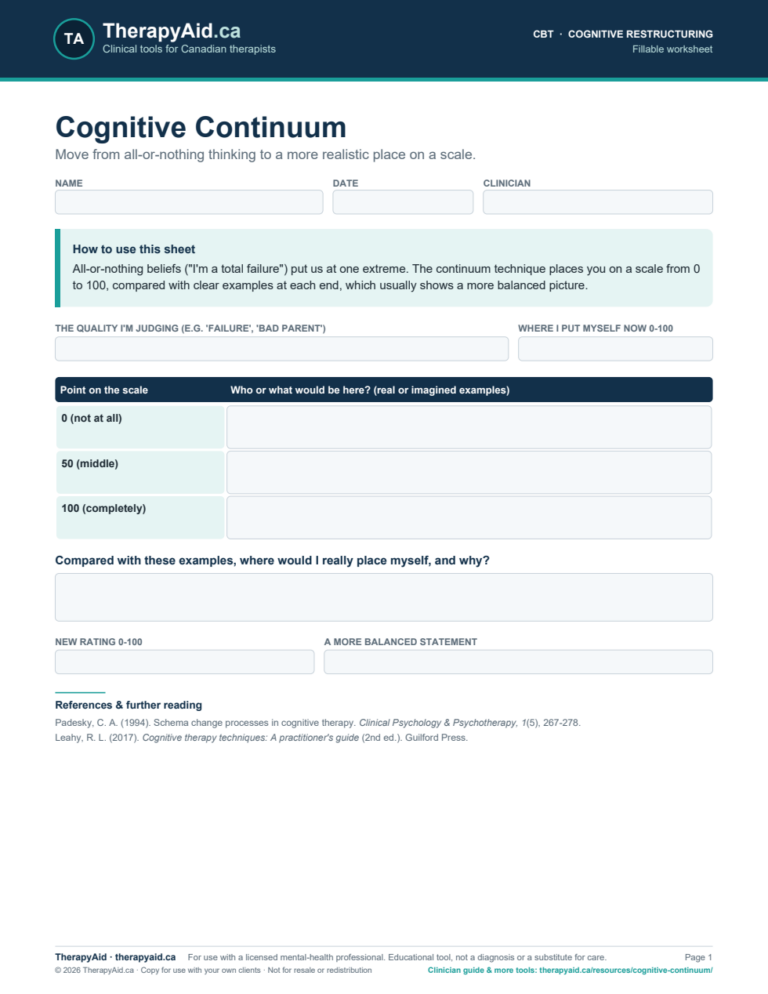
CBT at a Glance: Clinician Quick Guide
A one-page clinician quick guide to CBT covering the cognitive model, key techniques, session structure and conditions with strong evidence.
1-page fillable PDF · US Letter (prints on A4) · Clinician quick guide
- Approach / concern
- CBT
- Technique
- Clinician quick guide
- Format
- Fillable PDF, 1 page (US Letter / A4)
- Access
- Pro and Advanced plans (3-day free trial)
- For
- Licensed clinicians to use with clients
- Updated
- October 2026
Key facts
What is the CBT at a Glance: Clinician Quick Guide?
Cognitive behavioural therapy is a structured, evidence-based psychotherapy that targets the interplay of thoughts, emotions and behaviours, using collaborative empiricism and skills practice.
Why it works
CBT is among the most researched psychotherapies, with meta-analytic support across many conditions (Hofmann et al., 2012). Beck (2021) details the cognitive model and standard session structure.
When to use it
- Trainees and early-career clinicians
- Refreshers before sessions
- Explaining CBT to colleagues
- Supervision
How to use it in session
- Review the model.
- Pick techniques for the formulation.
- Use the session structure.
- Link to worksheets.
- Note client fit.
Clinician tips
- Formulation guides technique choice.
- Homework review signals importance.
- Adapt for culture and neurodiversity.
Worked example
Sharing with clients
Members can download the PDF to print or email, or copy a private client link from the download box. Your client opens the link and downloads the worksheet on any device. No client account is needed, and nothing your client writes is stored on TherapyAid.
Frequently asked questions
Is CBT only about thoughts?
No. Behavioural strategies like activation and exposure are central.
How long is a typical course of CBT?
Often 6-20 sessions, depending on the problem and client.
References
Beck, J. S. (2021). Cognitive behavior therapy: Basics and beyond (3rd ed.). Guilford Press.
Hofmann, S. G., Asnaani, A., Vonk, I. J. J., Sawyer, A. T., & Fang, A. (2012). The efficacy of cognitive behavioral therapy: A review of meta-analyses. Cognitive Therapy and Research, 36(5), 427-440.
This worksheet is an educational tool for use by, or under the guidance of, a licensed or registered mental-health professional. It is not a diagnostic instrument or a substitute for clinical judgement. If a client is in crisis in Canada, call or text 9-8-8 or call 9-1-1.