Body Image Triggers Log
A CBT body image log recording triggering situations, body thoughts, distress, behaviours like checking or avoidance, and kinder responses.
1-page fillable PDF · US Letter (prints on A4) · CBT for body image
- Approach / concern
- Body Image & Eating
- Technique
- CBT for body image
- Format
- Fillable PDF, 1 page (US Letter / A4)
- Access
- Pro and Advanced plans (3-day free trial)
- For
- Licensed clinicians to use with clients
- Updated
- October 2026
Key facts
What is the Body Image Triggers Log?
CBT for body image identifies activating events, appearance-related thoughts and behaviours such as checking and avoidance that maintain distress.
Why it works
Cash’s (2008) body image program uses diaries of triggers, thoughts and behaviours. Positive body image involves protective filtering and self-care (Tylka & Wood-Barcalow, 2015).
When to use it
- Body dissatisfaction
- Eating disorders
- Body dysmorphic concerns
- Teens and adults
How to use it in session
- Log triggers.
- Note thoughts and distress.
- Record behaviours.
- Write kinder responses.
- Review patterns.
Clinician tips
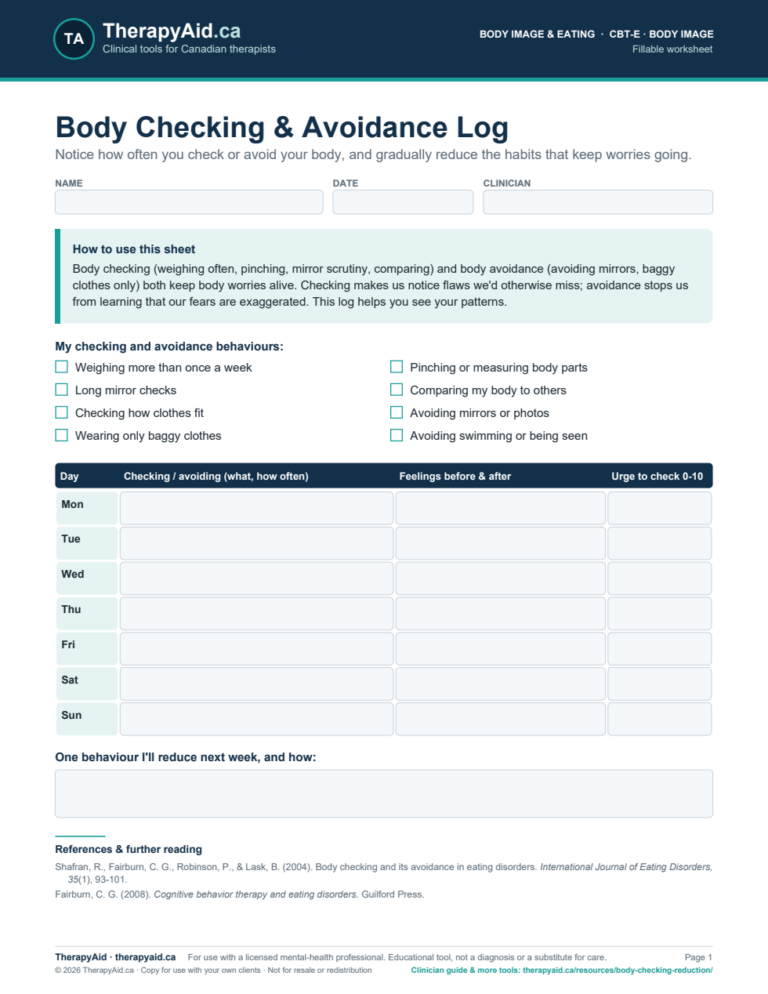
- Notice checking and avoidance.
- Pair with exposure.
- Use compassionate language.
Worked example
Sharing with clients
Members can download the PDF to print or email, or copy a private client link from the download box. Your client opens the link and downloads the worksheet on any device. No client account is needed, and nothing your client writes is stored on TherapyAid.
Frequently asked questions
Why log body image triggers?
Patterns become clearer, helping you prepare and respond differently.
What is body checking?
Repeatedly examining, measuring or pinching your body, which tends to increase distress.
References
Cash, T. F. (2008). The body image workbook: An eight-step program for learning to like your looks (2nd ed.). New Harbinger.
Tylka, T. L., & Wood-Barcalow, N. L. (2015). What is and what is not positive body image? Conceptual foundations and construct definition. Body Image, 14, 118-129.
This worksheet is an educational tool for use by, or under the guidance of, a licensed or registered mental-health professional. It is not a diagnostic instrument or a substitute for clinical judgement. If a client is in crisis in Canada, call or text 9-8-8 or call 9-1-1.