Anger Cycle & Time-Out Plan
A worksheet that maps the four stages of a client's anger cycle and builds a written time-out agreement, with a practice log to review in session.
2-page fillable PDF · US Letter (prints on A4) · CBT · Self-regulation
- Approach / concern
- Anger
- Technique
- CBT · Self-regulation
- Format
- Fillable PDF, 2 pages (US Letter / A4)
- Access
- Pro and Advanced plans (3-day free trial)
- For
- Licensed clinicians to use with clients
- Updated
- October 2026
Key facts
What is the Anger Cycle & Time-Out Plan?
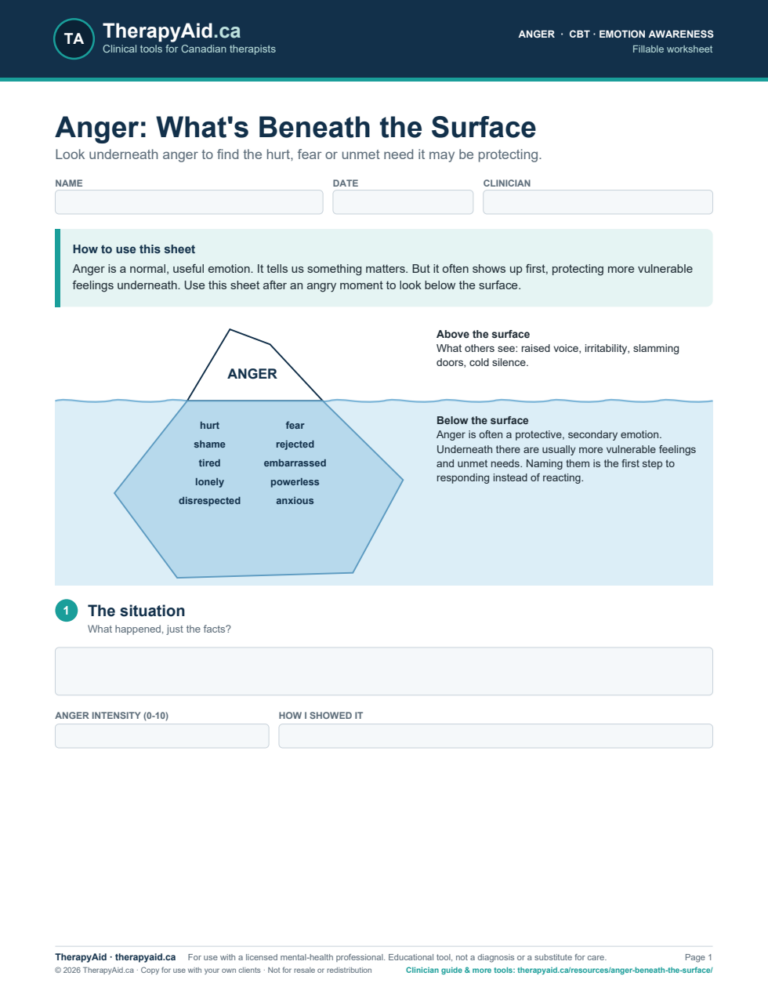
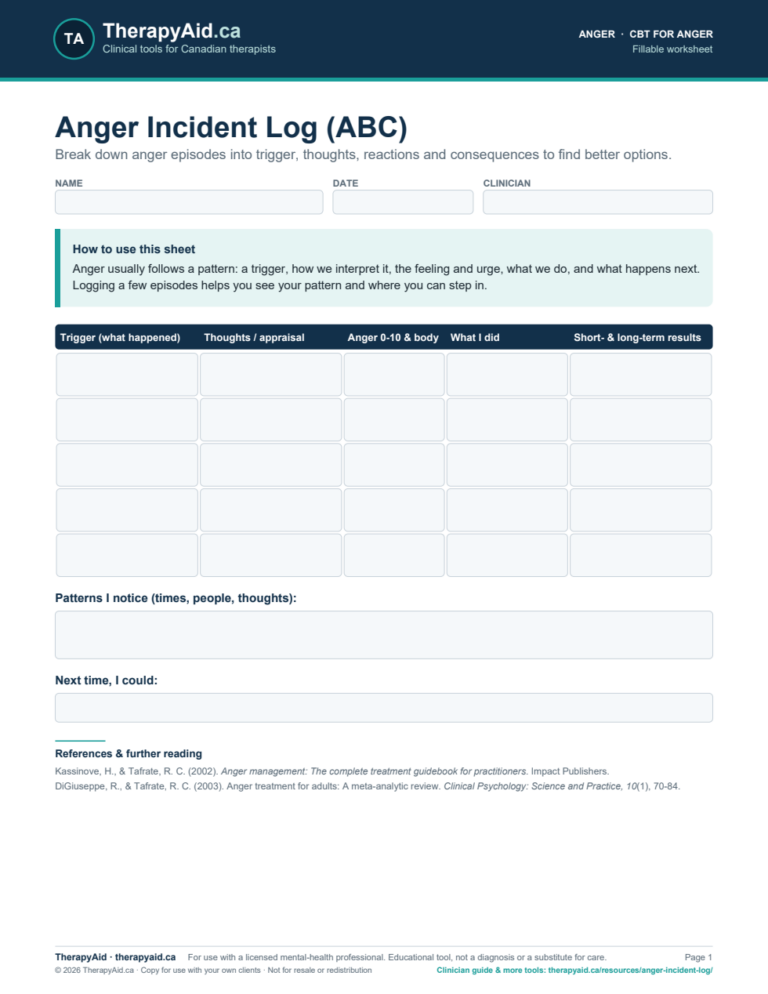
The time-out is one of the most widely taught behavioural strategies in anger management programs. Used well, it is a planned, communicated pause that interrupts escalation and is followed by a return to the conversation. Mapping the anger cycle (triggers, early signs, escalation and aftermath) helps clients notice when to use it.
Why it works
Structured anger-management programs that combine self-monitoring, arousal reduction and planned responses like time-outs are effective for reducing anger and aggression (Beck & Fernandez, 1998; Reilly & Shopshire, 2019). Writing the plan down and sharing it with family members increases follow-through.
When to use it
- Anger management programs
- Couples and family conflict (with both parties agreeing to the plan)
- Parents managing frustration with children
- Clients on probation or in mandated programs
How to use it in session
- Use a recent episode to fill in each stage of the cycle.
- Focus on early signs. That is where time-outs work best.
- Write the exact words the client will use to start a time-out.
- Agree on a length and a commitment to return.
- Review the practice log each week.
Clinician tips
- A time-out without a return becomes stonewalling. Stress coming back.
- If there is risk of violence, prioritize safety planning over communication skills.
- Invite partners to a session so the plan is shared, not sprung on them.
Worked example
Sharing with clients
Members can download the PDF to print or email, or copy a private client link from the download box. Your client opens the link and downloads the worksheet on any device. No client account is needed, and nothing your client writes is stored on TherapyAid.
Frequently asked questions
What if the other person won’t let me leave?
Discuss the plan in advance when everyone is calm, ideally in session. Agreement beforehand makes time-outs far easier.
How long should a time-out be?
Usually 20-60 minutes, which is long enough for the body to calm down. Too short and arousal is still high; too long and it can feel like avoidance.
References
Deffenbacher, J. L. (2011). Cognitive-behavioral conceptualization and treatment of anger. Cognitive and Behavioral Practice, 18(2), 212-221.
Reilly, P. M., & Shopshire, M. S. (2019). Anger management for substance use disorder and mental health clients: A cognitive-behavioral therapy manual. Substance Abuse and Mental Health Services Administration.
Beck, R., & Fernandez, E. (1998). Cognitive-behavioral therapy in the treatment of anger: A meta-analysis. Cognitive Therapy and Research, 22(1), 63-74.
This worksheet is an educational tool for use by, or under the guidance of, a licensed or registered mental-health professional. It is not a diagnostic instrument or a substitute for clinical judgement. If a client is in crisis in Canada, call or text 9-8-8 or call 9-1-1.