Getting Hooked: Daily Diary
An ACT daily diary tracking hooking thoughts, resulting actions and defusion strategies used, with a list of unhooking skills.
1-page fillable PDF · US Letter (prints on A4) · Cognitive defusion
- Approach / concern
- ACT
- Technique
- Cognitive defusion
- Format
- Fillable PDF, 1 page (US Letter / A4)
- Access
- Pro and Advanced plans (3-day free trial)
- For
- Licensed clinicians to use with clients
- Updated
- October 2026
Key facts
What is the Getting Hooked: Daily Diary?
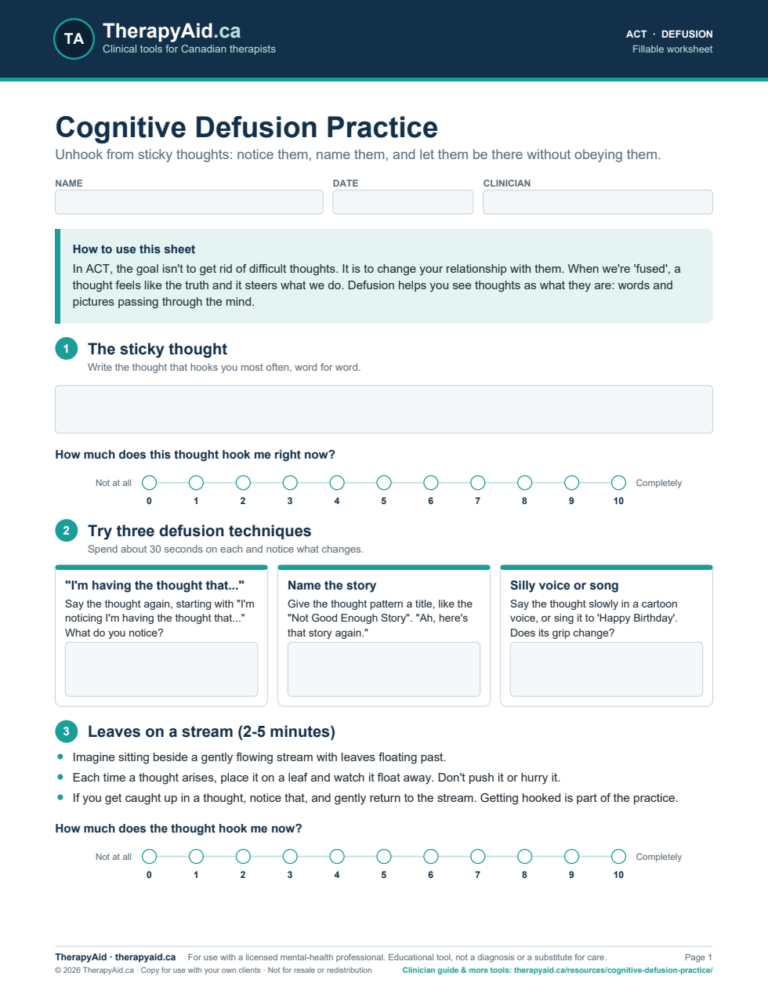
Cognitive defusion reduces the influence of thoughts on behaviour by changing one’s relationship to them rather than their content.
Why it works
Harris (2019) describes ‘hooks’ and unhooking skills. Defusion is a core ACT process with research support (Hayes et al., 2006).
When to use it
- Rumination and self-criticism
- Anxiety
- ACT homework
- Teens and adults
How to use it in session
- Log hooks daily.
- Note actions.
- Record unhooking.
- Review patterns.
- Practise favourite skills.
Clinician tips
- Celebrate noticing, even after the fact.
- Keep skills playful.
- Avoid arguing with thoughts.
Worked example
Sharing with clients
Members can download the PDF to print or email, or copy a private client link from the download box. Your client opens the link and downloads the worksheet on any device. No client account is needed, and nothing your client writes is stored on TherapyAid.
Frequently asked questions
What does being hooked mean?
When a thought grabs you and drives your behaviour automatically.
Is defusion the same as positive thinking?
No. It changes your relationship with thoughts rather than their content.
References
Harris, R. (2019). ACT made simple: An easy-to-read primer on acceptance and commitment therapy (2nd ed.). New Harbinger.
Hayes, S. C., Luoma, J. B., Bond, F. W., Masuda, A., & Lillis, J. (2006). Acceptance and commitment therapy: Model, processes and outcomes. Behaviour Research and Therapy, 44(1), 1-25.
This worksheet is an educational tool for use by, or under the guidance of, a licensed or registered mental-health professional. It is not a diagnostic instrument or a substitute for clinical judgement. If a client is in crisis in Canada, call or text 9-8-8 or call 9-1-1.