Cognitive Defusion Practice
An ACT worksheet that guides clients through three quick defusion techniques and the leaves-on-a-stream exercise, with before-and-after ratings and a values-based reflection.
2-page fillable PDF · US Letter (prints on A4) · Defusion
- Approach / concern
- ACT
- Technique
- Defusion
- Format
- Fillable PDF, 2 pages (US Letter / A4)
- Access
- Pro and Advanced plans (3-day free trial)
- For
- Licensed clinicians to use with clients
- Updated
- October 2026
Key facts
What is the Cognitive Defusion Practice?
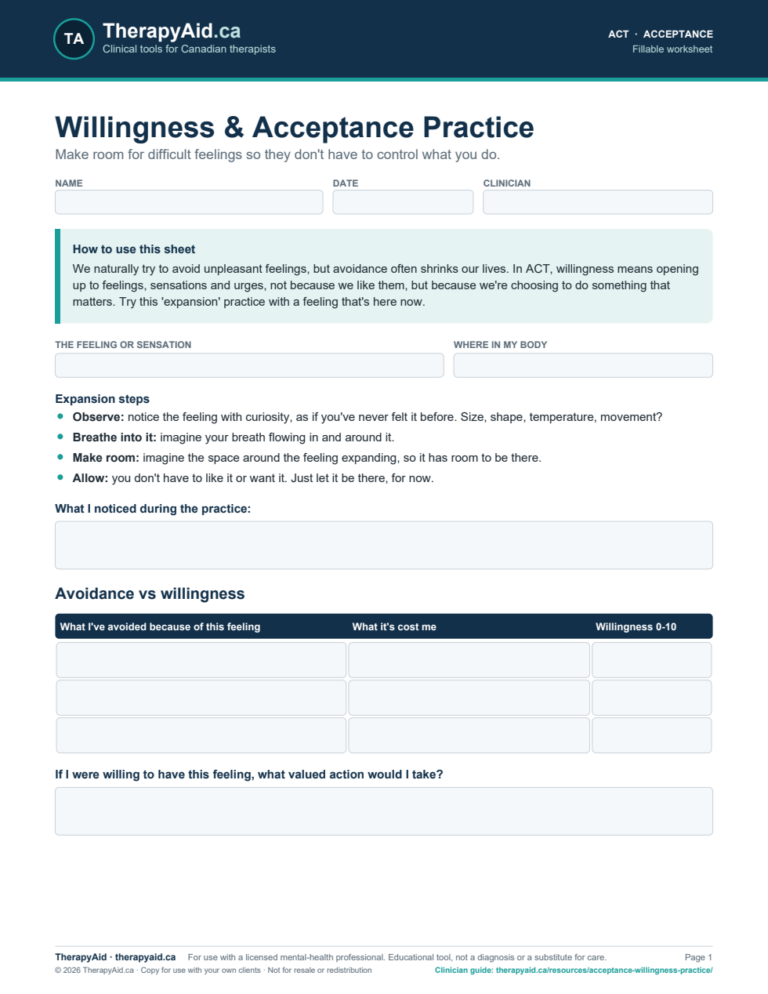
Cognitive defusion is one of the six core processes of Acceptance and Commitment Therapy (ACT). Fusion happens when we become entangled with our thoughts and treat them as literal truths or commands. Defusion techniques create distance so that thoughts lose some of their power to dictate behaviour, even if the thoughts themselves don’t change.
Why it works
Experimental studies show that defusion techniques reduce the believability and discomfort of self-relevant negative thoughts (Masuda et al., 2004). Defusion is a key mechanism in ACT’s effectiveness across anxiety, depression, chronic pain and substance use.
When to use it
- Rumination and self-critical thinking
- Anxiety, where arguing with thoughts makes them stickier
- Clients who find cognitive restructuring invalidating
- Chronic pain and health conditions
- Perfectionism and procrastination
How to use it in session
- Identify one recurring, sticky thought and rate how much it hooks the client.
- Try each technique briefly in session and ask what the client notices.
- Practise leaves on a stream together, then assign it daily for a week.
- Re-rate the hook and link the practice to valued action.
Clinician tips
- Use humour lightly and check that the client doesn’t feel mocked. Silly voices aren’t right for every thought (e.g. trauma content).
- Remind clients the aim is not to make the thought disappear.
- Pair with the Values Compass so defusion has a direction.
Worked example
Sharing with clients
Members can download the PDF to print or email, or copy a private client link from the download box. Your client opens the link and downloads the worksheet on any device. No client account is needed, and nothing your client writes is stored on TherapyAid.
Frequently asked questions
Isn’t defusion just avoiding thoughts?
No. Avoidance pushes thoughts away; defusion involves noticing and allowing them while choosing what to do.
How is this different from a thought record?
A thought record examines whether a thought is accurate. Defusion focuses on whether the thought is helpful, and on loosening its grip regardless of accuracy.
References
Hayes, S. C., Strosahl, K. D., & Wilson, K. G. (2012). Acceptance and commitment therapy: The process and practice of mindful change (2nd ed.). Guilford Press.
Harris, R. (2019). ACT made simple: An easy-to-read primer on acceptance and commitment therapy (2nd ed.). New Harbinger.
Masuda, A., Hayes, S. C., Sackett, C. F., & Twohig, M. P. (2004). Cognitive defusion and self-relevant negative thoughts: Examining the impact of a ninety year old technique. Behaviour Research and Therapy, 42(4), 477-485.
This worksheet is an educational tool for use by, or under the guidance of, a licensed or registered mental-health professional. It is not a diagnostic instrument or a substitute for clinical judgement. If a client is in crisis in Canada, call or text 9-8-8 or call 9-1-1.