ACT at a Glance: Clinician Quick Guide
A one-page clinician quick guide to ACT covering psychological flexibility, the six core processes grouped as open up, be present and do what matters, and common tools.
1-page fillable PDF · US Letter (prints on A4) · Clinician quick guide
- Approach / concern
- ACT
- Technique
- Clinician quick guide
- Format
- Fillable PDF, 1 page (US Letter / A4)
- Access
- Pro and Advanced plans (3-day free trial)
- For
- Licensed clinicians to use with clients
- Updated
- October 2026
Key facts
What is the ACT at a Glance: Clinician Quick Guide?
Acceptance and commitment therapy is a third-wave behavioural therapy built on relational frame theory, targeting six processes that together form psychological flexibility.
Why it works
Hayes et al. (2012) describe ACT’s model and processes. A meta-analysis found ACT effective across mental and physical health problems (A-Tjak et al., 2015).
When to use it
- Chronic pain and illness
- Anxiety, depression and OCD
- Stress and burnout
- Values-based work
How to use it in session
- Assess flexibility.
- Choose target processes.
- Select exercises.
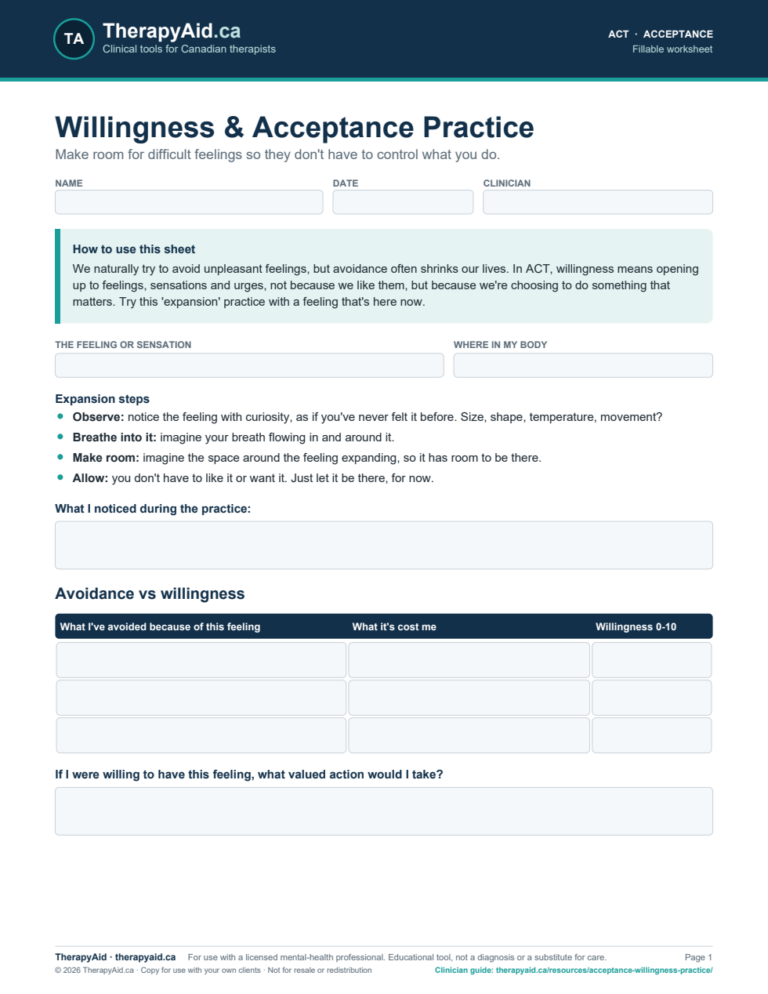
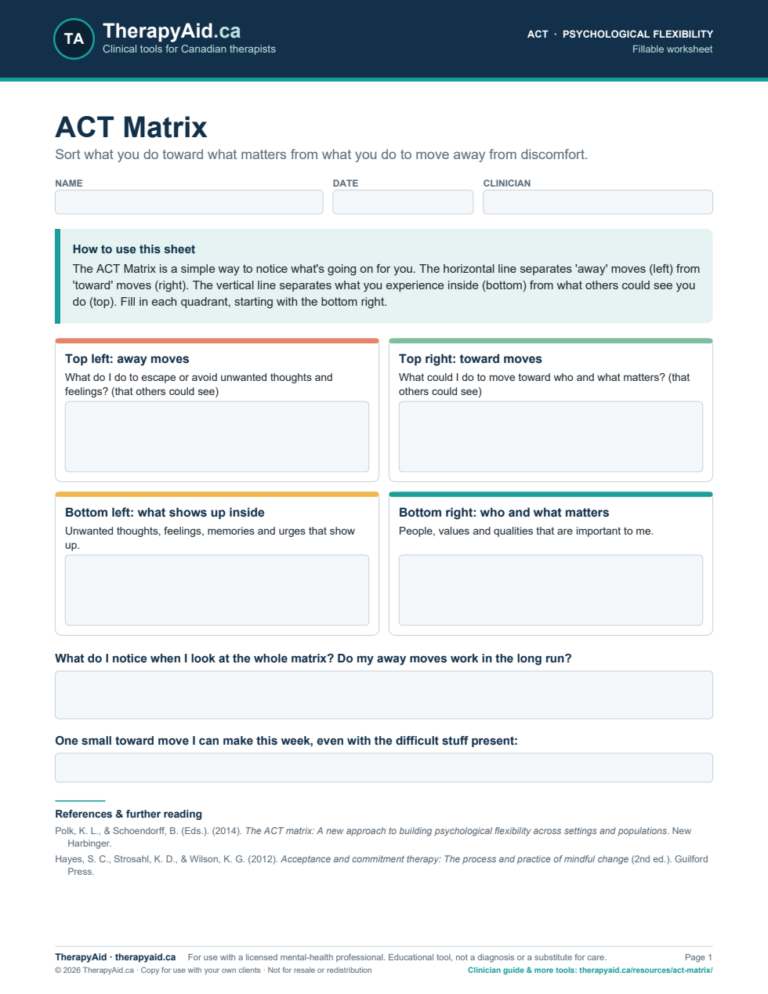
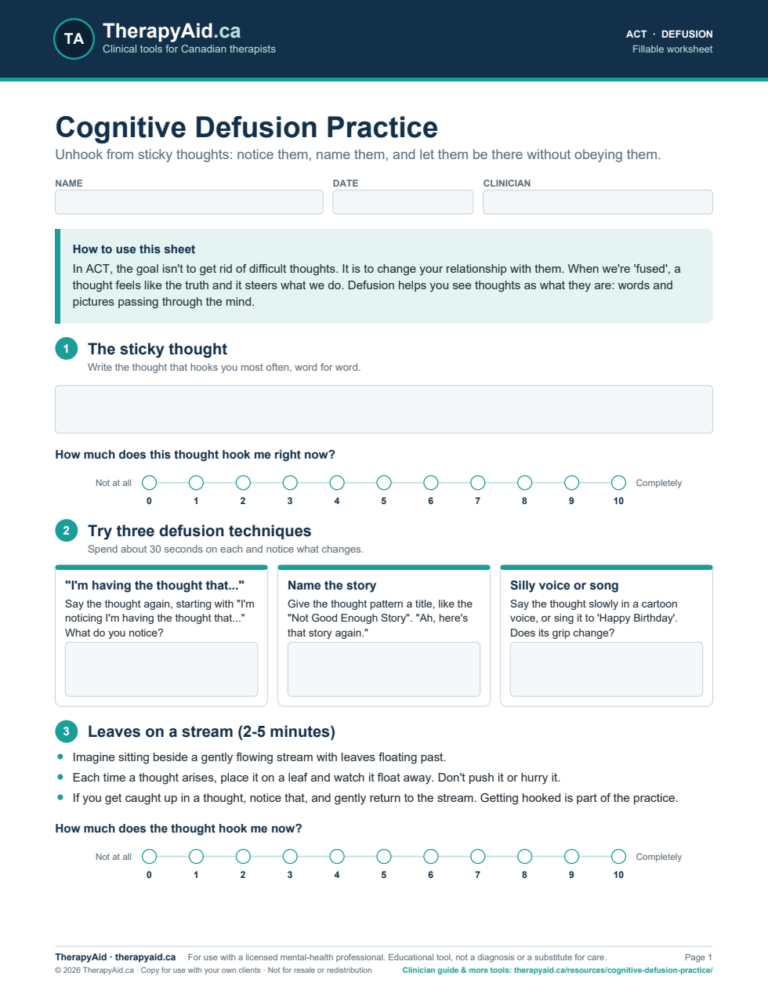
- Link to worksheets.
- Build committed action.
Clinician tips
- Use experiential exercises over explanation.
- Be careful not to use acceptance to control feelings.
- Model flexibility in session.
Worked example
Sharing with clients
Members can download the PDF to print or email, or copy a private client link from the download box. Your client opens the link and downloads the worksheet on any device. No client account is needed, and nothing your client writes is stored on TherapyAid.
Frequently asked questions
Is ACT the same as mindfulness?
Mindfulness skills are part of ACT, alongside values and committed action.
Does ACT try to reduce symptoms?
Not directly; symptom reduction often follows increased flexibility.
References
Hayes, S. C., Strosahl, K. D., & Wilson, K. G. (2012). Acceptance and commitment therapy: The process and practice of mindful change (2nd ed.). Guilford Press.
A-Tjak, J. G. L., Davis, M. L., Morina, N., Powers, M. B., Smits, J. A. J., & Emmelkamp, P. M. G. (2015). A meta-analysis of the efficacy of acceptance and commitment therapy for clinically relevant mental and physical health problems. Psychotherapy and Psychosomatics, 84(1), 30-36.
This worksheet is an educational tool for use by, or under the guidance of, a licensed or registered mental-health professional. It is not a diagnostic instrument or a substitute for clinical judgement. If a client is in crisis in Canada, call or text 9-8-8 or call 9-1-1.