My Emotional First-Aid Kit
A coping skills worksheet building a personal emotional first-aid kit across calming, comforting, distracting, connecting, reminding and grounding items.
1-page fillable PDF · US Letter (prints on A4) · Coping skills
- Approach / concern
- Universal
- Technique
- Coping skills
- Format
- Fillable PDF, 1 page (US Letter / A4)
- Access
- Pro and Advanced plans (3-day free trial)
- For
- Licensed clinicians to use with clients
- Updated
- October 2026
Key facts
What is the My Emotional First-Aid Kit?
Coping kits make self-soothing and distress tolerance strategies concrete and accessible during distress, when planning is harder.
Why it works
DBT distress tolerance includes self-soothing and distraction skills (Linehan, 2015). Safety planning lists internal coping strategies (Stanley & Brown, 2012).
When to use it
- Distress and crises
- Anxiety and depression
- Teens and adults
- Safety planning
How to use it in session
- Brainstorm categories.
- Choose items.
- Assemble a physical or phone kit.
- Decide when to use it.
- Update regularly.
Clinician tips
- Include sensory items.
- Make a digital version too.
- Link to the safety plan.
Worked example
Sharing with clients
Members can download the PDF to print or email, or copy a private client link from the download box. Your client opens the link and downloads the worksheet on any device. No client account is needed, and nothing your client writes is stored on TherapyAid.
Frequently asked questions
What goes in an emotional first-aid kit?
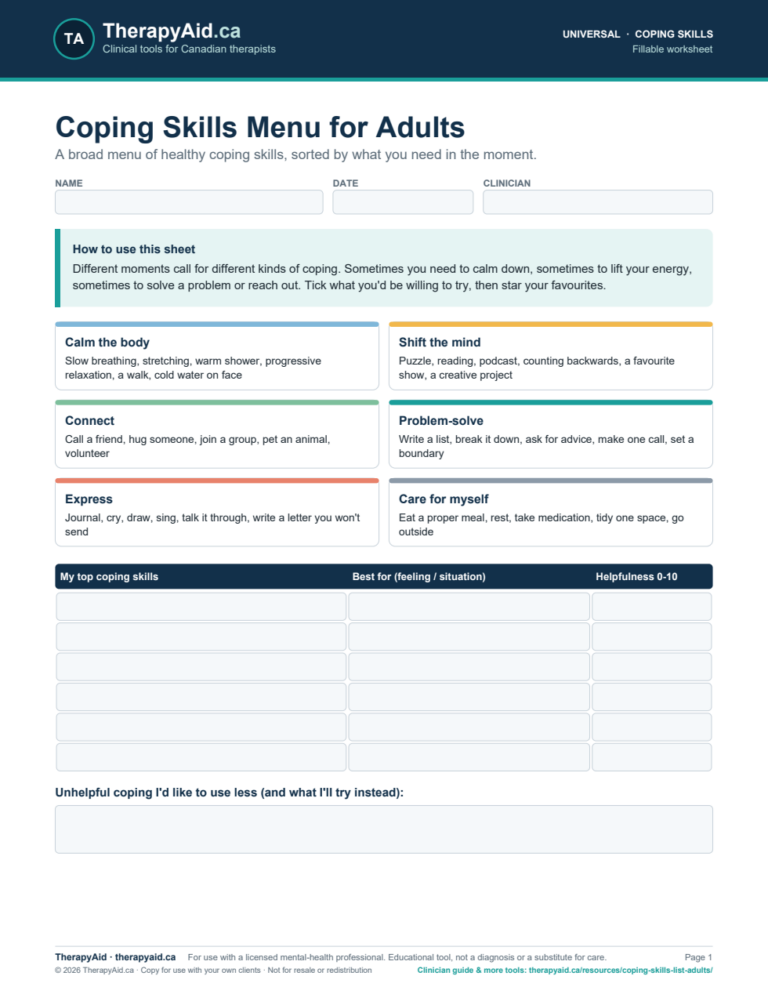
Anything that helps you calm, comfort, distract, connect or ground yourself.
Can it be on my phone?
Yes. Playlists, photos and messages work well digitally.
References
Linehan, M. M. (2015). DBT skills training manual (2nd ed.). Guilford Press.
Stanley, B., & Brown, G. K. (2012). Safety planning intervention: A brief intervention to mitigate suicide risk. Cognitive and Behavioral Practice, 19(2), 256-264.
This worksheet is an educational tool for use by, or under the guidance of, a licensed or registered mental-health professional. It is not a diagnostic instrument or a substitute for clinical judgement. If a client is in crisis in Canada, call or text 9-8-8 or call 9-1-1.