Getting Started in the Morning
A behavioural activation morning plan with up to six small steps, timing, helpers and self-compassionate words for difficult mornings.
1-page fillable PDF · US Letter (prints on A4) · Behavioural activation
- Approach / concern
- Depression
- Technique
- Behavioural activation
- Format
- Fillable PDF, 1 page (US Letter / A4)
- Access
- Pro and Advanced plans (3-day free trial)
- For
- Licensed clinicians to use with clients
- Updated
- October 2026
Key facts
What is the Getting Started in the Morning?
Consistent morning routines reduce decision fatigue and inertia in depression, supporting behavioural activation and circadian regularity.
Why it works
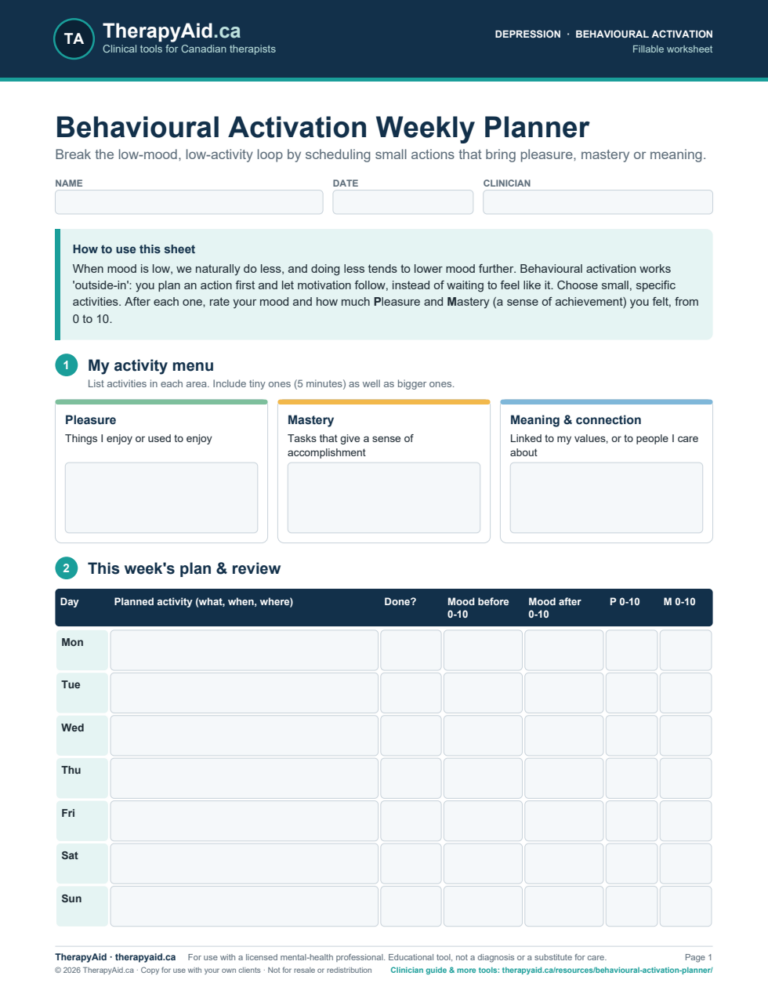
Behavioural activation targets avoidance and inactivity with structured routines (Martell et al., 2010). Activation treatments are effective for depression (Cuijpers et al., 2007).
When to use it
- Depression
- Low motivation mornings
- Oversleeping
- Return to work
How to use it in session
- Plan tiny steps.
- Set helpers up the night before.
- Follow the same order.
- Tick off steps.
- Be kind on hard days.
Clinician tips
- Keep steps tiny.
- Regular wake time matters most.
- Pair with evening preparation.
Worked example
Sharing with clients
Members can download the PDF to print or email, or copy a private client link from the download box. Your client opens the link and downloads the worksheet on any device. No client account is needed, and nothing your client writes is stored on TherapyAid.
Frequently asked questions
Why are mornings so hard with depression?
Low energy, sleep changes and dread can make starting the day difficult.
What if I don’t get through all the steps?
Any step counts; build gradually.
References
Martell, C. R., Dimidjian, S., & Herman-Dunn, R. (2010). Behavioral activation for depression: A clinician’s guide. Guilford Press.
Cuijpers, P., van Straten, A., & Warmerdam, L. (2007). Behavioral activation treatments of depression: A meta-analysis. Clinical Psychology Review, 27(3), 318-326.
This worksheet is an educational tool for use by, or under the guidance of, a licensed or registered mental-health professional. It is not a diagnostic instrument or a substitute for clinical judgement. If a client is in crisis in Canada, call or text 9-8-8 or call 9-1-1.