Building Positive Experiences (ABC)
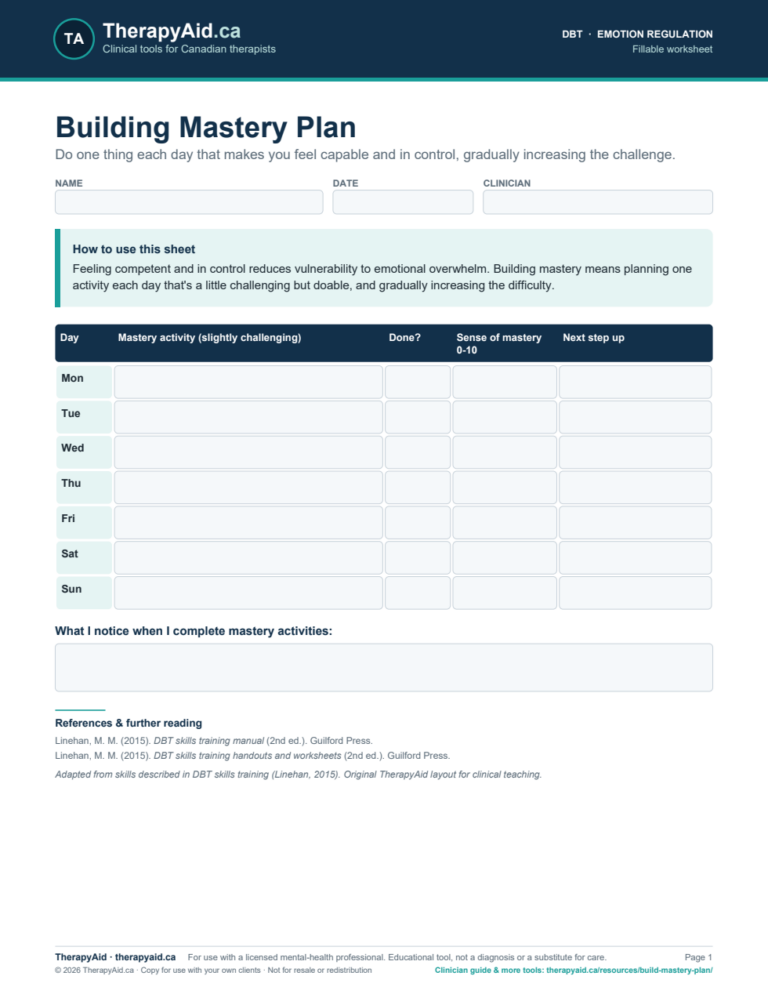
A DBT emotion regulation worksheet scheduling daily pleasant activities and long-term goal steps, with mood ratings and mindfulness of positive experiences.
1-page fillable PDF · US Letter (prints on A4) · DBT · Emotion regulation
- Approach / concern
- DBT
- Technique
- DBT · Emotion regulation
- Format
- Fillable PDF, 1 page (US Letter / A4)
- Access
- Pro and Advanced plans (3-day free trial)
- For
- Licensed clinicians to use with clients
- Updated
- October 2026
Key facts
What is the Building Positive Experiences (ABC)?
Accumulating positive emotions in the short and long term reduces emotional vulnerability. Mindfulness of positive experiences increases their impact.
Why it works
Linehan (2015) describes accumulating positive experiences as part of DBT’s ABC PLEASE skills. Activity scheduling also underpins behavioural activation (Martell et al., 2010).
When to use it
- Depression and low mood
- Emotion dysregulation
- DBT skills groups
- Building a life worth living
How to use it in session
- Plan daily pleasant activities.
- Choose long-term steps.
- Do them mindfully.
- Rate mood.
- Review.
Clinician tips
- Make activities realistic.
- Link long-term steps to values.
- Notice worry thoughts.
Worked example
Sharing with clients
Members can download the PDF to print or email, or copy a private client link from the download box. Your client opens the link and downloads the worksheet on any device. No client account is needed, and nothing your client writes is stored on TherapyAid.
Frequently asked questions
Why schedule pleasant activities?
Positive experiences build resilience against painful emotions.
What if I don’t enjoy anything?
Start small and notice even slight changes; enjoyment often follows action.
References
Linehan, M. M. (2015). DBT skills training manual (2nd ed.). Guilford Press.
Martell, C. R., Dimidjian, S., & Herman-Dunn, R. (2010). Behavioral activation for depression: A clinician’s guide. Guilford Press.
This worksheet is an educational tool for use by, or under the guidance of, a licensed or registered mental-health professional. It is not a diagnostic instrument or a substitute for clinical judgement. If a client is in crisis in Canada, call or text 9-8-8 or call 9-1-1.